
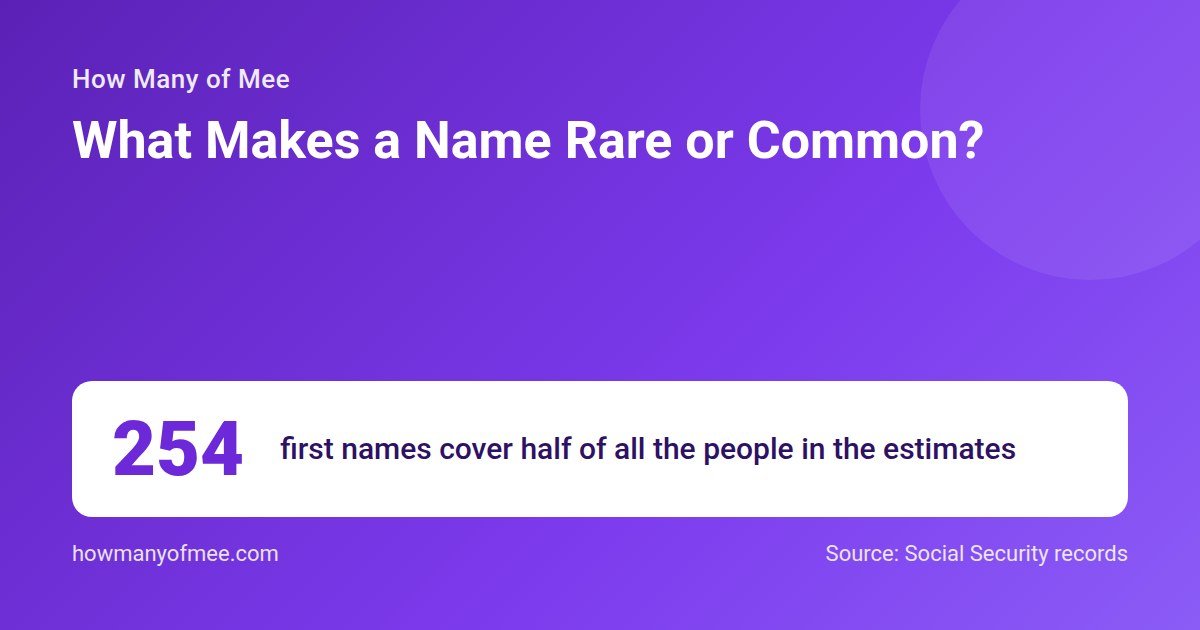
Only about 4,000 first names account for nearly 90% of the U.S. population. That means millions of people share the same handful of names — while thousands of other names belong to fewer than 100 people across the entire country.
Think about it. You probably know at least three people named James, Sarah, or Muhammad. But have you ever met someone named Zephyrine or Caspius? Probably not.
So what’s really going on here? Why do some names spread like wildfire while others remain hidden gems that almost nobody uses?
The answer isn’t simple. It’s a mix of culture, psychology, media influence, historical events, and even pure luck. A name’s rarity or commonality isn’t random — there are real, traceable patterns behind it.
This article breaks down every major factor that pushes a name toward popularity or keeps it rare. Whether you’re picking a baby name, curious about your own name’s history, or just fascinated by how naming trends work — you’ll find your answers here. And if you’re wondering how many people actually share your name, that’s worth checking too.
How Culture and Geography Shape Name Popularity
Names don’t exist in a vacuum. They’re deeply tied to where you live, what language you speak, and what traditions your family follows.
Regional Popularity Differences
A name that’s incredibly common in one country can be completely unheard of in another. Muhammad is one of the most popular names globally — used across dozens of countries with Muslim populations. But in Iceland? It barely registers.
Similarly, the name José dominates in Spanish-speaking countries but doesn’t even crack the top 100 in Japan or South Korea.
Even within a single country, names vary wildly by region. The most popular names in Texas look quite different from the most popular names in California. Texas leans heavily toward traditional and Hispanic-influenced names, while California shows more diversity and trendy picks.
Quick Fact: According to SSA (Social Security Administration) data, the #1 baby name in one U.S. state can rank #30 or lower in another state during the same year.
Religious and Ethnic Naming Traditions
Religion plays a massive role. Many Christian families choose Biblical names like Matthew, Mary, or John — names that have stayed common for centuries. Popular Christian baby names have remarkable staying power precisely because they’re rooted in sacred texts that don’t change.
Hindu naming traditions often connect names to deities, celestial bodies, or Sanskrit roots. Muslim naming traditions favor names with Arabic origins, often related to attributes of God or the Prophet’s companions. These religious pools create concentrated popularity — certain names appear frequently within those communities but rarely outside them.
Immigration and Blending
Immigration patterns directly affect which names become common in a given country. As communities grow, their traditional names start showing up in national statistics. That’s exactly why popular Pakistani names and popular Hindu names are gaining visibility in Western naming databases.
The Psychology Behind Name Choices
Parents don’t pick names at random. There’s real psychology behind why certain names feel “right” and others don’t.
The Sound Factor
Research from linguistics and psychology shows that the actual sound of a name affects how people perceive it. Names with soft consonants (L, M, N) like Lily, Mia, and Noah tend to feel warm and approachable. Names with harder sounds (K, T, X) like Knox, Axel, or Titus feel strong and bold.
This isn’t just opinion — multiple studies, including research published in the Journal of Experimental Psychology, confirm that people assign personality traits to names based purely on phonetics.
Names that are easy to pronounce in a given language naturally become more common. If a name trips up native speakers, parents tend to avoid it — making that name rarer by default.
The Familiarity Sweet Spot
Here’s something fascinating. Most parents want a name that’s recognizable but not overused. Psychologists call this the “mere exposure effect” combined with distinctiveness.
Parents typically avoid two extremes:
- Too common: “I don’t want my kid to be one of five Emmas in her class.”
- Too rare: “I don’t want people struggling to say or spell it.”
The sweet spot? A name that people recognize but don’t hear every day. That’s why names ranked between #50 and #200 on popularity lists often feel the most satisfying to parents. They’re known but not oversaturated.
If you’re curious about the psychology behind choosing unique names, the research goes even deeper than you’d expect.
The Generational Rejection Pattern
There’s a predictable cycle: names your parents’ generation loved, your generation avoids. Names your grandparents used feel “outdated” to your parents but “vintage-cool” to you.
That’s exactly why old-fashioned names are making a comeback right now. Names like Eleanor, Theodore, Hazel, and Arthur — considered “grandma/grandpa names” 20 years ago — are now climbing the charts fast.
This cycle takes roughly 80–100 years. A name peaks, becomes associated with a specific generation, falls out of favor, then returns when that generation’s memory fades.
How Media, Celebrities, and Pop Culture Create Trends
You can’t talk about name popularity without talking about media influence. It’s one of the most powerful forces that makes a name suddenly common — or suddenly rare.
The Celebrity Effect
When a celebrity rises to fame, their name often follows. The name Beyoncé barely existed in databases before 1981 — it was essentially a family surname turned first name. Now? It’s globally recognized, though most parents don’t actually use it for their children (it feels “owned” by one person).
On the flip side, some celebrity names become genuinely trending for babies. After Frozen hit theaters in 2013, the name Elsa jumped significantly in popularity. After Twilight? Bella and Jasper spiked. The name Arya exploded after Game of Thrones.
Did You Know? The name Khaleesi — not even a real name in any language, but a fictional title from Game of Thrones — was given to over 560 babies in the U.S. in a single year (2018, per SSA data).
Social Media’s Growing Power
Social media has added a completely new layer to naming trends. Instagram, TikTok, and YouTube influencers now shape baby name choices in ways that didn’t exist 15 years ago.
A viral TikTok video discussing “underrated baby names” can cause a noticeable bump in SSA registrations the following year. Parenting influencers sharing their baby name choices reach millions of followers instantly.
You can read more about how social media influences baby names — it’s a bigger deal than most people realize.
TV Shows and Books
Fiction creates names and popularizes them. Before J.M. Barrie wrote Peter Pan in 1904, the name Wendy was virtually nonexistent. He essentially invented it for his character — and now millions of women worldwide carry that name.
The name Madison was extremely rare for girls before the 1984 movie Splash, where Daryl Hannah’s mermaid character picks it off a street sign. Within a decade, it became a top-10 name.
These are extreme examples, but they prove an important point: a single cultural moment can transform a name from rare to common within a generation.
Historical Events and Their Lasting Impact on Names
Names carry historical baggage — both positive and negative. Major events can permanently alter a name’s popularity trajectory.
Names That Became Toxic
The most dramatic example: Adolf. Before the 1930s, Adolf was a perfectly normal, reasonably popular German name. After Adolf Hitler’s rise and the horrors of World War II, the name essentially disappeared from use worldwide. It went from common to virtually extinct in a single generation.
Similarly, the name Isis was gaining popularity in the 2000s — a beautiful name from Egyptian mythology. After the terrorist organization ISIS dominated headlines around 2014, its use plummeted by over 80% within two years.
The name Katrina dropped sharply after Hurricane Katrina devastated New Orleans in 2005.
Names Boosted by Historical Figures
The reverse happens too. The name Franklin surged during Franklin D. Roosevelt’s presidency. John F. Kennedy’s era boosted the already-popular John even higher. More recently, names of admired public figures and civil rights leaders — like Rosa, Martin, and Malcolm — have maintained steady popularity partly because of their historical associations.
War and Migration Patterns
Large-scale events like wars and mass migrations physically move naming traditions across borders. The name Dmitri is common in the U.S. partly because of waves of Russian and Eastern European immigration. Vietnamese names like Nguyen (as a first name) and Linh appeared in American records after the Vietnam War and subsequent refugee resettlement.
The Data Side: How Name Statistics Actually Work
Understanding what makes a name statistically rare or common requires looking at real numbers.
What Counts as “Rare”?
The SSA, which tracks every name given to babies born in the U.S., has a threshold: a name must be given to at least 5 babies in a year to appear in their public data. Names given to fewer than 5 babies are hidden for privacy.
Here’s a rough framework based on SSA annual data:
- Ultra-rare: Fewer than 100 people in the entire country have this name
- Rare: Given to fewer than 50 babies per year
- Uncommon: Ranked #500–#1000 on SSA lists
- Moderately common: Ranked #100–#500
- Very common: Top 100
- Dominant: Top 10
Want to know if your own name falls into the rare category? You can check if your name is truly unique using name frequency tools.
The Long Tail of Names
Name distribution follows a power law — a small number of names account for a huge chunk of the population, while thousands of names are used by very few people.
The top 10 male names in the U.S. cover roughly 10% of all males. The top 100 cover about 35%. But after the top 1,000? You’re looking at names shared by fewer than 200 people born per year.
Some names exist only a few times in the entire world — these are true statistical unicorns.
Surnames vs. First Names
Rarity works differently for first names and last names. First names are chosen, so they’re subject to trends. Last names are inherited, so they change much more slowly.
A name like Smith is the most common U.S. surname (about 2.4 million people), while thousands of surnames belong to single families. The difference between first name and surname popularity is a whole separate story worth understanding.
Why Some Names Suddenly Explode in Popularity
One year, nobody’s using a name. Five years later, it’s everywhere. What triggers these sudden jumps?
The Tipping Point Phenomenon
Names behave like trends — they spread through social networks. Sociologist Stanley Lieberson studied this extensively and found that name popularity often follows an S-curve:
- Early adopters choose the name (often educated, urban parents)
- It spreads through their social circles
- Media picks it up and accelerates the trend
- Mass adoption happens
- Oversaturation kicks in and the name starts declining
This entire cycle can play out in 10–20 years.
The “Sounds Like” Effect
Names don’t always spread individually — they spread in clusters of similar sounds. When Aiden became popular in the early 2000s, it pulled Jayden, Brayden, Kayden, and Hayden along with it. The “-aden” sound family exploded together.
Right now, names ending in “-a” for girls (Luna, Mila, Nova, Nora) and names ending in “-er” for boys (Asher, Oliver, Archer) are riding the same wave.
You can trace how name trends spread across different states and watch this ripple effect in real time.
Generational Identity Names
Each generation tends to develop a “sound signature.” Most popular Gen Z names have a distinctly different vibe from millennial names that are now disappearing. Millennial Jessicas, Ashleys, and Brandons are being replaced by Gen Z’s Lunas, Liams, and Olivias.
This generational shift is one of the strongest forces that makes once-common names become rare (and vice versa).
Factors That Keep a Name Rare
Not every rare name is rare by accident. Some names stay uncommon for very specific reasons.
Pronunciation and Spelling Barriers
Names that are hard to pronounce or spell in the dominant language of a country tend to stay rare there. Beautiful Irish names like Siobhán, Caoimhe, or Tadhg are rarely used outside Ireland because English speakers find them intimidating to pronounce.
Similarly, tonal language names (like many Chinese or Vietnamese names) can feel unfamiliar to English speakers, keeping them rare in Western countries even if they’re extremely common in their origin countries.
Negative Associations
A name can stay rare because of one famous (or infamous) person. Very few parents name their sons Judas, despite it being a Biblical name, because of its association with betrayal. The name Damien carries horror-movie baggage from The Omen franchise.
Even subtle associations matter. Research shows that names associated with lower socioeconomic status (rightly or wrongly) get avoided by parents who worry about their child’s future opportunities. Studies have shown names can genuinely affect career perception, which makes some parents cautious.
Intentionally Created Unique Names
Some names are rare because parents literally invented them. Combining syllables from family names, creating new spellings, or blending two names together produces one-of-a-kind results.
Pro Tip: If you’re creating a unique name, say it out loud in different contexts first — in a classroom, at a doctor’s office, during a job interview. A name that sounds beautiful at home might create practical problems elsewhere.
Parents who deliberately seek out rare names often have specific motivations. Understanding why parents choose rare names today reveals a lot about modern parenting psychology.
Common Myths About Rare and Common Names
Let’s clear up some misconceptions that keep floating around.
Myth #1: “Unique Names Are a Modern Trend”
Not true. People have been creating unusual names for centuries. Puritan families in the 1600s gave children names like “Fly-Fornication” and “If-Christ-Had-Not-Died-For-Thee-Thou-Hadst-Been-Damned.” Medieval records are full of creative, one-off names.
What’s changed isn’t the desire for uniqueness — it’s the scale at which parents now access global name pools. The internet lets you discover names from every culture on earth in seconds.
Myth #2: “Common Names Are Boring and Unoriginal”
A name like Elizabeth has been popular for over 500 years. It’s common — but does that make it boring? It’s endured because it’s beautiful, versatile (Liz, Beth, Ellie, Lizzy), and carries powerful historical associations (multiple queens, literary characters, activists).
Common names are often common because they’re genuinely excellent names.
Myth #3: “A Rare Name Guarantees Your Child Will Be Special”
Your name contributes to your identity, but it doesn’t define it. There’s limited evidence that rare names directly affect personality, though they can influence how others perceive and treat you. A rare name might make first impressions memorable, but it won’t determine your child’s character.
Myth #4: “Name Popularity Lists Tell the Whole Story”
SSA rankings can be misleading. A name might rank #1 but actually be given to a smaller percentage of babies than the #1 name 50 years ago. That’s because naming has become more diverse — parents spread their choices across more names than ever before.
In 1950, the #1 name (James) was given to 86,000+ boys. In 2024, the #1 name (Liam) goes to about 18,000–20,000 boys. The top name is “less dominant” than it used to be, even though it still holds the #1 spot.
How to Tell if a Name Is Truly Rare or Common
If you’re trying to evaluate a specific name’s rarity, here are practical steps.
Check Multiple Data Sources
Don’t rely on a single website. Cross-reference these:
- SSA Baby Names database (ssa.gov) — best for U.S. data
- Behind the Name — good for global and historical data
- Nameberry and BabyCenter — track current search trends among expecting parents
- HowManyOfMe.com — estimates how many people share your full name
Look at Trajectory, Not Just Current Rank
A name ranked #800 today might be boring and declining — or it might be a fast-rising name that will be in the top 100 within five years. Check the trend line over the past 5–10 years.
The name Olivia was #200+ in 1990. By 2020, it was #1. If you’d chosen it in 1995 thinking it was “unique,” you’d have been disappointed by 2010.
Consider Your Local Area
National data doesn’t reflect local reality. The name Mateo might rank #15 nationally but could be the #1 name at your local school if you live in a heavily Hispanic community. Or it might be completely absent in a small rural town in Vermont.
Pro Tip: Check your state’s specific SSA data, not just national rankings.
The Future of Rare and Common Names
Name trends are shifting faster than ever. Here’s what the data suggests about where things are heading.
Increasing Fragmentation
Naming is becoming more diverse year after year. The percentage of babies receiving a top-10 name has been declining since the 1980s. Parents are drawing from wider pools — international names, nature names, surname-as-first-name choices, and invented names.
This means “common” names are becoming less dominant, and the middle ground between rare and common is expanding.
AI and Data-Driven Name Discovery
Tools powered by AI and data analytics are starting to predict future baby name trends by analyzing search patterns, social media mentions, and cultural shifts. Parents now have access to more information about name frequency than any previous generation.
Gender-Neutral Names Rising
Gender-neutral names are gaining ground rapidly. Names like Avery, Riley, Jordan, and Quinn — once clearly gendered — now cross boundaries freely. This trend creates interesting rarity dynamics, as a name might be common overall but uncommon for a specific gender.
Global Name Pool Expansion
As the world gets more connected, parents increasingly pick names from cultures other than their own. A Japanese parent might choose an English name. An American parent might choose a Scandinavian one. This cross-pollination means that “rare in one country, common in another” names will increasingly appear in unexpected places.
FAQ Section
What makes a name rare?
A name becomes rare when very few parents choose it for their children within a given population. This can happen because of pronunciation difficulties, negative cultural associations, extreme uniqueness (invented names), or simply because the name fell out of fashion generations ago. In U.S. terms, a name given to fewer than 50 babies per year is generally considered rare by SSA standards.
How can I find out if my name is rare or common?
The easiest method is checking the SSA’s official baby names database at ssa.gov, which provides exact numbers of babies given each name per year since 1880. You can also use tools like HowManyOfMe.com to estimate how many people currently share your name in the U.S. Cross-referencing multiple sources gives you the most accurate picture.
Do rare names have any advantages over common names?
Rare names tend to be more memorable, which can help in social and professional networking. They create a stronger sense of individual identity. On the downside, they can be mispronounced, misspelled, or even cause unconscious bias in hiring situations. Common names have their own advantages — instant recognition, easier spelling, and less explaining. Neither is objectively “better” — it depends on your priorities and cultural context.
Why do some names become common so quickly?
Names can spike in popularity due to celebrity influence, hit TV shows or movies, viral social media moments, or a general shift in sound preferences (like the “-aden” trend). The speed of modern media means a name can go from obscure to mainstream within 2–3 years — much faster than in previous decades when trends spread mainly through local communities and word of mouth.
Can a common name become rare again?
Absolutely. Names like Gertrude, Mildred, Ethel, and Bertha were top-50 names in the early 1900s. Today, they’re given to fewer than 20 babies per year in the U.S. The generational rejection cycle means nearly every popular name will eventually decline — though some (like Elizabeth, William, and James) seem to resist this pattern due to deep historical and cultural roots.
Your Name’s Story Is Bigger Than You Think
Every name — rare or common — got where it is through a complex web of cultural forces, historical accidents, psychological preferences, and media influence. There’s no single “reason” a name becomes popular or stays hidden. It’s always a combination.
If you’re choosing a name for a child, understand that today’s rare name could be tomorrow’s #1 pick — and today’s trendy name could sound dated in 30 years. The best approach? Pick a name you love for its meaning, sound, and personal significance rather than chasing rarity or popularity rankings.
And if you’re simply curious about your own name? Go check the numbers. Find out how many people carry your name worldwide — the answer might surprise you more than you expect.
