
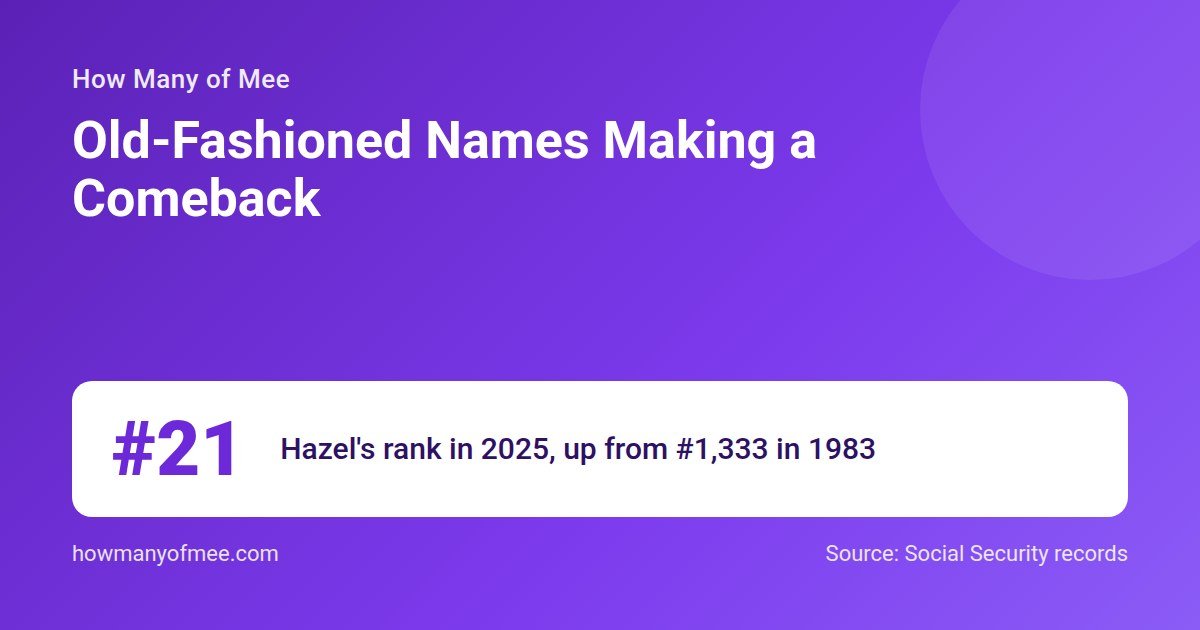
Old Fashioned Names Making a Comeback

A name that your great-grandmother carried might just end up on a 2025 birth certificate. Sounds surprising, right? But here’s the thing — names like Hazel, Theodore, Eloise, and Arthur are popping up everywhere. From maternity ward name tags to Instagram announcements, parents are reaching back a century or more to find the perfect name for their babies.

And there’s solid data behind this shift. According to the U.S. Social Security Administration (SSA), dozens of names that ranked in the top 100 between 1900 and 1930 have climbed right back onto the popularity charts. Names like Pearl, Mabel, and Otto — once considered dusty and outdated — now feel fresh, charming, and distinctive.

So what’s driving this revival? Why are millennial and Gen Z parents falling in love with their great-grandparents’ names? And which old fashioned names are actually making a comeback right now?

Let’s break it all down — name by name, trend by trend.


H2: What Counts as an “Old Fashioned” Name?

Before we get into the specific names, let’s get clear on what “old fashioned” really means here.

An old fashioned name is typically one that peaked in popularity before the 1950s and then steadily declined for decades. These aren’t names that stayed consistently popular (like James or Elizabeth). These are names that practically vanished from baby name lists for 40, 50, even 70 years — and are now reappearing.

Think of it like fashion. Bell-bottoms disappeared for decades, then came back as “vintage cool.” Names follow the exact same cycle.

H3: The 100-Year Rule of Name Trends

Name researchers, including Laura Wattenberg (creator of the Baby Name Wizard), have identified something fascinating: names tend to cycle back roughly every 80–120 years. That means names from the 1900s–1920s are hitting their sweet spot right now.

Your grandma’s name felt outdated to your mom. But to you? It sounds elegant. That emotional distance is exactly what makes a name feel “vintage” instead of “old.”

If you’re curious about how name popularity changes over time, the pattern is surprisingly predictable once you see the data.


H2: Old Fashioned Girl Names Making a Comeback

Let’s start with the girls’ names. Some of these have already re-entered the top 100, while others are climbing fast.

H3: Names Already in the Top 100

  • Hazel — Ranked #28 in 2023 (SSA data). It was last this popular in 1901.
  • Eleanor — Back in the top 25. The influence of Eleanor Roosevelt gives it strength and grace.
  • Violet — Currently around #35. A century ago, it was a common flower name. Now it feels poetic.
  • Clara — Sitting comfortably in the top 100 again after decades in the wilderness.
  • Stella — Another star. This name was huge in the early 1900s and is thriving again.

H3: Names on the Rise (Watch These)

  • Maeve — An old Irish name that’s surging among American parents.
  • Beatrice — Royal connections (Princess Beatrice of the UK) have given it a boost.
  • Adelaide — Once considered hopelessly old-timey. Now it’s charming and regal.
  • Pearl — Just re-entered the top 500. Expect it to climb higher.
  • Mabel — Gaining serious traction, especially in the UK and Australia.
  • Cora — The “Downton Abbey” effect played a big role here.

H3: Names on the Verge

These haven’t fully returned yet, but name forums and baby registries are buzzing about them:

  • Edith
  • Agnes
  • Mildred (yes, really)
  • Harriet
  • Dorothea
  • Winifred

Did You Know? The name Mildred was a top-10 name from 1903 to 1926. It dropped off the top 1000 entirely by 1984. But parenting forums in 2024 and 2025 show growing interest in “Millie” as a nickname — which could pull Mildred back.

If you want to see where these sit among the most common female names in the USA, the contrast between past and present rankings is really eye-opening.


H2: Old Fashioned Boy Names Making a Comeback

Boys’ names are following the same pattern, though the revival started a bit later.

H3: Names Already Back in the Top 100

  • Theodore — This is the biggest comeback story. Theodore cracked the top 10 in 2023, sitting at #8. The last time it was this popular? 1904.
  • Henry — Steady and strong. It never fully disappeared but has surged back to top-10 status.
  • Arthur — Currently in the top 150 and climbing quickly. Royal vibes without being too flashy.
  • Oscar — Especially popular in the UK, but gaining ground in the U.S. too.
  • Felix — A Latin name meaning “happy.” It’s back on the charts after a long absence.

H3: Names Gaining Momentum

  • Otto — Short, punchy, and distinctly vintage. Re-entering the top 500.
  • Jasper — Old English origins. Parents love its warmth and character.
  • August — Both the full name and the nickname “Gus” are trending.
  • Silas — Biblical roots, vintage feel, modern appeal. A triple win.
  • Hugo — Especially popular among parents who want something European and timeless.

H3: Deep Cuts (Brave Picks)

  • Ambrose
  • Clarence
  • Percival
  • Rufus
  • Reginald
  • Archibald (with “Archie” as the nickname — thanks, Prince Harry)

Pro Tip: If you love a deep-cut vintage name but worry it’s too much, use a familiar nickname. Archibald becomes Archie. Reginald becomes Reggie. Suddenly the name feels approachable and modern.

Check out the most popular names by decade from 1950–2020 to see exactly when these names peaked, dropped, and started rising again.


H2: Why Are Old Fashioned Names Coming Back?

This isn’t random. Several cultural and psychological forces are driving this trend.

H3: 1. The “Grandparent Chic” Effect

Here’s the basic psychology: your parents’ names feel boring. Your grandparents’ names feel outdated. But your great-grandparents’ names? Those feel unique and special.

That generational distance creates a nostalgia sweet spot. The name doesn’t carry personal baggage (you probably didn’t know your great-grandma personally), so it feels fresh.

The psychology behind unique names plays a huge role here. Parents want a name that stands out — but not in a “weird” way. Vintage names hit that balance perfectly.

H3: 2. Reaction Against Trendy Names

After years of names like Jayden, Brayden, Kayden, and Aiden, many parents are looking for something with more substance. They want names that feel rooted and meaningful — not like a product of a trend factory.

Old fashioned names carry weight. They feel solid. A Theodore or an Eleanor sounds like someone who gets things done.

Some parents are also actively avoiding the most overused baby names right now, and vintage names offer a natural escape route.

H3: 3. Pop Culture and Media Influence

TV shows, movies, and books play a massive role in name revivals:

  • Cora spiked after “Downton Abbey” (2010–2015)
  • Hazel got a boost from “The Fault in Our Stars” (2014)
  • Theodore benefited from the movie “Her” (2013) and the “Alvin and the Chipmunks” franchise
  • Violet rose partly thanks to “Willy Wonka” and “The Incredibles”
  • Atticus surged after renewed interest in “To Kill a Mockingbird”

Pop culture doesn’t create these trends from scratch. It accelerates what’s already simmering.

H3: 4. Celebrity Baby Names

Celebrity influence is undeniable. When Ryan Reynolds and Blake Lively named their daughter James (a classic old-fashioned crossover), it made headlines. When the Duke and Duchess of Sussex chose Archie for their son, the name Archibald got a massive bump.

Other celebrity vintage picks:

  • Jessica Biel and Justin Timberlake → Silas
  • Ashton Kutcher and Mila Kunis → Wyatt and Dimitri
  • Jessica Alba → Honor (a Puritan-era classic)

The ripple effect is real. You can explore more about celebrity names that became trending and how quickly these choices spread.

H3: 5. The Search for Meaning and Heritage

Modern parents often research name meanings more deeply than previous generations did. Old fashioned names frequently have rich etymologies:

  • Theodore = “Gift of God” (Greek)
  • Clara = “Bright, clear” (Latin)
  • Felix = “Happy, fortunate” (Latin)
  • Beatrice = “She who brings happiness” (Latin)

There’s also a growing desire to honor family heritage. Naming a baby after a great-grandparent feels deeply personal — and it sidesteps the awkwardness of choosing a living relative’s name.


H2: The Data Behind the Comeback

Let’s get specific with numbers. SSA data (the most reliable public source for U.S. baby names) shows clear revival patterns.

H3: Biggest Jumps in Ranking (2010 vs. 2023)

NameRank in 2010Rank in 2023Jump
Theodore#278#8+270 spots
Hazel#211#28+183 spots
Eleanor#240#22+218 spots
Arthur#372#133+239 spots
August#528#109+419 spots
Pearl#935#467+468 spots
Mabel#882#310+572 spots

These aren’t small shifts. Some of these names have climbed hundreds of positions in just over a decade.

H3: The “100-Year Cycle” in Action

Look at when these names originally peaked:

  • Hazel peaked at #23 in 1901. It hit #28 in 2023. Almost exactly 122 years later, it’s at nearly the same rank.
  • Eleanor was #25 in 1920. It’s #22 in 2023. A century apart, almost identical popularity.
  • Theodore was #30 in 1904. It’s now #8 — actually MORE popular than its original peak.

The cycle is real, and you can watch it play out with the most popular names according to SSA data.


H2: Old Fashioned Names That Probably WON’T Come Back (At Least Not Yet)

Not every vintage name is revival material. Some still carry too much “dusty” energy. Others have sounds that don’t mesh with modern naming preferences.

H3: Names Still Stuck in the Past

  • Ethel — The sounds feel harsh to modern ears. Nickname potential is limited.
  • Gertrude — Despite “Trudy” being cute, the full name hasn’t gained any traction.
  • Bertha — “Big Bertha” jokes have essentially killed this name’s chances for now.
  • Hubert — Doesn’t have the smooth, vowel-heavy sound parents favor today.
  • Hortense — Too unusual, and the sounds feel awkward in English.
  • Cornelius — A few brave parents choose it, but it’s far from trending.
  • Gladys — Still feels very “old lady” without the charm factor.
  • Herman — The “herman” sound hasn’t aged as well as “Arthur” or “Theodore.”

Quick Fact: A name’s comeback potential often depends on its ending sounds. Names ending in vowels (-a, -o, -ie) or soft consonants (-n, -l, -s) tend to cycle back faster. Names ending in hard sounds (-th, -rt, -ld) take longer.

There’s a reason why some names suddenly become popular while others stay dormant. Sound patterns, nickname potential, and cultural associations all play a part.


H2: How to Choose an Old Fashioned Name That Works Today

So you’re sold on a vintage name. How do you pick one that won’t feel awkward?

H3: Test the Nickname Factor

Great vintage names often come with built-in nicknames:

  • Theodore → Theo, Teddy, Ted
  • Eleanor → Ellie, Nora, Nell
  • Archibald → Archie
  • Beatrice → Bea, Trixie
  • Augustus → Gus, Auggie
  • Josephine → Josie, Jo

A strong nickname gives your child options. They can use the formal version on resumes and the nickname with friends.

H3: Say It Out Loud — A Lot

Write the full name (first + middle + last) and say it out loud 20 times. Does it flow? Does it feel natural when you’re calling someone across a playground? Does it work in a professional setting?

Names that pass both the “playground test” and the “business card test” are keepers.

H3: Check the Popularity Sweet Spot

You want a name that’s recognizable but not overused. If a vintage name has already cracked the top 10 (like Theodore), your kid might end up being one of three Theos in their class. If that bothers you, consider names in the 100–500 range — popular enough to feel familiar, rare enough to feel special.

Curious about where your favorite pick lands? You can see how many people have your chosen name and get a real sense of its current frequency.

H3: Consider the Cultural Fit

Some vintage names work across cultures beautifully. Felix, Clara, Hugo, and Stella are recognized in English, Spanish, French, Italian, and German. If you have a multicultural family or want a name that travels well internationally, these versatile vintage picks are gold.

H3: Honor Heritage Thoughtfully

If you’re naming after a family member, think about how closely you want to match:

  • Exact match — Grandma was Florence, baby is Florence
  • Variation — Grandma was Florence, baby is Flora
  • Meaning match — Florence means “flourishing,” so you might pick a different name with a similar meaning

All three approaches work. There’s no single right answer.


H2: Common Misconceptions About Old Fashioned Names

Let’s clear up some myths that float around parenting forums.

H3: Myth #1: “Old Names Will Make My Kid Get Bullied”

This might have been true in 1995. Not in 2025. With names like Hazel, Theodore, and Violet already in the top 50, these names are mainstream now. Your kid named Arthur will be sitting next to a Silas and an Eleanor. Nobody’s going to bat an eye.

H3: Myth #2: “If I Choose a Vintage Name, It’ll Be Unique”

Here’s where parents sometimes get surprised. Theodore is now a top-10 name. Eleanor is in the top 25. If your primary goal is uniqueness, some of the most popular “vintage” names might actually be MORE common than you expect.

For genuinely rare options, look at the names that haven’t fully revived yet — Mabel, Pearl, Otto, Ambrose. Or check out the rarest baby names ever recorded for truly uncommon choices.

H3: Myth #3: “Old Fashioned Names Sound Stuffy”

Stuffy is a matter of perception, and perception shifts with generations. “Emma” sounded old fashioned in 1980. By 2003, it was the #1 baby name in America. “Olivia” felt dated in the 1970s. Now it’s been in the top 3 for years.

The names you think sound “stuffy” today might be the trendiest names in 5 years.

H3: Myth #4: “These Names Are Only Popular Among White Families”

Not accurate. Vintage name revivals cross racial and ethnic lines. Names like Hazel, Theodore, August, and Pearl appear across diverse communities. The revival is driven by aesthetics, meaning, and family heritage — factors that aren’t limited to any one group.


H2: What’s Next? Vintage Names to Watch in 2026 and Beyond

Based on current trajectory, early forum activity, and the 100-year cycle pattern, here are names that could break through soon:

Girls:

  • Edith (Edie is the nickname that makes this work)
  • Rosalind
  • Clementine
  • Marguerite
  • Cecilia
  • Winifred (Winnie is an adorable nickname)

Boys:

  • Ambrose
  • Edmund
  • Alistair
  • Lionel
  • Rupert
  • Wallace (Wally is charming)

Pro Tip: Look at what’s trending in the UK and Australia. These countries often lead U.S. naming trends by 2–3 years. Names like Elsie, Ivy, and Archie were already popular there before they gained steam in America.

Some of these millennial names are disappearing to make room for these vintage revivals. The naming landscape is always shifting.


FAQ Section

Q: What is the most popular old fashioned name right now?

Theodore is arguably the biggest vintage comeback name. It climbed from #278 in 2010 to #8 in 2023 according to SSA data. For girls, Hazel and Eleanor are the frontrunners, both sitting in the top 30.

Q: Are old fashioned names a good choice for my baby?

Absolutely. Old fashioned names offer several advantages: they’re recognizable (easy to spell and pronounce), they carry historical weight and meaning, they have built-in nickname options, and they tend to age well from childhood through adulthood. A baby named Arthur or Clara won’t outgrow their name.

Q: Will my child be teased for having an old fashioned name?

Very unlikely in 2025. Vintage names are firmly mainstream now. With Theodore in the top 10 and dozens of other vintage names in the top 100, these names sound normal and even stylish to today’s kids. The days of only hearing these names on elderly relatives are long gone.

Q: How do I find out if an old fashioned name is getting too popular?

The SSA’s baby names database (ssa.gov) lets you search any name and see its ranking by year. You can also check how many people share a specific name to get a real-world sense of how common it is right now. If a name has cracked the top 50, expect your child to meet others with the same name.

Q: What makes some old names come back while others don’t?

Sound patterns matter a lot. Names with soft, vowel-rich sounds (Hazel, Violet, Theo, Hugo) tend to revive faster than names with harder, clunkier sounds (Gertrude, Hubert, Bertha). Nickname potential, celebrity usage, and pop culture appearances also accelerate — or stall — a name’s return.


Closing Thoughts

Naming a baby is one of the most personal decisions you’ll ever make. You’re giving someone a word they’ll carry every single day of their life. And there’s something deeply satisfying about choosing a name that connects your child to a larger story — to history, to family, to a tradition that spans generations.

Old fashioned names aren’t coming back because they’re trendy. They’re coming back because they’re good names. They’ve stood the test of time once already. They have roots, meanings, and a kind of quiet confidence that flashy modern names sometimes lack.

Whether you go with a fully revived name like Theodore or a still-under-the-radar pick like Ambrose, you’re choosing something with character. And 20 years from now, when your kid asks why you chose their name, you’ll have a much better answer than “it was popular on Instagram.”

Grab a cup of tea, open up the SSA database, and start exploring. Your perfect vintage name is waiting — probably in a census record from 1910.

Leave a Comment