
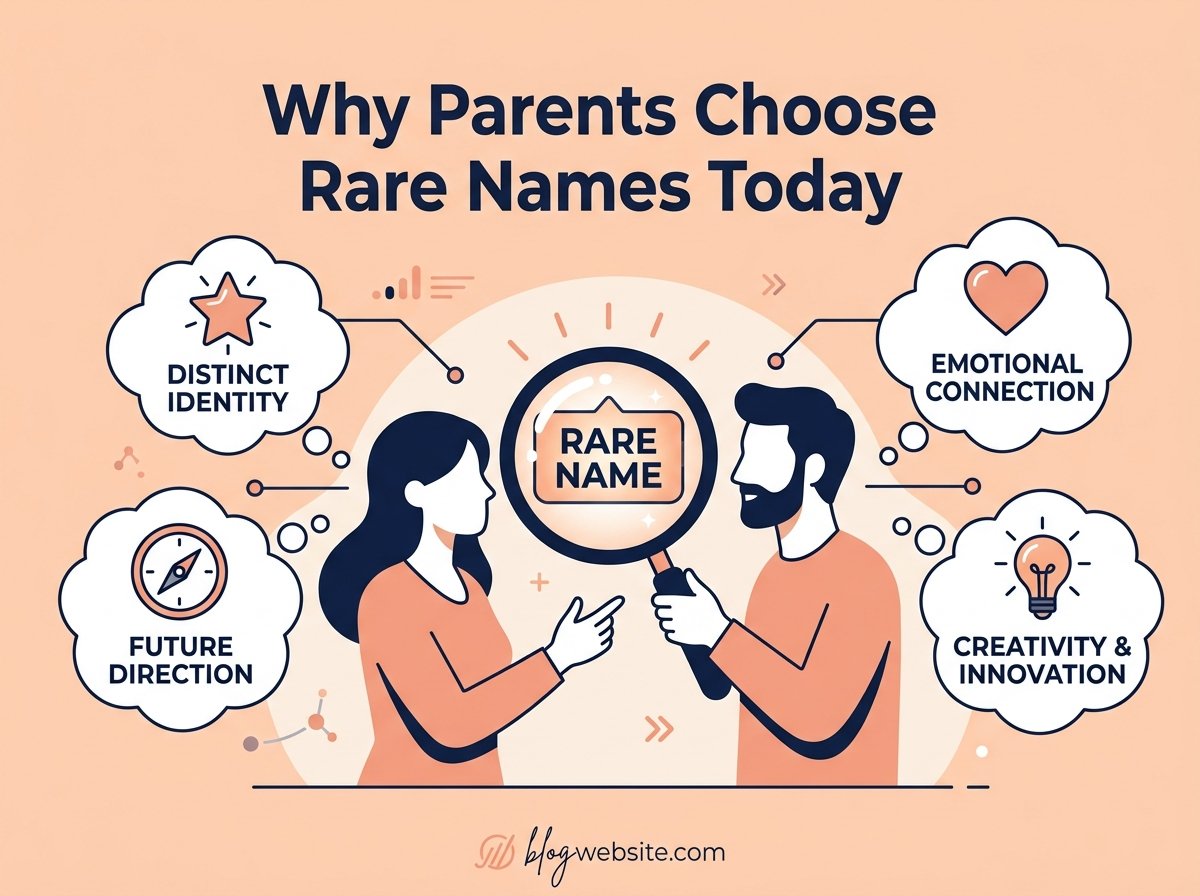
Back in 1990, the top 10 baby names in the US covered about 30% of all newborns. By 2024, that number dropped to barely 7%. Think about that for a second — parents are actively running away from popular names like never before.
If you’re expecting a baby, or even just curious about the naming trend shift, you’ve probably noticed something. Names like Liam, Emma, and Olivia still top the SSA charts, sure. But scroll through any new mom’s Instagram, and you’ll spot names you’ve never heard before — Ozias, Elowen, Zephyrine, Caius.
So what changed? Why are parents today obsessed with giving their kids names that nobody else has?
It’s not random. There’s real psychology, cultural shifts, and even technology driving this trend. Let’s break it all down — the real reasons, the myths, and what you should actually think about before picking a rare name for your child.
The Big Shift: How Baby Naming Culture Changed
From Family Tradition to Personal Expression
Your grandparents probably didn’t spend months researching baby names. They named kids after family members, saints, or whatever was common in their community. Simple.
But something shifted around the late 1990s and early 2000s. Naming a baby became a form of personal branding — almost like creating an identity before the child even takes a first breath.
A few things happened at once:
- Smaller families — When you have one or two kids instead of six, each name carries more weight
- Rise of individualism — Western culture increasingly values standing out over fitting in
- Internet culture — Parents can now search how many people have their chosen name in seconds
- Global exposure — Access to names from every culture, language, and historical period
The result? Parents treat naming like a creative project. And creativity, by definition, pushes you toward the unusual.
The Data Tells the Story
The U.S. Social Security Administration (SSA) data paints a crystal-clear picture. In 1950, about 5% of all boys born were named James. By 2023, the most popular boy’s name (Liam) accounted for less than 1% of births.
That’s not because parents hate the name Liam. It’s because the entire pool of names in use has exploded. The SSA recorded over 29,000 unique baby names in 2023, compared to roughly 5,000 in the 1950s.
You can actually explore how name popularity has changed over time decade by decade — the pattern is unmistakable.
The Psychology Behind Choosing Rare Names
Identity and Uniqueness
Here’s the core truth: most parents who pick rare names aren’t trying to be weird. They’re trying to give their child a head start on having a distinct identity.
Dr. Jean Twenge, a psychologist at San Diego State University, has researched this extensively. Her findings show that parents increasingly see a unique name as a gift — something that helps a child feel special and stand out in a crowded world.
Think about it from your own experience. If you grew up as one of four Jessicas in your class, you probably remember the frustration of always being “Jessica M.” or “Jessica with the glasses.” Parents who lived through that don’t want it for their kids.
The psychology behind unique names goes even deeper. Research suggests that people with uncommon names develop slightly stronger self-concepts around individuality — though the effects are subtle and vary widely.
The Fear of Being “Basic”
Let’s be honest about something. Social media created a new fear for millennial and Gen Z parents: being perceived as basic or unoriginal.
When you post your baby’s name on Instagram and 47 people comment “Oh, my neighbor’s kid has the same name!” — that stings a little. It shouldn’t, but it does. Parents feel quiet pressure to pick something that gets the reaction: “Wow, where did you find that name?”
This isn’t vanity. It’s a natural human response to a culture that rewards uniqueness. And it’s real — you can’t pretend social media hasn’t changed how parents think about names.
Attachment and Meaning
Many parents who choose rare names report spending months on research. They look into etymology, historical significance, cultural roots, and even numerology.
This deep investment creates a stronger emotional attachment to the name itself. A parent who names their daughter “Thessaly” after the Greek region where they got engaged has a story. And stories create meaning.
Compare that to “we just picked Emma because it was popular” — neither is wrong, but the emotional weight feels different to many parents.
7 Real Reasons Parents Pick Rare Names in 2025
1. Standing Out in a Digital World
Here’s a practical reason people don’t talk about enough: Google-ability.
If your name is John Smith, good luck building an online presence. Employers, college admissions officers, and collaborators will struggle to find you online. But if your name is Caspian Wilder? You own page one of Google results before you’re even old enough to type.
Parents who work in tech, media, or entrepreneurship think about this. A rare name gives a child a built-in digital identity advantage.
Quick Fact: In 2024, “digital identity” was cited as a naming consideration by 23% of parents in a BabyCenter survey — up from just 4% in 2010.
2. Cultural Heritage and Roots
Many parents are returning to names from their ancestral languages that fell out of use during assimilation periods. A third-generation Irish-American might pick “Saoirse.” A family with West African roots might choose “Amara” or “Zuberi.”
These names feel rare in the US context, but they carry deep cultural weight. Parents see them as a way to reclaim heritage that previous generations had to suppress to fit in.
You’ll notice this trend is particularly strong among families from cultures where popular names tend to cluster — reclaiming the less common ones from their tradition feels like an act of cultural pride.
3. Pop Culture and Media Influence
Every few years, a TV show, movie, or book launches a wave of unusual names into the mainstream. Game of Thrones gave us Arya and Khaleesi. Bridgerton revived old-fashioned British names. Anime introduced Western parents to Japanese names they’d never heard before.
But here’s the interesting twist — parents in 2025 aren’t copying the exact names from shows. Instead, they’re using pop culture as a springboard. They hear an unusual name on screen, it opens their mind to the “rare name” category, and then they go searching for something even more unique.
Social media’s influence on baby name choices is massive. A single viral TikTok featuring an unusual name can generate thousands of searches overnight.
4. Avoiding Overused Names
Some parents don’t start with “I want something rare.” They start with “I definitely don’t want something overused.”
It’s a subtle but important difference. These parents begin by eliminating the most overused baby names right now — your Liams, Olivias, Noahs, and Emmas — and end up in rare-name territory almost by accident.
The elimination process goes something like this:
- Cross off top 100 names → too common
- Cross off names of people they know → too weird
- Cross off names with bad associations → can’t use that
- Cross off names that are hard to spell → practical concern
- What’s left? Usually something rare
5. Gender Neutrality Movement
The rise of gender-neutral names has naturally pushed parents toward rarer territory. Traditional gender-neutral names like Jordan and Taylor are now so common they don’t feel “neutral” anymore — they feel dated.
Parents looking for truly gender-neutral options often end up with names that barely register on popularity charts: Wren, Sage, Cosmo, Arbor, Indigo.
This overlaps with broader cultural conversations about gender identity and expression. Parents who value gender flexibility see a rare, ungendered name as giving their child freedom to define themselves.
6. The “Old Is New” Effect
Here’s something fascinating: many “rare” names today aren’t actually new. They’re extremely old names that fell out of use so long ago they feel fresh again.
Names like Ezra, Silas, Aurelia, and Cora were common 150+ years ago. They vanished for decades, and now they’re back — but they still feel uncommon because nobody’s grandmother has them.
Old-fashioned names making a comeback is one of the strongest trends in baby naming right now. Parents get the best of both worlds: a name with historical depth that still sounds distinctive.
7. Rejecting “Trendy” Name Patterns
Every era has its naming patterns. The 1980s had the “-ifer” names (Jennifer, Heather). The 2000s had the “-aiden” names (Jayden, Brayden, Cayden). The 2010s had the “-ella” names (Isabella, Gabriella, Arabella).
Savvy parents see these patterns forming and deliberately avoid them. They don’t want their kid’s name to scream “born in 2024” the way “Brittany” screams “born in 1990.”
Choosing a rare name that doesn’t follow any current pattern feels like a way to make the name timeless rather than trendy.
Common Myths About Rare Baby Names
Myth 1: “Rare Names Will Get Your Kid Bullied”
This is the number one concern parents hear from worried grandparents. And it’s largely outdated.
In the 1970s, a kid named “Zephyr” in a classroom full of Michaels and Davids would absolutely stand out. But in a 2025 classroom where you’ve got an Aria, a Bodhi, a Juniper, and a Kai? Unusual names are the new normal.
Research from the University of California (2019) found that name-based teasing has decreased significantly as name diversity has increased. Kids today are exposed to so many different names through media and diverse classrooms that unusual names don’t trigger mockery the way they once did.
That said, there are limits. Names that are deliberately provocative, look like misspellings, or are impossible to pronounce in your local language can still cause friction. There’s a difference between “rare” and “problematic.”
Myth 2: “Rare Names Hurt Career Prospects”
This one’s more complicated. Research does show that names can affect career perception, but the effect is mostly about ethnic bias, not rarity itself.
A study from the National Bureau of Economic Research found that names perceived as “ethnic” received fewer callback rates in job applications. But a rare name that sounds “neutral” — like Everett or Linnea — doesn’t trigger the same bias.
The bigger truth? By the time today’s babies enter the workforce (around 2045-2050), hiring managers will themselves be people with unusual names. The workforce culture will have shifted dramatically.
Myth 3: “You’re Just Trying to Be Different for the Sake of It”
Some people assume parents who choose rare names are attention-seeking. That’s unfair and usually wrong.
Most parents who pick uncommon names have deeply personal reasons — a family connection, a meaningful origin story, a cultural reference. The assumption that it’s all about “being different” ignores the genuine thought process behind the decision.
The Potential Downsides — Be Honest About These
Rare names aren’t all upside. Here are real challenges you should think about:
Spelling and Pronunciation Issues
If you name your daughter “Siobhan” (pronounced Shi-VAWN), she’ll spend her life correcting people. That’s not a dealbreaker, but it’s a reality.
Pro Tip: Before finalizing a rare name, do the “Starbucks test.” Imagine your child telling a barista their name. If it takes three attempts to get it right, consider whether that daily friction is worth it.
The “Never Finding Your Name on a Keychain” Problem
This sounds trivial, but it matters to kids. Children notice when every souvenir shop has a “Sarah” keychain but nothing close to their name. It’s a small thing that can make a child feel left out.
Some parents see this as character-building. Others see it as unnecessary frustration. Neither view is wrong — just know it’s part of the package.
Legal and Administrative Hassles
Some countries have name laws. In Denmark, you must choose from an approved list of about 7,000 names. In the US, most states are permissive, but certain characters (accents, hyphens, numbers) may not work in government databases.
If you’re choosing a name with special characters or unusual formatting, check your state’s rules first.
The “Explaining” Fatigue
People with very rare names report a common experience: every new introduction becomes a mini-conversation about their name. “Where does it come from? What does it mean? How do you spell it?”
Some people love this — it’s an instant conversation starter. Others find it exhausting by age 25. You can’t predict which type your child will be.
How to Choose a Rare Name the Smart Way
If you’ve decided a rare name is right for your family, here’s a practical framework:
Step 1: Check the Actual Rarity
What feels rare might not be. “Luna” sounds unusual but was the 14th most popular girl’s name in 2023. Use tools to check if your chosen name is truly unique before committing.
Also look at trending data. A name that’s rare today might be exploding in popularity. You don’t want to pick “Maeve” thinking it’s unique, only to find three Maeves in your kid’s preschool class.
Step 2: Test Pronunciation Across Contexts
Say the name out loud in different scenarios:
- Doctor’s office waiting room
- Job interview introduction
- Sports team roster announcement
- Phone call with bad reception
If the name works smoothly in all these contexts, it passes the practical test.
Step 3: Check Cross-Cultural Meanings
A name that sounds beautiful in English might mean something unfortunate in Spanish, Arabic, or Mandarin. If you live in a diverse community (or want your child to travel), run the name through basic translation checks.
Step 4: Give Them a Nickname Option
Smart parents who choose very unusual first names often pair them with a conventional middle name. This gives the child an “escape hatch” — if 12-year-old Persephone decides she’d rather go by “Kate” for a while, she can use her middle name.
Step 5: Sleep on It — For Weeks
Don’t finalize a rare name in the excitement of pregnancy. Write it down. Say it 50 times. Imagine yelling it across a playground. Imagine it on a resume. Imagine introducing your 80-year-old self with that name.
If it still feels right after a month? Go for it.
What the Data Actually Shows About Rare Names
The SSA releases detailed name data every year, and the 2024 data reveals some striking patterns:
- Names given to fewer than 5 babies aren’t even reported by the SSA for privacy reasons — but estimates suggest over 10,000 such names exist annually
- Name concentration is at an all-time low — the top 1,000 names account for a smaller share of total births than at any point since records began in 1880
- Regional variation matters — a name can be rare nationally but common in a specific state. Check popular names by state for a localized view
The science behind name statistics is actually quite fascinating. Naming patterns follow predictable mathematical curves — a name rises gradually, peaks, and then drops. Rare names of today are often the mainstream names of 2040.
The Cultural Perspective: It’s Not Just a Western Trend
This rare-name movement isn’t limited to the US or Europe. Parents globally are shifting away from traditional naming conventions:
- China: Parents increasingly avoid common characters and create unique character combinations
- Japan: The government expanded the list of approved kanji for names in 2024 due to demand
- India: Urban parents are moving away from traditional naming ceremonies toward individually chosen rare names
- Middle East: While traditional naming remains strong, younger parents in cities are exploring less common Arabic names
The pattern is consistent — urbanization, education, and internet access all correlate with greater name diversity. The more connected parents are to global culture, the more likely they are to choose something unusual.
FAQ Section
Do rare names actually affect a child’s personality?
Research is mixed on this. Some studies suggest people with uncommon names develop slightly higher levels of self-awareness and individuality. But personality is shaped by thousands of factors — parenting, environment, genetics, experiences. A name alone won’t determine who your child becomes. You can explore more about whether rare names affect personality if this question interests you.
How rare is “too rare” for a baby name?
There’s no universal rule, but most naming experts suggest avoiding names that exist only a handful of times in the world unless you have a strong personal reason. A name that’s unfamiliar but pronounceable (like “Elowen” or “Caspian”) hits the sweet spot. A name that looks like a random string of letters? That might create more problems than benefits.
Can I make up a completely new name for my baby?
Legally, yes — in most US states. Practically, think carefully. Invented names with no etymological root can feel weightless. They have no history, no meaning, no cultural anchor. If you want to create a new name, try blending elements from existing names or languages so it still carries some linguistic DNA. That gives it both uniqueness and substance.
What if family members hate the rare name we chose?
This is extremely common. Grandparents especially tend to resist names they’ve never heard before. The best approach? Share the name’s meaning and your reason for choosing it. Most family resistance softens once they understand the story behind the name. And honestly? Once they hold the baby and say the name 200 times, it starts sounding perfectly normal.
Are there any names that are literally one-of-a-kind?
According to SSA data, thousands of names are given to only one baby per year in the US. But “one of a kind” globally? That’s nearly impossible to verify. Names cross borders, and no single database tracks every name on Earth. You can check how many people share a specific name to get a rough sense, but absolute uniqueness is hard to confirm.
Your Name, Your Choice — But Make It a Thoughtful One
Here’s what all of this boils down to: parents choose rare names today because the world has changed. We live in bigger, more connected, more searchable communities. Standing out isn’t just a preference — for many families, it feels like a practical necessity.
But choosing a rare name is a decision your child lives with, not you. The best rare names are the ones that sound beautiful, carry meaning, work practically in daily life, and give your child something to be proud of.
Don’t pick a rare name just because it’s rare. Pick it because it’s right. Because when your kid is 30 and someone asks about their name, they smile and say, “Yeah, my parents chose it because…” — and they have a real answer.
That’s the difference between a rare name that works and one that doesn’t. It was never about being different. It was always about being intentional.