Most Common Male Names in the USA

Over 4.5 million James exist in the United States right now. That’s roughly the entire population of Ireland — all sharing one first name. Wild, right?

If you’ve ever sat in a classroom, an office, or a coffee shop and heard someone call out “James” or “John” only to see three heads turn, you already know how common some male names are in America. But here’s the thing most people don’t think about: why do certain names dominate for decades while others vanish in a few years?

The Social Security Administration (SSA) has tracked every registered baby name since 1880. That’s over 140 years of data. And the patterns inside that data tell a fascinating story — about culture, immigration, religion, pop culture, and even economics.

This article breaks down the most common male names in the USA, what makes them so popular, how they’ve shifted over the decades, and what the current trends look like heading into 2025 and beyond. Whether you’re picking a baby name, doing genealogy research, or just genuinely curious, you’ll find your answers here.


The All-Time Most Common Male Names in the USA

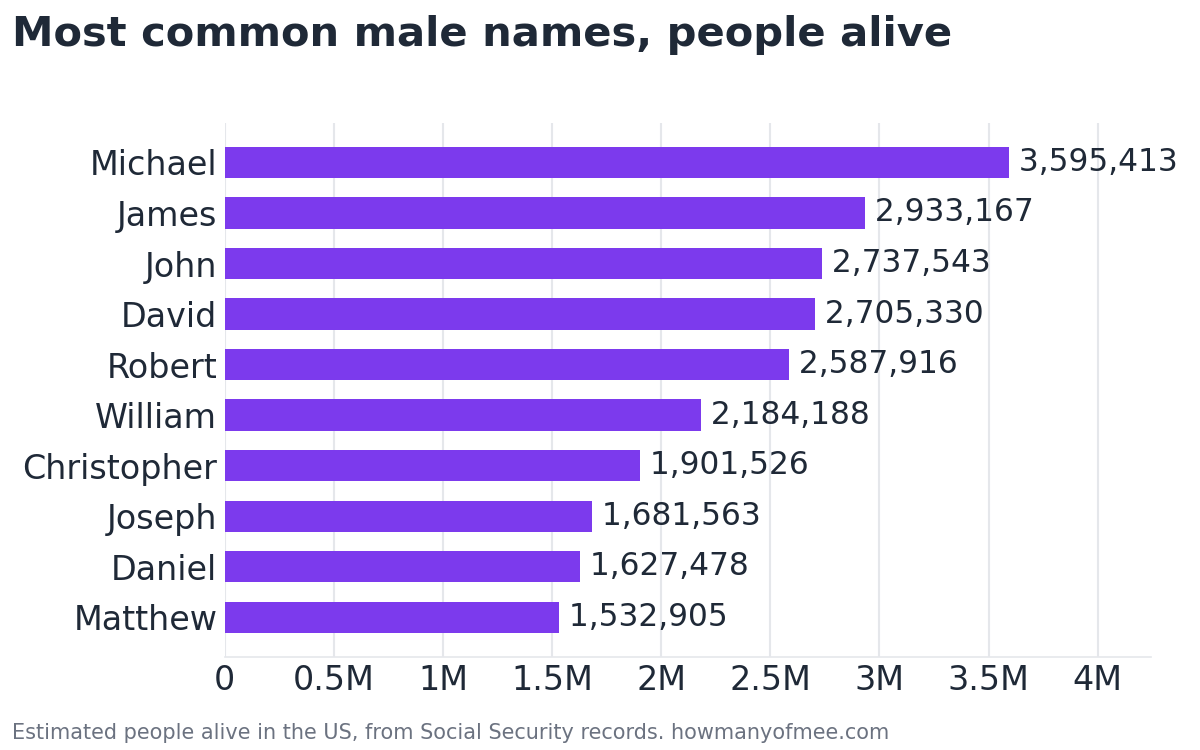
Let’s start with the big picture. Based on cumulative SSA data and U.S. Census records, these names have been given to the most males across American history:

RankNameEstimated Living Americans
1James4.7 million
2Robert4.5 million
3John4.5 million
4Michael4.3 million
5David3.6 million
6William3.6 million
7Richard2.5 million
8Joseph2.6 million
9Thomas2.3 million
10Charles2.1 million

📌 Quick Fact: James has been in the top 20 baby names for every single decade since 1880. No other male name comes close to that kind of consistency.

Notice something? These names are almost all Biblical or English in origin. That’s not a coincidence — it reflects America’s dominant cultural and religious influences for most of its history. We’ll dig deeper into the “why” soon.

If you’re curious about how many people actually share your full name, the numbers might surprise you — especially if your first name is on this list.


Top 10 Most Popular Male Baby Names Right Now (2024–2025)

The all-time list and the current list look very different. Trends have shifted dramatically in the last two decades. Based on the latest SSA data (2023 final report, with 2024 preliminary trends):

  1. Liam — #1 for six consecutive years
  2. Noah
  3. Oliver
  4. James — the only classic holding a top-5 spot
  5. Elijah
  6. Theodore
  7. Henry
  8. Lucas
  9. William
  10. Benjamin

See the shift? Michael, which dominated from 1954 to 1998 (the longest #1 streak in SSA history), isn’t even in the top 10 anymore. Robert and John — once the backbone of American male names — have fallen out of the top 20 entirely.

🔍 Did You Know? Liam was barely in the top 100 before 2000. Its rise is largely attributed to actor Liam Neeson’s fame and a broader trend toward shorter, softer-sounding male names.


How Male Name Popularity Has Changed Over the Decades

Names don’t just become popular randomly. They follow patterns — rising, peaking, and fading in waves. Here’s a decade-by-decade snapshot of the #1 most common male baby name:

1950s–1960s: James and Michael Era

James held the crown through the early 1950s, then Michael took over in 1954. The post-war baby boom meant millions of boys received these names. The influence? Strong, traditional, no-nonsense names that parents associated with reliability.

1970s–1980s: Michael’s Dominance

Michael stayed #1 for an extraordinary run. By the 1980s, roughly 92,000 boys per year were being named Michael. The name was everywhere — Michael Jordan, Michael Jackson, Michael J. Fox. Pop culture reinforced what was already a cultural default.

1990s: The Transition Period

Michael finally started slipping. Jacob rose quickly, partly driven by the trend toward Biblical names that felt traditional but slightly less common than John or James. Christopher and Matthew were also huge during this period.

2000s–2010s: Jacob’s Reign and New Sounds

Jacob was #1 from 1999 to 2012 — a 14-year run. But something else was happening underneath. Parents started choosing names that sounded softer, more international, and less “traditionally American.” Names like Aiden, Ethan, and Mason entered the top 10.

2020s: Liam and the Modern Aesthetic

Liam has owned the top spot since 2017. The current top 10 features names that are shorter (often one or two syllables), have a softer sound, and many have European roots. Theodore’s rapid climb reflects a growing taste for old-fashioned names making a comeback.

For a deeper look at how name popularity changes over time, the patterns are genuinely eye-opening.


Why Are Certain Male Names So Common?

You might wonder — with thousands of possible names, why do a handful dominate so heavily? There are real, identifiable reasons:

Religious and Biblical Roots

The most common male names in the USA trace directly back to the Bible or Christian tradition. James, John, Joseph, David, Michael, Thomas, William — these aren’t random. America’s historically Christian-majority population chose names with spiritual meaning.

Even today, Elijah, Noah, and Benjamin (all top 10) are Biblical names. The religious influence hasn’t disappeared — it has just shifted to different Biblical names.

Family Naming Traditions

For generations, American families named sons after fathers, grandfathers, or uncles. This “recycling” effect kept names like James, Robert, and William in the top ranks for over a century. A boy named William in 1920 might name his son William Jr. in 1950, who might name his son William III in 1980.

This tradition has weakened significantly since the 1990s. Modern parents are much less likely to pass down names and much more likely to choose something they feel is unique.

Pop Culture and Celebrity Influence

You can literally track name spikes alongside famous people and fictional characters. Some proven examples:

  • Elvis spiked after Elvis Presley’s rise in the 1950s
  • Logan surged after the X-Men movies
  • Liam climbed steadily after Liam Neeson became a household name
  • Kylo appeared on the SSA charts for the first time after Star Wars: The Force Awakens

Curious about this effect? There’s great data on celebrity names that became trending in the real world.

Immigration Waves

America’s name landscape is directly shaped by who immigrates and when. German immigration in the 1800s boosted names like Karl and Friedrich (later anglicized). Irish immigration strengthened Patrick, Sean, and Liam. Hispanic immigration has pushed names like Mateo, Santiago, and Diego into the mainstream — Mateo is currently in the top 15 nationally and #1 in several states.

The Sound Factor

Linguists and name researchers have identified clear sound trends. Right now, male names ending in a vowel sound or a soft consonant are dominating: Liam, Noah, Elijah, Leo, Luca. In the 1950s–1980s, harder endings were more popular: Robert, Richard, Donald, Frank.

Names literally sound different across generations.


Most Common Male Names by U.S. State — It’s Not the Same Everywhere

National data hides a lot of regional variation. America is a huge, culturally diverse country, and name preferences vary significantly by state.

Some 2023–2024 Highlights:

  • Liam is #1 in over 20 states, especially in the Northeast and Midwest
  • Mateo is #1 in several states with large Hispanic populations, including parts of the Southwest
  • Oliver is strongest in the Pacific Northwest and New England
  • James still holds top-3 positions in Southern states like Alabama and Mississippi
  • William remains especially popular in the Deep South

📌 Pro Tip: If you check popular names in Texas versus popular names in California, you’ll see clear cultural differences — Texas leans more traditional, while California trends toward modern and international names.

The regional differences aren’t just about taste. They reflect local demographics, religious traditions, and cultural communities. A name that’s #1 in Utah might not even crack the top 50 in New York.


Common Male Names Across Different Cultures in the USA

America’s diversity means the “most common” list changes depending on which community you’re looking at.

Hispanic/Latino Community

Mateo, Santiago, Sebastian, Diego, Daniel — These names reflect Spanish-language naming traditions and have crossed over into mainstream American popularity. Mateo’s rise into the national top 15 is one of the biggest name stories of the 2020s.

African American Community

Research by scholars like Lisa Cook and Trevon Logan shows distinct naming patterns. Names like DeAndre, Jamal, Terrence, and Malik were especially popular in the 1980s–1990s. Today, there’s a mix of traditional names, Afrocentric names, and unique creations that reflect cultural identity.

South Asian Community

With growing Indian and Pakistani American populations, names like Arjun, Aarav, Rohan, and Aryan appear with increasing frequency. You can explore most popular Hindu names worldwide or popular Pakistani names to see how these overlap with American trends.

Muslim American Community

Muhammad (and its various spellings) has become one of the fastest-rising names in the USA. When you combine all spellings — Muhammad, Mohammed, Mohammad — it already ranks in the top 10 in some states. Check out most popular Muslim names in the USA for the full picture.


Myths and Misconceptions About Common Male Names

Let’s clear up some things people often get wrong:

❌ Myth: “John is still the most common male name in America”

Reality: John hasn’t been the #1 baby name since 1923. It’s still extremely common among living Americans (because millions of Johns are still alive), but among newborns, it currently ranks around #27. The name isn’t dying, but it’s definitely not dominating anymore.

❌ Myth: “Popular names are less popular than they used to be”

Reality: This one is actually true — but people misunderstand what it means. In 1950, the top name (James) was given to about 86,000 boys. In 2023, the top name (Liam) was given to about 20,000 boys. That’s not because fewer babies are born. It’s because parents today spread their choices across far more names. There’s more variety now than at any point in American history.

❌ Myth: “A common name hurts your career or personality”

Some people genuinely believe that having a common name makes you “blend in” or limits your success. Research doesn’t support this. What studies do show is that names perceived as easy to pronounce — regardless of popularity — tend to receive slightly more favorable responses in hiring. That’s a pronunciation bias, not a popularity bias. If you’re curious about whether names actually affect careers, the real data is more nuanced than the headlines suggest.

❌ Myth: “Unique names are always better”

There’s a growing trend toward unique names (and that’s perfectly fine). But “unique” doesn’t automatically mean “better.” Some extremely unique names can cause spelling and pronunciation issues throughout a person’s life. The sweet spot for many parents is a name that’s recognizable but not overused — think Theodore or Sebastian rather than James or Liam.


The Data Behind the Names: How Name Statistics Work

The primary source for U.S. name data is the Social Security Administration (SSA), which has published name frequency data since 1880. Here’s what you should know about how this data works:

  • The SSA only counts names from Social Security card applications. Before the Social Security Act of 1935, the data is less complete.
  • Names with fewer than 5 occurrences in a given year aren’t published (for privacy reasons).
  • The SSA doesn’t track nicknames separately. “Bill” and “William” are counted as different names even though most Bills are legally named William.
  • Spelling matters. “Micheal” and “Michael” are counted separately. This means some names are actually MORE common than they appear because their popularity is split across multiple spellings.

📌 Pro Tip: If you want to see the real science behind how these numbers work, the science of name statistics explains the methodology in plain language.


What Makes a Male Name “Stick” for Generations?

Some names survive for centuries. Others burn bright for a decade and disappear. What separates them?

Names that endure tend to share these qualities:

  • Short and simple — Easy to spell, easy to say (James, John, William)
  • Multiple nickname options — William gives you Will, Bill, Billy, Liam. Robert gives you Rob, Bob, Bobby, Bert.
  • Cross-cultural adaptability — James works in English, but it has equivalents in almost every European language (Jacques, Jaime, Giacomo, Jakob)
  • No strong single association — Names tied too closely to one person (like Adolf, for tragic reasons) can collapse. Names like James have been shared by so many famous people that no single association dominates.
  • A balance of traditional and modern feel — Names that sound both “classic” and “current” tend to last longest

Meanwhile, names that die out quickly are often:

  • Heavily tied to one celebrity or character
  • Based on a trend sound that dates quickly (the -ayden wave: Jayden, Brayden, Cayden)
  • Extremely unusual spellings of common names

Current Trends Shaping Male Names in 2025 and Beyond

Based on SSA data, baby name expert analysis (from sources like Nameberry and BabyCenter), and cultural trends, here’s where American male names are heading:

Trend 1: Old-Fashioned Names Rising Fast

Theodore, Henry, Arthur, Felix, Hugo — These “grandpa names” are climbing rapidly. Parents are reaching back 100+ years for names that feel fresh precisely because nobody in their generation has them.

Trend 2: Nature and Word Names

River, Forest, Sage, Jasper, Atlas — Nature-inspired names and “word names” are gaining ground for boys, something that was almost exclusively a girls’ name trend until recently.

Trend 3: International Crossover Names

Mateo, Kai, Luca, Arlo, Ezra — These names work across multiple languages and cultures. In an increasingly multicultural America, parents want names that travel well.

Trend 4: Shorter is Better

The average length of top male names has gotten shorter. One and two-syllable names dominate: Kai, Leo, Max, Finn, Jack. The era of Christopher, Alexander, and Nathaniel at the top seems to be fading (though these names certainly aren’t disappearing).

Trend 5: Gender-Neutral Expansion

Some traditionally male names are now used for girls too, and some parents are deliberately choosing gender-neutral names like Avery, Riley, Jordan, and Morgan. This blurs the traditional “common male name” category in interesting ways.


Names That Are Rapidly Declining

Just as interesting as what’s rising is what’s falling. These once-dominant male names are now rarely given to newborns:

  • Gary — Top 10 in the 1950s, now below #600
  • Larry — Nearly extinct for newborns
  • Donald — Dropped sharply (political associations play a role)
  • Dennis — Was top 20 in the 1950s, now barely registers
  • Keith — Same story
  • Kevin — Was massive in the 1960s–1980s, now dropping fast

🔍 Did You Know? Most names follow a roughly 100-year cycle. Names that feel “dated” today (like Walter or Harold) may become trendy again in 20–30 years as they lose their “dad/grandpa” association and start sounding fresh. It’s already happening with Theodore, Henry, and Arthur.

If you want to explore millennial names that are disappearing, the decline patterns are surprisingly predictable.


How to Check If Your Name Is Common or Rare

Wondering where your own name falls? Here are some practical tools:

  • SSA Baby Names Database (ssa.gov/oact/babynames) — Free, searchable by year and state
  • HowManyOfMe.com — Estimates how many people have your name in the world based on census and frequency data
  • Nameberry & BabyCenter — Track current trending names and community discussions
  • Forebears.io — Useful for surname frequency and global distribution

You might find that your “common” name isn’t as common as you assumed — or that your “unique” name has thousands of holders. The data often contradicts our intuition.


FAQ: Most Common Male Names in the USA

What is the #1 most common male name in the USA right now?

Liam has been the #1 male baby name in the USA since 2017, according to the Social Security Administration. Among all living American males (not just babies), James likely still holds the overall top spot because of its dominance across multiple generations.

Why did Michael stop being the most popular male name?

Michael was #1 from 1954 to 1998 — a 44-year run. It faded for the same reason all dominant names eventually fade: overexposure. When a name becomes too common, younger parents start avoiding it precisely because it feels played out. Naming trends naturally cycle this way.

Are traditional male names dying out?

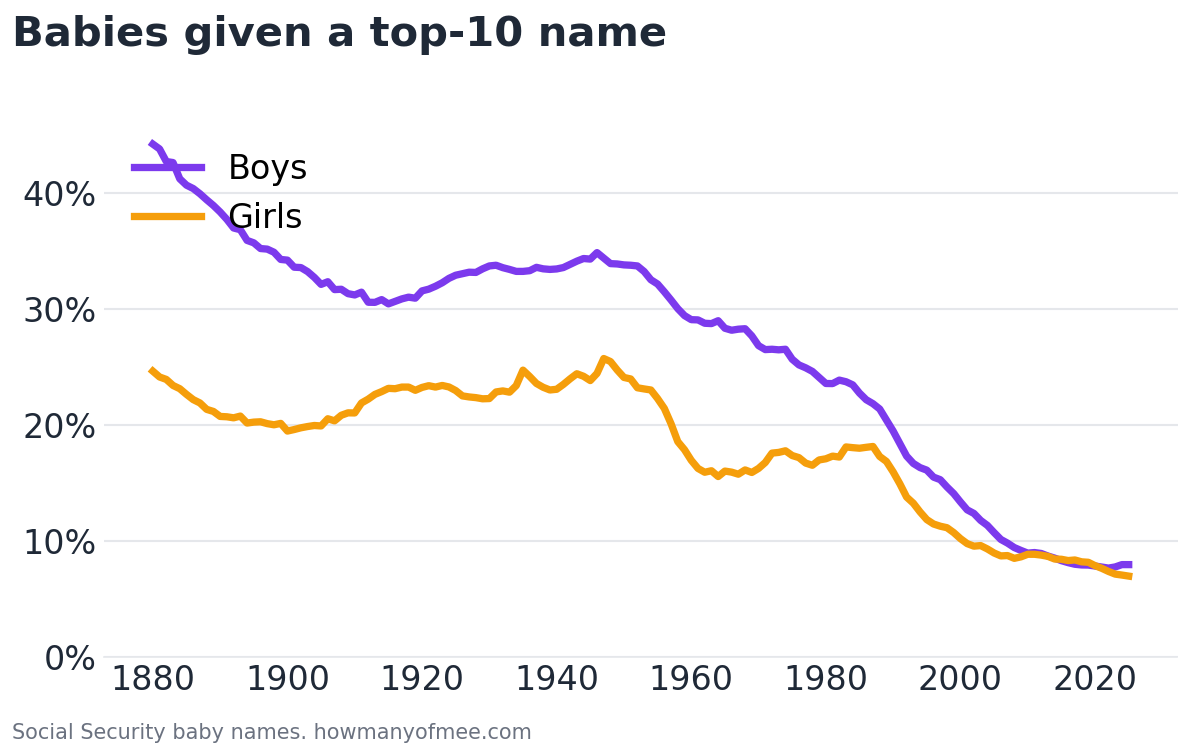
Not exactly. Traditional names like James, William, and Henry are still in the top 10. What’s happening is that the pool of popular names is much wider now. In the 1950s, the top 10 names accounted for about 30% of all boys. Today, the top 10 accounts for less than 10%. Traditional names haven’t died — they’re just sharing space with many more options.

What’s the difference between “most common” and “most popular” names?

“Most common” usually refers to the highest total number of living people with that name. “Most popular” typically refers to the name given to the most babies in a specific year. James is the most common (most living holders). Liam is the most popular (most new babies receiving the name).

Do most common male names vary by state?

Absolutely. Liam dominates in most Northeastern and Midwestern states. Mateo leads in states with large Hispanic populations. William and James are strongest in the South. Regional culture, demographics, and immigration patterns create significant state-by-state differences.


Your Name Tells a Story

Every common male name in America carries a piece of history. James connects back to kings and apostles. Michael rode a wave of mid-century confidence. Liam reflects a 21st-century taste for simplicity and global appeal. Mateo signals America’s increasingly multicultural identity.

The names parents choose aren’t random — they’re shaped by faith, family, culture, media, and even the sounds that feel “right” for a particular era. And the data shows us that these preferences shift in surprisingly predictable patterns.

So the next time you meet yet another James at a party or notice three Liams at the playground, you’ll know exactly why. These names didn’t become common by accident. They earned their place through generations of cultural momentum — and the story of how that momentum builds and fades is one of the most human stories data can tell.

Want to find out where your own name lands? Try checking how many people have your name — the answer might be more interesting than you think.

Leave a Comment