
Somewhere out there, a person walks around with a name that literally no one else on the planet shares. Not five people. Not ten. Just one single human being carrying that exact combination of sounds and letters.
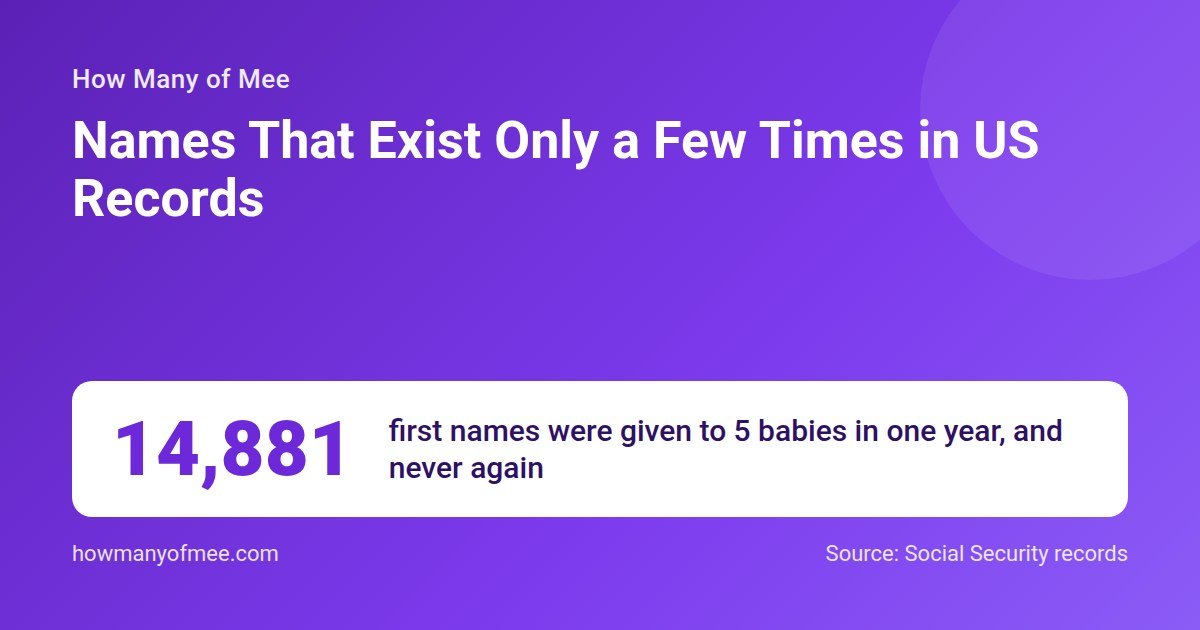
Think about that for a second. There are roughly 8 billion people alive right now. The U.S. Social Security Administration (SSA) tracks millions of baby names every single year. And yet, buried inside all that data, you’ll find names that have been registered only once, twice, or maybe three times — ever.
You probably know a few Jasons, a couple of Emmas, and at least one Muhammad. But what about a person named Brfxxccxxmnpcccclllmmnprxvclmnckssqlbb11116? Yes, that was a real name attempt (more on that wild story later). Or consider names from small indigenous communities that have never been entered into any Western database.
The truth is, some names are so rare they’re practically invisible. And the reasons behind their rarity are fascinating — from cultural traditions and legal restrictions to parents who simply decided to invent something brand new.
If you’ve ever wanted to check if your name is truly unique, this article will give you a whole new perspective on just how rare a name can actually get.
Let’s get into it.
What Does “Ultra-Rare” Actually Mean for a Name?
Before we start listing names, we need to define what “rare” means here. Because rare is relative.
A name like Wren might feel rare in your friend group, but the SSA recorded over 2,000 baby girls named Wren in 2023 alone. That’s not rare — that’s just uncommon.
When we talk about names that exist only a few times in the world, we mean:
- Names given to fewer than 5 people in recorded databases
- Names that appear exactly once in SSA records (registered fewer than 5 times total, since SSA doesn’t publish names with fewer than 5 occurrences for privacy)
- Names that exist in no official registry at all — oral tradition names from small communities
- Invented names that parents created from scratch
Quick Fact: The SSA only reports a name publicly if at least 5 babies received it in a given year. So any name that appears fewer than 5 times effectively becomes invisible in official U.S. data. That means thousands of ultra-rare names are hiding right under the surface.
Understanding what makes a name rare or common depends on several factors — geography, language, culture, and sometimes pure parental creativity.
Real Examples of Names Held by Almost No One
Here’s where things get interesting. Let’s look at actual names — verified through records, news reports, or cultural documentation — that only a tiny handful of people (or even just one person) have ever carried.
Names from Official Records
Some names slip through the cracks of official registries, appearing just once or twice before disappearing entirely:
Names from Indigenous and Small Communities
Some of the world’s rarest names come from communities so small that their naming traditions never enter global databases:
Invented Names That Parents Created
Every year, parents around the world coin entirely new names. Some catch on. Most don’t. And a few remain genuinely one-of-a-kind:
Did You Know? Parents in countries with the most unique naming traditions often produce names that literally can’t be found anywhere else because their languages have sounds that don’t exist in other tongues.
Why Do Some Names Exist Only Once?
A name doesn’t become ultra-rare by accident. Several specific forces push a name into the “only one on Earth” category.
1. Language Extinction
When a language dies, its names often die with it. UNESCO estimates that a language disappears every two weeks. Each lost language carries unique names that will never be given again.
The Eyak language of Alaska lost its last fluent speaker, Marie Smith Jones, in 2008. Names from the Eyak tradition that were given to only one or two people during the language’s final decades are now frozen in time — unrepeatable, because the cultural context for giving them no longer exists.
2. Legal Restrictions That Block Repetition
Many countries have strict naming laws:
- Denmark requires parents to choose from a pre-approved list of about 7,000 names. If you want something off-list, you need government approval. Rejected names become one-time legal oddities.
- Germany requires names to clearly indicate gender and not “endanger the well-being of the child.”
- New Zealand banned names like “Lucifer,” “Messiah,” and “4Real.” The attempted registrations exist in records but never became official.
When a name gets rejected, it often exists in exactly one place — the rejection file. That makes it technically a recorded name with a count of zero successful registrations.
3. Extreme Spelling Variations
Take a common name like “Ashley.” Now consider these real registered variations: Ashleigh, Ashlee, Ashlie, Ashly, Ashlea, Ashlei, Ashleah, Ashli, Ashlay. Each creative spelling reduces the population count. Push the spelling far enough — say, Aeshlyiegh — and you might end up with a name only one person has.
This spelling-variation effect is one of the biggest generators of ultra-rare names. The rarest baby names ever recorded often turn out to be unusual spellings of otherwise familiar names.
4. Cultural One-Time Naming Traditions
Some cultures practice event-based naming, where a child receives a name tied to a specific moment — the weather during birth, a historical event that day, or a dream the mother had.
Among the Akan people of Ghana, for example, day-names (like Kofi for a boy born on Friday) are common. But when combined with unique circumstantial names, the full name can become something no other person will ever carry.
5. Parents Deliberately Seeking Uniqueness
This is the most straightforward reason. Some parents specifically want a name nobody else has. They blend syllables, invent words, or combine elements from multiple languages.
The psychology behind unique names shows that parents choosing rare names often value individuality, creativity, and cultural distinction. They want their child to stand out — and a name that literally no one else carries guarantees that.
How Can You Tell If a Name Is Truly One-of-a-Kind?
You might think your name is rare. But how do you actually verify that?
Check SSA Data (for U.S. Names)
The Social Security Administration’s baby name database goes back to 1880. You can search any name and see exactly how many babies received it each year. If a name doesn’t appear at all, it means fewer than 5 people were given that name in any single year.
Pro Tip: A name missing from SSA data doesn’t mean zero people have it. It means fewer than 5 registrations in a given year. Over decades, a few scattered registrations could add up to 10–20 people total. Still very rare — but not truly unique.
Use Global Name Frequency Tools
Tools like HowManyOfMe estimate how many people in the U.S. share your exact first + last name combo. You can find out how many people have your name in the world using census data and statistical models.
These tools aren’t perfect — they rely on available data, which skews heavily toward English-speaking countries. Names from sub-Saharan Africa, Central Asia, or indigenous communities often won’t appear in any database.
Cross-Reference Multiple Sources
For the most accurate picture, check:
- SSA database (U.S. births since 1880)
- Census records (population snapshots)
- Social media search (Facebook, LinkedIn, Instagram)
- Ancestry databases (historical records)
- Phone directories (old-school but useful)
If your name returns zero results across all of these? You might genuinely be the only one.
The Rarest Last Names Make Full Names Even More Unique
We’ve focused mostly on first names, but your full name is where real rarity lives.
A moderately rare first name paired with an ultra-rare last name can create a combination that exists exactly once on Earth.
Consider these factors:
- Surnames tied to tiny communities — Some surnames belong to a single family lineage. If that family is small (say, 5–10 living members), then any first name paired with that surname creates extreme rarity.
- Changed surnames — Immigrants who altered their names at borders, or people who legally changed their surnames, sometimes created entirely new last names. These single-origin surnames mean everyone carrying them descends from one specific person.
- Hyphenated and blended surnames — When two uncommon surnames get combined through marriage, the result can be a surname that literally didn’t exist before. Pair that with an uncommon first name, and you’re looking at a full name shared by nobody.
Did You Know? There are an estimated 6.3 million distinct surnames in the United States alone, according to census data. Many of those are carried by just a single household.
Famous Cases of Extremely Rare Names
Some ultra-rare names have made headlines specifically because of their rarity.
Lopadotemachoselachogaleokranioleipsanodrimhypotrimmatosilphiokarabomelitokatakechymenokichlepikossyphophattoperisteralektryonoptekephalliokigklopeleiolagoiosiraiobaphetraganopterygon
Not a typo. This 183-letter word comes from an ancient Greek play by Aristophanes (Assemblywomen, 391 BCE). It describes a fictional dish. While nobody uses it as an actual name today, it holds the record for the longest word in literature — and at least one person has reportedly attempted to use a shortened version as a legal name.
Marijuana Pepsi Vandyck
Yes, that’s a real name. Marijuana Pepsi Vandyck is a real person — an American educator who earned her PhD from Cardinal Stritch University in 2019. She kept her unusual name throughout her life and even wrote her doctoral dissertation on how unusual names affect professional identity. She’s the only known person with this exact name.
Her story directly connects to research on whether rare names affect personality and professional life. Spoiler: she became a doctor. The name didn’t hold her back.
Brfxxccxxmnpcccclllmmnprxvclmnckssqlbb11116 (Revisited)
We mentioned this earlier, but the full story deserves a moment. The Swedish parents, Elisabeth Hallin and Lasse Diding, submitted this 43-character name in 1996 for their son. They said it was “pronounced Albin” and was meant as a protest against Sweden’s Naming Law (namnlagen), which they considered overly controlling.
The court rejected it. They then submitted “A” (just the letter). Also rejected. Eventually, the child was registered with a more conventional name. But the rejected name lives on in Swedish legal records — the only one of its kind anywhere.
Names That Disappeared and Left Almost No Trace
Some names were once slightly more common but have since faded to the point where only 1–2 living people still carry them.
Victorian-Era Names Lost to Time
- Lettice — A perfectly normal English name in the 1600s (it comes from “Laetitia,” meaning joy). By 2025, almost nobody gives this name. The handful of living Lettices are mostly elderly British women.
- Fanny — Once hugely popular in the 1800s, it’s now essentially extinct as a given name in the U.S. due to its modern slang meaning. A few older women still carry it.
- Bertha — Hit its peak around 1900 and has been in free-fall ever since. SSA data shows it barely registers anymore.
Understanding how name popularity changes over time shows that every name has a lifespan. Some fade gradually. Others disappear almost overnight.
Names Killed by Negative Associations
- Adolf — Before the 1940s, Adolf was a perfectly common German name. After World War II, it essentially went extinct in most Western countries. In the U.S., the SSA shows near-zero registrations since 1945. A few elderly Adolfs remain, but new ones are almost never born.
- Isis — Was rising in popularity as a beautiful name derived from the Egyptian goddess. Then ISIS (the militant group) dominated headlines from 2013 onward, and the name collapsed. Parents abandoned it rapidly.
- Karen — Not extinct yet, but dropping fast. The “Karen” meme has made many parents avoid the name entirely. SSA registrations have plummeted since 2019.
Some millennial names are already disappearing at a shocking rate, which means a few decades from now, certain names from the 1990s might be as rare as Victorian-era names are today.
Can You Legally Give Your Child a Completely Unique Name?
The answer depends entirely on where you live.
Countries with Strict Rules
| Country | Key Restrictions |
|---|---|
| Denmark | Must choose from ~7,000 approved names or get special permission |
| Germany | Name must indicate gender; can’t be a product or surname only |
| Iceland | Must fit Icelandic grammar rules; approved list exists |
| Sweden | Tax authority must approve; can’t cause “offense or discomfort” |
| Japan | Must use approved kanji characters; limited character set |
Countries with Flexible Rules
| Country | What’s Allowed |
|---|---|
| United States | Almost anything goes, with few state-level restrictions (some ban numerals or symbols) |
| United Kingdom | Very permissive; no official naming law |
| Brazil | Registrars can refuse “embarrassing” names but enforcement varies |
| Australia | Can’t use official titles, symbols, or obscenities; otherwise flexible |
Warning: Even in permissive countries, giving your child a truly bizarre name can create real problems — from playground bullying to job application discrimination. Research on how names affect careers suggests that extremely unusual names sometimes trigger unconscious bias in hiring managers.
The Loneliest Names: What It Feels Like to Be the Only One
Carrying a name that nobody else has sounds cool in theory. But what’s the actual experience like?
People with ultra-rare names report a mix of positive and negative experiences:
The Good:
- Instant recognizability — people remember you
- Strong sense of individual identity
- Great conversation starter
- Easy to claim usernames on social media and email
The Challenging:
- Constant misspelling and mispronunciation
- Having to spell your name out loud at every coffee shop, doctor’s office, and phone call
- Difficulty finding personalized items (keychains, mugs, license plates)
- Occasional teasing, especially during childhood
- People assuming you changed your name or that it’s a stage name
Reddit discussions about names frequently feature people with ultra-rare names sharing their experiences. The general consensus? Most grow to appreciate their unique names by adulthood, even if childhood was tough.
How to Find Out If YOUR Name Is One of the Rarest
Want to know where your own name falls on the rarity spectrum? Here’s a simple process:
Step 1: Search the SSA baby name database for your first name. Note the peak year and total registrations.
Step 2: Use a tool to check how many people share your full name. The combination of first + last is what really matters.
Step 3: Google your full name in quotes. Count the distinct real people who appear.
Step 4: Search Facebook and LinkedIn for your exact name. Count the results.
Step 5: Check ancestry databases for historical occurrences.
If you find fewer than 5 other people with your exact full name across all these sources? You’re genuinely rare. If you find zero? You might be a name-of-one.
Pro Tip: Even common first names can become rare when paired with the right surname. “John” is one of the most popular male names in history, but “John Zzyzx” probably exists nowhere. The difference between first name and surname popularity matters more than people realize.
FAQ Section
How many names are used only once in the world?
There’s no exact global number, but the SSA alone withholds data on thousands of names each year because they appear fewer than 5 times. Extrapolating globally across all naming traditions, languages, and cultures, it’s likely that hundreds of thousands of unique name combinations exist that are carried by only one living person. Many of these are found in indigenous communities, among immigrants who transliterated names in unusual ways, or in families who invented entirely new names.
What is the #1 rarest name on Earth?
There’s no single “rarest name” because rarity itself is hard to measure globally. Names from uncontacted tribes, extinct languages, or rejected legal filings might have zero other bearers but aren’t in any searchable database. Among documented names, one-time registrations like Dovahkiin or extreme cases like Brfxxccxxmnpcccclllmmnprxvclmnckssqlbb11116 come close. Realistically, any name appearing exactly once in SSA data and nowhere else in global records would qualify.
Can I legally name my baby something completely invented?
In the United States, yes — almost certainly. Most states allow invented names as long as they don’t contain numerals, pictograms, or obscenities. Some states restrict the character set to standard English letters (no accents or special characters). In countries like Denmark, Germany, or Iceland, invented names face much stricter review processes and are often rejected. Always check your local regulations before submitting an unusual name to the registrar.
Do people with extremely rare names face discrimination?
Research does suggest some bias. A well-known 2004 study by economists Marianne Bertrand and Sendhil Mullainathan found that résumés with “unusual” names received fewer callbacks than identical résumés with conventional names. The bias appears to be stronger in certain industries and regions. That said, plenty of people with ultra-rare names thrive professionally — Marijuana Pepsi Vandyck earning her PhD is a perfect example.
How do I find out if my name is truly unique?
Start with SSA data, then cross-reference with global name lookup tools, social media searches, and ancestry databases. If your name produces zero results across all sources, there’s a strong chance you’re the only one. Keep in mind that databases have blind spots — people in remote areas, non-digital communities, or countries without centralized naming records simply won’t appear in any search.
Your Name Is More Than a Label
Every name carries a story. But names that exist only a few times in the world? They carry stories nobody else can tell.
Whether a name is rare because a language died, because a parent got wildly creative, because a culture assigns names based on unrepeatable events, or because a court rejected something outrageous — each ultra-rare name represents a tiny, unique point in the massive human story.
If you’ve got a rare name, own it. The misspellings, the mispronunciations, the blank stares when you say it at Starbucks — those are part of the deal. But so is knowing that when someone says your name, they’re talking about you and only you.
And if you’re a parent thinking about giving your child a one-of-a-kind name? Do your homework. Check the reasons parents choose rare names today, think about how it’ll feel on a résumé, and make sure it’s something your child can carry proudly for a lifetime.
Because a name that only exists once isn’t just rare. It’s a responsibility.
