
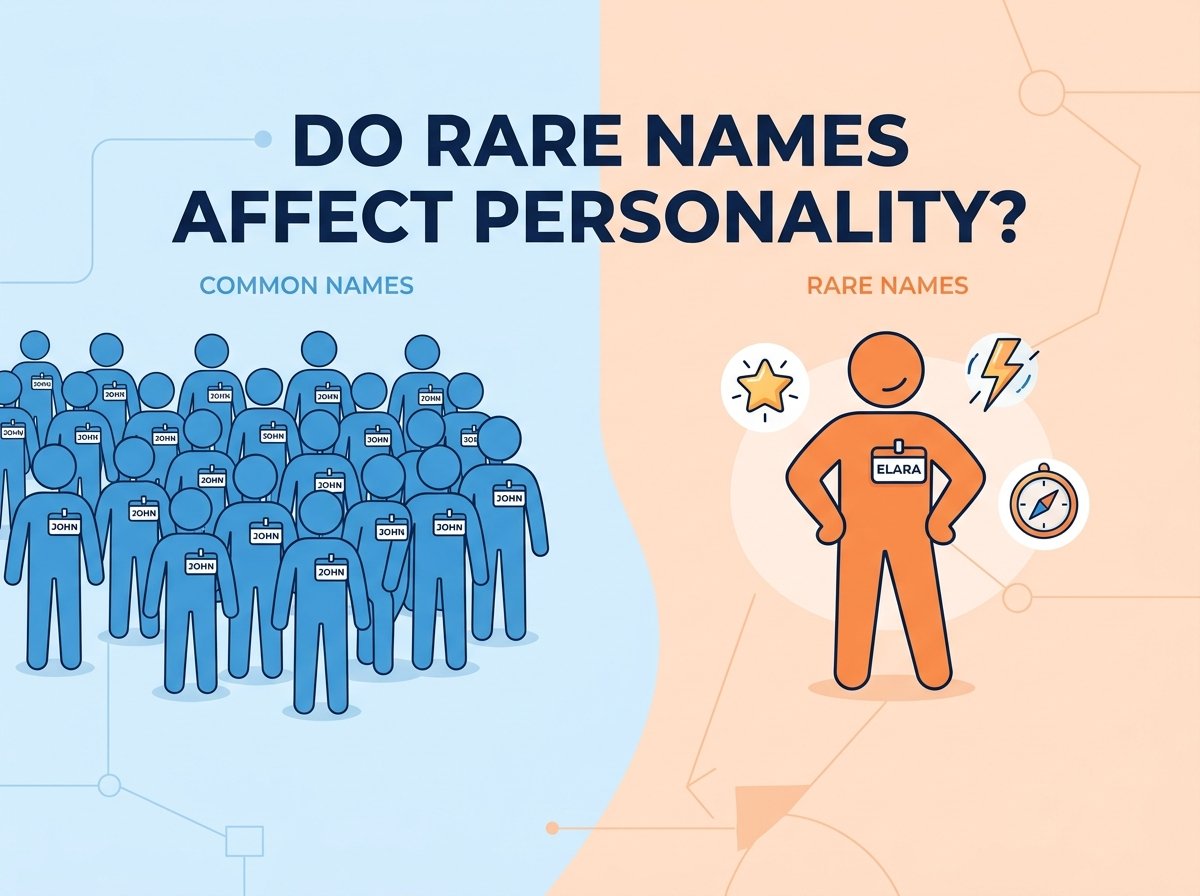
A boy named “Xavion” walks into a classroom full of Johns, Michaels, and Davids. Every head turns. The teacher pauses, double-checks the attendance sheet, and asks him to repeat his name — twice. That one moment, repeated hundreds of times throughout his life, quietly shapes how Xavion sees himself.
Your name isn’t just a label on a birth certificate. It’s the very first story the world tells about you — often before you even learn to walk. And if that name happens to be rare, that story gets a lot more interesting.
But here’s the real question: does carrying an uncommon name actually change who you become? Does it push you toward confidence or awkwardness, creativity or isolation? Parents who are thinking about choosing rare baby names for their child deserve honest answers, not just opinions.
Let’s break down what psychology, sociology, and real-life experience actually tell us about the connection between rare names and personality.
What Counts as a “Rare” Name, Anyway?
Before we talk about personality effects, let’s get clear on what “rare” actually means.
A name is generally considered rare if fewer than 5 people per million carry it in a given country. According to the U.S. Social Security Administration (SSA), thousands of names are registered each year that belong to fewer than 5 babies nationwide. Some names exist only a handful of times in the entire world.
Quick Fact: The SSA doesn’t even publish data on names given to fewer than 5 babies in a year — that’s how uncommon some names are.
Rarity can come from different sources:
- Invented names — Parents create a brand new name (like Renesmee, which Twilight fans popularized)
- Cultural names in a different country — A traditional Yoruba name in a small-town Kansas school
- Old-fashioned names — Victorian-era names that fell off the charts decades ago
- Unusual spellings — Turning “Ashley” into “Aeshleigh”
Understanding what makes a name rare or common helps you see why the effects on personality vary so much depending on the type of rarity involved.
The Psychology Behind Names and Identity
Your Name Is Your First Identity Marker
Psychologists have studied the “name-identity link” for over a century. The basic idea? Your name is the earliest and most persistent piece of your social identity. You hear it thousands of times before you turn five. It’s how people call you, greet you, and think about you.
Dr. David Figlio, a researcher at Northwestern University, published a study showing that names carry implicit signals — about race, socioeconomic background, and even perceived intelligence — and those signals affect how others treat the name-bearer from childhood onward.
When your name is rare, those signals become louder. People notice you. They form impressions before you’ve said a single word.
The Implicit Egotism Effect
There’s a fascinating concept in psychology called implicit egotism. People tend to gravitate toward things that resemble their own name. Someone named Dennis is statistically slightly more likely to become a dentist. A woman named Virginia might feel an unexplained pull toward living in Virginia.
Now imagine your name is truly one-of-a-kind. You don’t share it with a profession, a state, or even another person. That creates a unique psychological dynamic. You can’t “match” yourself to external patterns. You’re essentially starting from scratch — which can foster either deep individuality or a nagging sense of not fitting in.
Do Rare Names Actually Shape Personality Traits?
Here’s where it gets really interesting. Let’s look at what the research and real-world observations show us about specific personality traits linked to uncommon names.
1. Creativity and Divergent Thinking
Multiple studies suggest that people with unusual names tend to score higher on measures of divergent thinking — the ability to come up with multiple solutions to open-ended problems.
Why? Because growing up with a rare name forces you into “explain mode” constantly. You’re always spelling it out, telling the story behind it, and dealing with mispronunciations. That ongoing need to differentiate yourself encourages creative problem-solving from a young age.
Did You Know? A 2017 study published in the Journal of Social Psychological and Personality Science found that people with uncommon names were more likely to pursue unconventional career paths, including arts, entrepreneurship, and innovation-driven fields.
If you’re curious about the deeper psychology behind unique names, there’s a whole world of research worth exploring.
2. Self-Confidence (It Goes Both Ways)
This is where the picture gets complicated. Rare names can build extraordinary confidence — or they can chip away at it.
The confidence-building side: When a child with an unusual name receives positive attention — “What a beautiful name!” — they internalize the idea that being different is a strength. They learn early that standing out is okay. Many successful public figures with unusual names credit their distinctiveness as a source of pride.
The confidence-eroding side: Constant teasing, mispronunciation, and having to correct people gets exhausting. A child named “Seraphina” in a class full of Emmas might feel singled out in ways that aren’t always comfortable. Research from the University of California found that children who disliked their own names showed lower self-esteem scores on standardized psychological measures.
Pro Tip for Parents: The key factor isn’t the rarity itself — it’s how the people around the child react to it. Supportive environments turn rare names into confidence boosters. Hostile environments do the opposite.
3. Resilience and Thick Skin
Here’s a trait that comes up consistently in interviews and anecdotal research. People with rare names often develop remarkable resilience.
Think about it. If you’ve spent your entire childhood politely correcting substitute teachers, tolerating playground jokes, and explaining your name’s origin to every new person you meet, you’ve essentially been doing resilience training since kindergarten.
A 2019 survey by Nameberry (one of the largest baby name databases) found that 68% of adults with uncommon names said they felt the experience made them “tougher” and “more patient.”
4. Introversion vs. Extroversion
You might assume rare names push people toward introversion — after all, unwanted attention can make you want to hide. But the data tells a more nuanced story.
Some people with unusual names become more extroverted because they’re constantly in situations that require social interaction around their name. They’re forced to be outgoing, to break the ice, to tell the story.
Others retreat inward, especially if the attention they received was negative. A study from Appalachian State University found no strong statistical link between name rarity and introversion/extroversion overall — meaning both outcomes are equally possible depending on personal temperament and environment.
5. Sense of Individuality and Nonconformity
This one has the strongest evidence behind it. People with rare names consistently report a higher sense of individuality. They feel less pressure to conform to group norms, and they’re more comfortable being “the odd one out.”
Jean Twenge, a psychology professor at San Diego State University and author of Generation Me, tracked baby name data over decades and found that the trend toward unique names correlates with rising individualism in American culture. The names aren’t just reflecting individuality — they might be actively nurturing it.
The “Name Pronunciation” Effect on Social Interactions
There’s a less obvious way rare names affect personality: through how other people behave around you.
A 2012 study in the Journal of Experimental Social Psychology found that people with easy-to-pronounce names were judged more favorably — as more trustworthy, more likable, and more competent — than those with hard-to-pronounce names. The effect held true regardless of the actual ethnicity or background of the person.
This matters because if your rare name is also hard to pronounce, you’re fighting an uphill battle in first impressions. Over years, this can shape how you approach new relationships, job interviews, and social situations.
Warning: This doesn’t mean you should avoid rare names. It means you should be aware of pronunciation difficulty as a separate factor from rarity. A name can be rare AND easy to say — and that’s often the sweet spot.
If you’re wondering how names can even affect career outcomes, the pronunciation factor plays a big role there too.
Cultural Context Changes Everything
A name that’s rare in Ohio might be common in Lagos. A name that sounds exotic in London might be completely ordinary in Seoul. Cultural context is the invisible hand that shapes everything about this discussion.
Moving Between Cultures
Imagine a girl named Aisling (pronounced “ASH-ling”) — a perfectly normal Irish name. In Dublin, nobody blinks. In rural Texas, she spends her entire school life being called “AYE-sling” and explaining that it’s Gaelic for “dream.”
Same name, two completely different personality effects based purely on geography.
Immigrant Families and Name Identity
Children of immigrants often carry names from their parents’ home culture that are rare in their new country. Research from the Migration Policy Institute shows these children frequently develop a “dual identity” — navigating between their family’s cultural expectations and their peers’ norms. The name becomes a bridge, or sometimes a barrier, between two worlds.
This dual navigation can develop strong code-switching abilities, cultural intelligence, and adaptability — personality traits that are incredibly valuable in an increasingly connected world.
You can explore countries with the most unique naming traditions to see how dramatically culture shapes what’s considered “rare.”
Common Myths About Rare Names and Personality
Let’s clear up some misconceptions that pop up constantly in online discussions and even in some outdated research.
Myth 1: “Rare Names Cause Behavioral Problems”
This myth traces back to a widely misquoted 2009 study that found boys with unusual names were slightly more represented in juvenile justice systems. What most articles leave out? The researchers themselves cautioned that socioeconomic factors — not the names — were the likely cause. Lower-income families tend to choose more unusual names AND face systemic challenges that increase contact with the justice system.
The name didn’t cause the behavior. Correlation isn’t causation, and responsible researchers have debunked this myth repeatedly.
Myth 2: “Unique Names Make Kids Weird”
There’s zero scientific evidence that a rare name, by itself, causes odd behavior. What CAN happen is that a rare name becomes a focal point for bullying — and bullying, not the name, causes social difficulties. The name is the trigger, not the disease.
Myth 3: “People With Rare Names Hate Their Names”
Actually, the opposite is more common. A 2021 Nameberry survey found that 73% of adults with uncommon names said they liked their name and wouldn’t change it. The dislike was strongest during middle school years (no surprise there — middle schoolers find reasons to mock anything), but most people grew into appreciation by their twenties.
Myth 4: “Rare Names Are Just Parents Being Selfish”
This judgment pops up a lot on Reddit threads and parenting forums. But understanding why parents choose rare names today reveals thoughtful motivations — honoring heritage, expressing hope, commemorating loved ones, or simply wanting their child to feel special. Dismissing these choices as vanity is unfair and usually inaccurate.
What the Data Actually Shows: A Balanced View
Let’s pull all of this together into something practical.
What rare names CAN do:
- Create more opportunities for self-expression
- Build resilience through repeated social interactions about the name
- Foster a strong sense of individuality
- Encourage creative thinking and nonconformity
- Develop cultural pride (especially for heritage names)
What rare names CAN’T do:
- Guarantee any specific personality outcome
- Override parenting, environment, or genetics
- Cause mental health disorders on their own
- Determine career success or failure in isolation
What matters more than the name itself:
- How family members talk about the name
- How schools and peers respond
- The child’s own temperament
- Cultural context and geographic location
- Whether the name has personal meaning to the family
Real-Life Examples Worth Knowing
Elon Musk’s son, X Æ A-12 — This might be the most extreme example of a rare name in modern times. While it sparked global debate, it also highlighted how celebrity culture influences naming trends. Whether this name will affect his personality is impossible to know yet, but celebrity names that influence trends often trigger waves of imitation.
Condoleezza Rice — Named after the Italian musical term “con dolcezza” (with sweetness). She’s spoken publicly about how her unusual name shaped her confidence and sense of identity growing up in segregated Birmingham, Alabama.
Shia LaBeouf — His first name means “gift from God” in Aramaic. He’s talked in interviews about how his unusual name contributed to feeling like an outsider — a feeling he channeled into acting.
These examples show the same pattern: rare names don’t dictate personality, but they become part of the personality story.
Practical Advice for Parents Considering Rare Names
If you’re thinking about giving your child an uncommon name, here are some evidence-based tips:
Say it out loud — a lot. Can a teacher call it during attendance without stumbling? Can a 4-year-old spell it (roughly)?
Check for teasing potential. Kids are creative in cruel ways. Run the name through a “playground test” — what rhymes with it? What nicknames could emerge?
Give them a built-in backup. A natural nickname or shortened version lets the child choose how to present themselves. “Persephone” who goes by “Sephie” has options.
Research the meaning. Names with beautiful meanings give children a positive story to tell about themselves. That story becomes a psychological asset.
Consider the full name combination. A rare first name with a common surname (or vice versa) creates balance. You can check if your chosen name is truly unique to gauge where it falls on the rarity scale.
Think long-term. A name that sounds cute on a baby needs to also work on a 45-year-old lawyer, a grandmother, a CEO. Test it mentally across life stages.
FAQ Section
Does having a rare name make you more creative?
Research suggests a correlation, not a guaranteed cause. People with unusual names often develop stronger divergent thinking skills because they grow up explaining and differentiating themselves. A 2017 study in the Journal of Social Psychological and Personality Science supports this link. But creativity also depends heavily on upbringing, education, and personal interests — the name is just one piece of a much bigger puzzle.
Can a rare name cause social problems for a child?
The name itself doesn’t cause social problems. What can happen is that a difficult-to-pronounce or easily mockable name becomes a target for teasing, which then affects social development. The critical factor is the child’s environment — supportive schools, kind peer groups, and confident parents make a massive difference. Most adults with rare names report positive feelings about their names by their twenties.
Should I give my baby a unique name or stick with something common?
There’s no universally “right” answer. Rare names can foster individuality, confidence, and cultural pride. Common names offer ease of pronunciation, social blending, and fewer awkward moments. The best approach? Choose a name that has personal meaning to your family, passes the pronunciation test, and feels right for the child’s likely cultural environment. If you’re weighing both sides, understanding the common names vs. unique names debate can help you decide.
Do rare names affect job prospects?
Some research indicates that names difficult to pronounce may face unconscious bias during resume screening. A study by the National Bureau of Economic Research found that certain names triggered different callback rates in job applications. This isn’t about rarity alone — it’s about pronunciation ease and perceived cultural markers. Your name might open some doors and narrow others, but skills, experience, and networking ultimately matter more.
Are rare names becoming more common?
Yes — paradoxically, the trend toward unique names is making uniqueness itself more common. SSA data shows the top 10 most popular names now account for a smaller percentage of total births than ever before. Parents are spreading out across thousands of options rather than clustering around a few favorites. Name popularity changes dramatically over time, and right now, the overall direction favors diversity.
Your Name Is Just the First Chapter
Here’s what 15 years of researching this topic has taught me: your name influences your personality, but it doesn’t write it.
Think of a rare name like being born left-handed in a right-handed world. It shapes certain experiences. It creates specific challenges and advantages. It makes you more aware of something most people never think about. But it doesn’t define your intelligence, your character, or your future.
The real power isn’t in the name itself — it’s in the story you build around it. A child named “Zephyrine” who grows up hearing “your name means the west wind, and you were born to move through life with grace” carries a different psychological gift than one who just hears “ugh, why did your parents pick THAT?”
If you’re a parent wrestling with this decision, give your child a name that means something to you. Then give them the confidence to own it. That combination — a meaningful name plus a supportive environment — is where the real personality magic happens.
And if you’re someone living with a rare name right now? You’re already carrying something most people don’t: a built-in conversation starter, a story only you can tell, and a lifetime of practice at standing out. That’s not a burden. That’s a head start.