
Here’s something wild to think about. The name “James” has been a top 20 first name in the United States for over 100 years straight. But the surname “James”? It barely cracks the top 300 last names. Same exact word. Completely different popularity story.
Most people don’t stop to think about this, but first names and surnames play by entirely different rules. Your parents chose your first name — maybe they loved how it sounded, or a celebrity inspired them, or grandma insisted. But your surname? That was handed down through generations, shaped by migration, marriage, and history you had zero control over.
So why does “Emma” spike overnight while “Smith” stays number one for centuries? Why do first names ride waves of trends but last names barely budge? And what does this mean if you’re curious about how many people share your full name?
Let’s break this down — because once you understand the difference, you’ll never look at names the same way again.
How First Name Popularity Actually Works
First names are the “fashion” side of naming. Think of them like clothing trends. One decade everyone’s wearing bell-bottoms, the next it’s skinny jeans. First names follow a surprisingly similar cycle.
Parents Drive the Trend Machine
Every single year, millions of parents face the same decision: “What should we name this baby?” And that decision is influenced by dozens of factors happening right now — pop culture, social media, family traditions, and even political events.
The Social Security Administration (SSA) has tracked baby name data in the U.S. since 1880. Their records show a clear pattern: first names rise, peak, and fall with shocking regularity. A name like “Linda” dominated the 1940s and 1950s, then practically vanished from maternity wards by the 1980s. “Jennifer” owned the 1970s but feels dated to Gen Z ears today.
This happens because first names are chosen fresh with every single birth. Parents actively pick them. And human beings are wired to be influenced by what’s around them.
The Pop Culture Effect Is Real
When a hit movie, TV show, or celebrity explodes into mainstream culture, first name charts react almost immediately. After “Frozen” hit theaters in 2013, the name “Elsa” jumped 243% in popularity according to BabyCenter data. The name “Arya” shot up after Game of Thrones premiered.
You can explore more about why some names suddenly become popular — the patterns are honestly fascinating.
But here’s the thing about surnames: no movie, no celebrity, no trend can make millions of people suddenly change their last name. That distinction alone explains most of the difference.
The Lifecycle of a First Name
Most popular first names follow a predictable arc:
- Emergence: A handful of trendsetters start using an unusual name
- Growth: The name appears on “rising names” lists and gets attention
- Peak: Everyone knows multiple kids with this name
- Decline: Parents start avoiding it because it feels “too common”
- Dormancy: The name feels old-fashioned for a generation or two
- Revival: New parents rediscover it as “vintage” and the cycle restarts
This entire cycle can play out in 30–50 years. Some old-fashioned names are already making a comeback right now — names like Hazel, Theodore, and Pearl that your great-grandparents would recognize.
How Surname Popularity Works (Completely Different Game)
Now forget everything you just read about first names. Surnames operate on a totally different engine. They don’t ride trends. They don’t cycle. They move like glaciers — slowly, heavily, and mostly in one direction.
Surnames Are Inherited, Not Chosen
This is the fundamental difference. You don’t pick your last name the way you pick a first name. You inherit it. Your dad’s dad’s dad’s dad passed it down through a chain that might stretch back centuries.
Because surnames transfer automatically from generation to generation, their popularity rankings change at a glacial pace. “Smith” has been the most common surname in America for as long as records exist. It’s not going anywhere. Nobody is “trending” toward Smith — it’s just that the millions of Smiths keep having kids, and those kids are also Smiths.
According to the U.S. Census Bureau’s data, the top 10 surnames in 2000 and 2010 were almost identical. The same names — Smith, Johnson, Williams, Brown, Jones — just swapped minor positions. Compare that to first names, where the top 10 can completely transform within a single decade.
What Actually Changes Surname Rankings?
If trends don’t move surnames, what does? A few slow-burning forces:
Immigration patterns are the biggest driver. As new populations arrive in a country, they bring their surnames with them. The surname “Garcia” climbed from #18 in the 2000 Census to #6 by 2010 in the United States, reflecting decades of Hispanic immigration. “Nguyen” entered the top 40, driven by Vietnamese-American population growth.
Birth rate differences between ethnic and demographic groups also shift surname rankings over many decades. Families with higher average birth rates will slowly see their surnames climb.
Marriage practices play a role too. Traditionally, women adopt their husband’s surname, which can concentrate certain last names over time. Though this pattern is shifting — more women keep their maiden names today — the effect on surname stats takes generations to show up.
Did You Know? About 2.4 million Americans carry the surname “Smith.” That’s roughly the entire population of Houston, Texas — all sharing one last name. Curious about your own? Check how many people have your surname.
The Speed Factor — Trends vs. Traditions
Here’s a simple way to visualize the core difference:
First names move like social media trends. They can spike in months and fade in years. A single viral TikTok, a hit Netflix series, or a royal baby announcement can shift naming patterns almost overnight.
Surnames move like tectonic plates. Changes happen over decades or centuries. You won’t notice them in real-time, but zoom out far enough and the shifts are massive.
A Real-World Example
Let’s track two names to make this concrete.
First name: “Madison”
- Before 1985: Almost nobody named their daughter Madison
- 1984: The movie Splash featured a character named Madison
- 1985–1995: Steady climb on baby name charts
- 2000: Peaked at #2 most popular girl’s name in America
- 2020: Dropped to #26 and still falling
- Total journey from obscure to peak to decline: About 35 years
Surname: “Williams”
- 1850: Third most common surname in the U.S.
- 1900: Third most common surname in the U.S.
- 1950: Third most common surname in the U.S.
- 2000: Third most common surname in the U.S.
- 2020: Still third most common surname in the U.S.
- Total change over 170 years: Basically zero
That contrast tells you everything. First names are dynamic and reactive. Surnames are stable and resistant to change. Understanding how name popularity changes over time helps you see these patterns clearly.
What Makes a First Name Popular vs. What Makes a Surname Common
The reasons behind popularity are also completely different for first names and surnames. Let’s compare them side by side.
First Name Popularity Drivers
- Sound and aesthetics: Names with soft vowel sounds (Ava, Ella, Noah) tend to trend upward right now
- Cultural moments: Celebrity babies, fictional characters, historical events
- Generational rebellion: Parents avoiding names that feel “too old” or “too common” from their own generation
- Social media influence: Instagram, TikTok, and parenting forums spread name ideas faster than ever — read more about how social media influences baby names
- Meaning and origin: Some parents research deeply; others go purely by sound
- Uniqueness factor: Many modern parents specifically want a name that’s rare or uncommon
Surname Commonness Drivers
- Occupational origins: Smith (blacksmith), Miller (grain miller), Baker, Taylor, Carpenter — these surnames are common because those were common medieval jobs
- Patronymic origins: Johnson (son of John), Williams (son of William), Jackson — popular father names created popular surnames
- Geographic origins: Hill, Wood, Brooks, Lane — common landscape features became common surnames
- Population size of origin group: English-origin surnames dominate in the U.S. because English settlers arrived early and in large numbers
- Forced naming practices: Enslaved people in America were often given their enslaver’s surname, which concentrated certain last names heavily within Black communities
Pro Tip: The reason you know so many Smiths, Johnsons, and Williamses isn’t because those names are “trendy.” It’s because the source of those surnames — common occupations and common father names — was shared by millions of unrelated families centuries ago.
The Diversity Gap — First Names vs. Surnames
Here’s something that surprises most people: there’s a LOT more variety in first names than in surnames.
First Names Are Getting More Diverse
The SSA data shows a clear long-term trend. In 1950, the top 10 baby boy names accounted for about 28% of all male births. By 2023, the top 10 barely covered 8%. Parents today spread their choices across thousands of names instead of clustering around a few favorites.
This means your first name is increasingly likely to be somewhat distinctive. The most popular Gen Z names show this pattern — even the #1 name is chosen by a smaller percentage of parents than ever before.
Surnames Are Concentrated
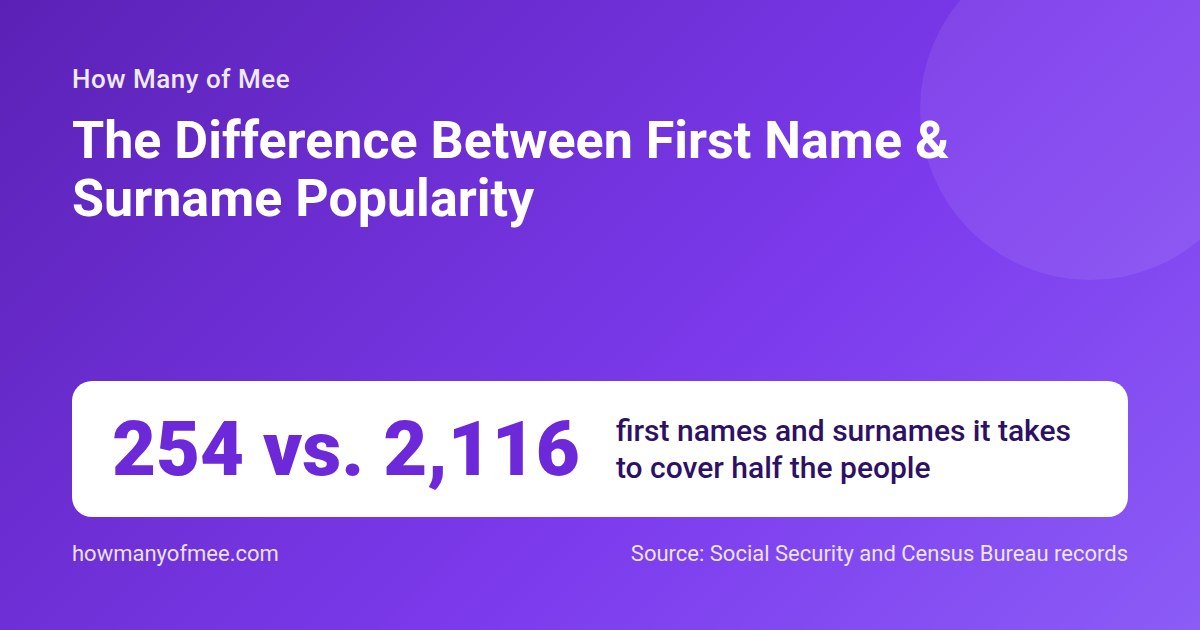
Surnames show the opposite pattern. A relatively small number of last names cover a huge chunk of the population. In the U.S., the top 1,000 surnames account for roughly 35% of the entire population. The top 150,000 first names would be needed to cover the same percentage.
In some countries, the concentration is even more extreme:
- Vietnam: About 40% of the population shares the surname “Nguyen”
- South Korea: Kim, Lee, and Park cover roughly 45% of all Koreans
- China: Wang, Li, and Zhang account for about 20% of 1.4 billion people
Compare that to first names in those same countries, where parents still choose from thousands of options for given names.
Wondering where your own last name falls? You can explore the most unique last names in America to see the other end of the spectrum.
Regional Differences — How Geography Shapes Both
Both first names and surnames vary by region, but for totally different reasons.
First Names and Regional Flavor
First name preferences shift from state to state, influenced by local culture, religious demographics, and ethnic composition. The name “José” consistently ranks high in Texas and California but barely registers in Vermont or Maine. Southern states tend to favor traditional names longer than coastal urban areas.
The most popular names in Texas look noticeably different from the most popular names in California, even though these states share a border.
Surnames and Regional History
Surname distribution maps tell the story of who settled where. The surname “Olson” clusters heavily in Minnesota and Wisconsin — Scandinavian settlement territory. “LeBlanc” dominates in Louisiana, reflecting French-Acadian heritage. “Garcia” is thickest in the Southwest, mirroring Mexican-American population centers.
These patterns are essentially frozen history. You can read a surname distribution map almost like a history book, tracing migration patterns from centuries ago. First name maps, by contrast, show you what’s trending right now.
Common Myths About Name Popularity
Myth #1: “Rare Last Names Mean Your Family Is Special or Royal”
Not necessarily. Some surnames are rare simply because the family was small, or the name got changed at an immigration checkpoint, or a spelling error on a census form created a new “unique” surname accidentally. A rare last name is interesting, but it doesn’t automatically signal noble ancestry.
Myth #2: “Popular First Names Have Always Been Popular”
People assume names like “Emma” or “Olivia” have been favorites forever. Actually, “Emma” was common in the 1880s, practically disappeared for 80 years, and then surged back in the 2000s. Names cycle. What feels timeless often isn’t.
You can trace these waves decade by decade with the most popular names by decade from 1950–2020.
Myth #3: “Your Surname Can’t Change in Popularity”
It can — just very slowly. Immigration, intermarriage, and differential birth rates do shift surname rankings. The rise of “Garcia” and “Rodriguez” in the American top 10 over the past 30 years is proof. It just happens on a timeline measured in decades, not months.
Myth #4: “If My First Name Is Common, My Full Name Must Be Common Too”
Not at all. Even if your first name is “John” and your last name is “Smith,” your specific combination might be shared by only a few hundred people. The math of combining two names creates huge variety. You can check how many people share your exact full name — the results usually surprise people.
Why This Difference Actually Matters
This isn’t just trivia. Understanding the gap between first name and surname popularity has real practical value.
For Parents Choosing Baby Names
If you want your child to have a distinctive full name, focus on the first name — that’s where you have control and where trends shift fast. Pairing an uncommon first name with a common surname (like “Seren Williams”) creates a unique identity even though the last name is everywhere.
Some parents specifically look for rare baby names to stand out, while others pick from trending lists. Either way, knowing that your surname is fixed helps you make smarter first-name choices.
For Genealogy Research
Surname popularity directly affects how easy (or frustrating) your ancestry research will be. Tracing the “Smith” family tree? Good luck — you’ll wade through millions of records. Tracing a rare surname like “Featherstonhaugh”? Much easier to pinpoint your specific branch.
For Personal Branding and Career
Your name combination affects online searchability. A “David Johnson” will struggle to build a unique Google presence, while an “Orion Blackwood” practically owns their search results. Your name can genuinely affect your career in ways most people underestimate.
For Data Scientists and Researchers
The science of name statistics treats first names and surnames as fundamentally different datasets. First name data is used to track cultural trends and immigration patterns in real-time. Surname data helps demographers study population genetics, migration history, and ethnic composition over centuries.
A Quick Side-by-Side Comparison
| Factor | First Names | Surnames |
|---|---|---|
| How you get it | Parents choose it | Inherited from family |
| Speed of change | Years to decades | Decades to centuries |
| Main influence | Culture, media, trends | Immigration, birth rates, history |
| Diversity | Growing rapidly | Relatively concentrated |
| Can you change it? | Informally, yes (nicknames) | Legally, yes, but rarely done |
| Regional variation | Moderate, trend-driven | Strong, history-driven |
| Data tracking | SSA tracks since 1880 | Census Bureau, less frequent |
| Predictability | Somewhat predictable cycles | Very stable, slow shifts |
FAQ Section
Do first names and surnames ever influence each other?
Yes, but it’s subtle. Sometimes a famous person’s surname becomes a trendy first name. Think “Kennedy,” “Reagan,” “Monroe,” or “Carter” — all originally surnames that crossed over into first-name territory. The reverse almost never happens. Nobody takes a popular first name like “Emma” and adopts it as their family surname.
Why do some countries have much less surname variety than others?
It depends on how surnames were historically assigned. In countries like Vietnam and South Korea, surnames were adopted from a small pool — often linked to royal dynasties or clan systems. In English-speaking countries, surnames developed from many sources (occupations, locations, father’s names, physical traits), creating wider variety. Cultural practices around naming simply produced different levels of concentration.
Can data predict which first names will be popular in the future?
To some degree, yes. Researchers at institutions like the Wharton School have studied naming patterns and found that sounds, letter patterns, and cultural shifts follow identifiable trends. Names ending in “-a” for girls and “-n” for boys have been climbing for years. AI-based tools are even starting to predict future baby name trends based on current data patterns. Surname prediction, by contrast, is mostly just demographic projection — far less exciting but far more accurate.
Is it true that some names exist only a handful of times in the entire world?
Absolutely. Both extremely rare first names and extremely rare surnames exist. Some names exist only a few times globally, making their holders essentially one-of-a-kind. This is more common with surnames that were created through spelling errors, immigration changes, or deliberate modification.
Your Name Tells Two Different Stories
Here’s what it all comes down to. Your first name tells people when you were born and what your parents valued. Your surname tells people where your family came from and what your ancestors did.
One name is a snapshot of a cultural moment. The other is a thread connecting you to centuries of family history. One changes with every generation’s whims. The other resists change like a mountain resists weather.
Both parts of your name carry weight, meaning, and a surprising amount of data behind them. The next time someone asks your full name, remember — you’re giving them two completely different stories in just a few syllables.
Want to see exactly how your own name stacks up? Find out how many people have your name in the world — and discover just how unique (or common) your personal name combination really is.
