Between 1997 and 2012, roughly 68 million babies were born in the United States alone — and their parents unknowingly participated in one of the most fascinating cultural experiments ever. They picked names. Names that would echo through classrooms, college campuses, TikTok bios, and job applications for decades.
If you’ve ever sat in a coffee shop and heard someone yell “Emma!” only to watch three heads turn — you already know what Gen Z naming trends look like in real life.
But here’s what most people don’t think about: why did certain names dominate this generation? What made parents across different states, backgrounds, and income levels gravitate toward the same handful of names? And which Gen Z names are so common that thousands of people share them?
That’s exactly what we’re breaking down here. You’ll get the full list of the most popular Gen Z names for both boys and girls, the cultural forces behind them, how name popularity has shifted over time, and a few surprises you probably didn’t expect.
Let’s get into it.
Who Exactly Is Gen Z?
Before we talk names, let’s be clear about who we’re talking about.
Gen Z refers to people born roughly between 1997 and 2012. That’s a 15-year window. As of 2025, they’re between 13 and 28 years old — a mix of teenagers, college students, and young professionals already making their mark.
This generation grew up during a very specific cultural moment:
- The rise of the internet became a household reality
- Social media platforms like YouTube (2005), Instagram (2010), and Snapchat (2011) launched during their formative years
- Pop culture was dominated by Harry Potter, the MCU, and reality TV
- 9/11 and the 2008 recession shaped their parents’ worldview
All of this matters because naming trends don’t happen in a vacuum. Parents’ anxieties, hopes, and cultural surroundings directly influence what they name their kids. Understanding why some names suddenly become popular gives you a much deeper appreciation of these patterns.
The Most Popular Gen Z Girl Names
The SSA (Social Security Administration) data from 1997–2012 tells a very clear story for girls’ names. A few names absolutely dominated year after year.
Top 15 Gen Z Girl Names
| Rank | Name | Peak Popularity Period |
|---|---|---|
| 1 | Emma | 2002–2008 |
| 2 | Emily | 1997–2005 |
| 3 | Madison | 1999–2004 |
| 4 | Olivia | 2001–2012 |
| 5 | Hannah | 1997–2004 |
| 6 | Abigail | 2001–2007 |
| 7 | Isabella | 2006–2012 |
| 8 | Sophia | 2008–2012 |
| 9 | Ava | 2005–2012 |
| 10 | Samantha | 1997–2003 |
| 11 | Ashley | 1997–2002 |
| 12 | Elizabeth | 1997–2006 |
| 13 | Alexis | 1999–2007 |
| 14 | Mia | 2008–2012 |
| 15 | Chloe | 2007–2012 |
What Patterns Stand Out?
Look at that list carefully. A few things jump out right away.
Soft, vowel-heavy sounds dominated. Emma, Olivia, Isabella, Ava, Mia — these names roll off the tongue. They feel warm. Approachable. Linguists call this the “sonority preference,” and Gen Z parents leaned into it hard.
Classic names made a strong comeback. Emma, Elizabeth, and Abigail are names with centuries of history. Parents didn’t want anything too experimental for their daughters. They wanted names that sounded timeless but still felt fresh.
The “Isabella effect” is real. When Stephenie Meyer’s Twilight series exploded in 2005, the name Isabella — and its nickname Bella — skyrocketed. By 2009, Isabella was the #1 girl name in America. That’s the power of celebrity and fictional character names becoming trending in real life.
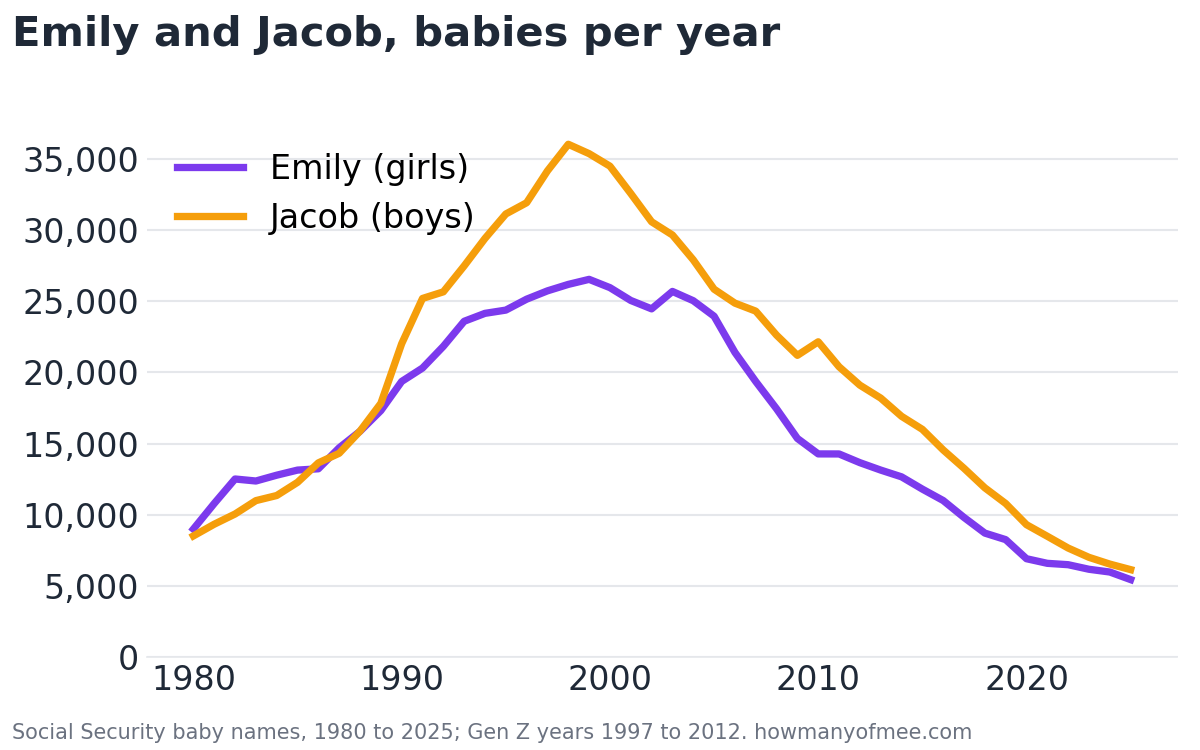
Did You Know? The name Emily held the #1 spot for girls for an incredible 12 consecutive years (1996–2007) according to SSA data. That’s the longest reign of any girl’s name in modern American history.
The Most Popular Gen Z Boy Names
Boys’ names during the Gen Z era tell a slightly different story. There’s more variety at the top, and the shifts happened faster.
Top 15 Gen Z Boy Names
| Rank | Name | Peak Popularity Period |
|---|---|---|
| 1 | Jacob | 1999–2012 |
| 2 | Michael | 1997–2003 |
| 3 | Ethan | 2002–2010 |
| 4 | Joshua | 1997–2005 |
| 5 | Matthew | 1997–2004 |
| 6 | Daniel | 1997–2008 |
| 7 | Andrew | 1997–2005 |
| 8 | Noah | 2008–2012 |
| 9 | Aiden | 2003–2011 |
| 10 | William | 2002–2012 |
| 11 | Liam | 2008–2012 |
| 12 | Alexander | 2001–2010 |
| 13 | Mason | 2009–2012 |
| 14 | James | 1997–2012 |
| 15 | Logan | 2000–2010 |
What’s Different About Boy Name Trends?
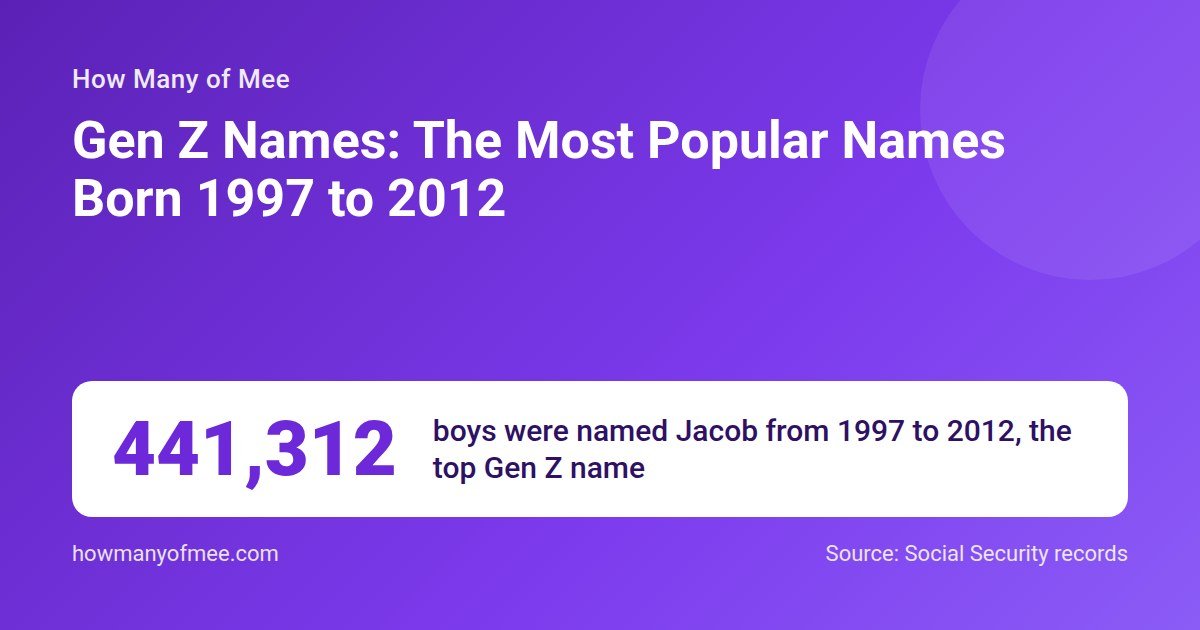
Jacob was the undeniable king. According to SSA records, Jacob held the #1 boy name position for 14 straight years (1999–2012). No other boy’s name even comes close to that streak in modern times. And yes, Twilight’s Jacob Black probably helped extend its run.
Biblical names stayed strong. Jacob, Joshua, Daniel, Noah, Matthew, Ethan — all have biblical roots. Unlike girls’ names, where trends shifted more toward softer modern sounds, boy names clung to traditional, strong-sounding roots.
The “-aiden” explosion. If you know more than one Aiden, Jayden, Brayden, Cayden, or Hayden — you’ve witnessed one of Gen Z’s most distinctive naming trends. This rhyming pattern became so widespread that some of these names are now considered the most overused baby names by newer parents.
Late-Gen Z saw a shift toward shorter names. Noah, Liam, and Mason — all rising sharply between 2008–2012 — are punchy, two-syllable names. This matches a broader trend toward simplicity that’s carried into Gen Alpha naming.
Pro Tip: Want to see how common your own name is? You can check how many people share your full name and get a better sense of where you stand.
Why Did These Specific Names Dominate?
Naming trends aren’t random. There are real, identifiable forces behind them. Here’s what drove Gen Z naming choices.
1. The TV and Movie Effect
Pop culture during 1997–2012 was a naming goldmine.
- “Friends” (1994–2004) gave us Emma — Ross and Rachel’s baby, born in a 2002 episode watched by over 34 million viewers. The name Emma had been climbing already, but that episode turbocharged it.
- “Twilight” saga (2005–2012) directly boosted Isabella, Jacob, and even Jasper and Rosalie.
- Disney influence: Characters from movies like Finding Nemo (2003) and later Disney princess films influenced names like Nemo, Elsa, and Moana — though these peaked more with Gen Alpha.
The connection between social media, pop culture, and baby name trends has only gotten stronger since then.
2. The “Safe But Special” Paradox
Most Gen Z parents were Millennials or late Gen Xers. These parents grew up in the 1970s and 1980s — a time when names like Jennifer, Jessica, Michael, and Christopher were everywhere.
Many of them experienced the frustration of being one of five Jennifers in their class. So they wanted something slightly different for their kids. But not too different. Not risky.
The result? They picked names that felt classic but weren’t their generation’s classics. Emma instead of Jennifer. Ethan instead of Jason. Old enough to feel legitimate, new enough to feel personal.
3. The Sound Shift
Linguists who study name trends noticed something specific about Gen Z names: a massive shift toward certain sounds.
- Hard “a” sounds became dominant in boys’ names: Jacob, Aiden, Mason, Alexander
- Soft endings (-a, -ia, -ah) dominated girls’ names: Emma, Olivia, Isabella, Sophia, Hannah
- The letter “L” became oddly popular: Liam, Logan, Lily, Luna, Layla
These aren’t coincidences. Parents unconsciously gravitate toward sounds that feel modern to their ear — and they’re all hearing the same cultural soundtrack.
4. Regional Variations Matter
While national lists give us the big picture, name popularity varies significantly by state. A name like José might rank in the top 10 in Texas and California but barely crack the top 100 in Vermont. Similarly, names popular in the South (like Mason or Hunter) had different adoption rates in the Northeast.
You can explore how name trends spread across different states to see just how much geography shapes naming.
Gen Z Names That Surprised Everyone
Not every popular Gen Z name was predictable. A few came out of nowhere.
Nevaeh
This name — “heaven” spelled backward — barely existed before 2001. Then a reality TV star mentioned it on air, and it rocketed into the SSA top 100 by 2003. By 2010, it was one of the most popular names for Black and Hispanic girls in the U.S. It’s a perfect example of how a single pop culture moment can create an entirely new naming trend from scratch.
Aiden (and All Its Variants)
The name Aiden was relatively uncommon in the U.S. before 2000. Its rise was partly driven by the TV show Sex and the City (Aidan Shaw, played by John Corbett). But once it caught on, parents started creating variants — Jayden, Brayden, Cayden, Hayden, Kayden — turning it into an entire naming family. Combined, the “-aiden” names would easily top any popularity chart.
Mason
Mason went from a barely-used name to a top-5 name in under a decade. Its rise coincided with celebrity influence (Kourtney Kardashian named her son Mason in 2009) and a broader trend toward strong, one-word occupational names.
Quick Fact: The name Madison wasn’t even in the top 1000 until the 1984 movie Splash, where Daryl Hannah’s mermaid character chose it from a street sign. By 2001, it was a top-3 girl’s name. That’s a 17-year rise from nonexistence to dominance.
Gender-Neutral Gen Z Names: A Growing Trend
One of the most interesting patterns in the Gen Z era was the quiet but steady rise of gender-neutral names. While this trend has exploded with Gen Alpha, its roots are firmly in the Gen Z period.
Names that gained popularity for both boys and girls during 1997–2012:
- Jordan — consistently popular for both genders throughout the period
- Taylor — peaked earlier but remained strong into the early 2000s
- Riley — started as primarily a boy’s name, then became more popular for girls
- Avery — similar trajectory to Riley
- Morgan — steady for both genders
- Quinn — rising sharply in the late Gen Z years
The shift toward gender-neutral names that are trending reflects broader cultural conversations about gender identity and expression. Gen Z parents (who are now naming Gen Alpha babies) are taking this even further.
Gen Z Names vs. Other Generations: What Changed?
Let’s put Gen Z names in context by comparing them to other generations.
Baby Boomers (1946–1964)
Top names: James, Robert, Mary, Linda
Vibe: Patriotic, simple, family-honoring
Gen X (1965–1980)
Top names: Michael, Christopher, Jennifer, Jessica
Vibe: Modern but mainstream, influenced by TV
Millennials (1981–1996)
Top names: Jessica, Ashley, Michael, Matthew
Vibe: Transition period — traditional meets trendy
Gen Z (1997–2012)
Top names: Emma, Olivia, Jacob, Ethan
Vibe: Classic revival with a modern twist
Gen Alpha (2013–present)
Top names: Liam, Noah, Olivia, Charlotte
Vibe: Short, international, influenced by streaming/social media
If you look at the most popular names by decade from 1950 to 2020, the pattern becomes clear: each generation reacts against the previous one’s naming choices while still being shaped by the same cultural forces.
Did You Know? The name “Karen” — once a top-10 name in the 1960s — dropped completely out of the top 1000 during the Gen Z naming years. Names carry cultural baggage, and parents are keenly aware of it.
Common Myths About Gen Z Names
Let’s clear up a few misconceptions that come up constantly.
Myth #1: “Gen Z names are all made up”
Reality: The most popular Gen Z names are actually more traditional than Millennial names. Emma, William, Elizabeth, and James are centuries old. The perception of weird Gen Z names comes from the tail end of the distribution — the creative spellings and unique names that get attention but don’t represent the majority.
Myth #2: “Every Gen Z kid has a unique name”
Reality: Name concentration actually remains high. In any given year during the Gen Z period, the top 10 names accounted for about 8–10% of all births. That means millions of Gen Z kids share the same first names. If you’re curious about the difference between common names vs. unique names, the data tells a more nuanced story than you’d expect.
Myth #3: “Unusual spellings make a name unique”
Reality: Spelling Jayden as “Jaydyn” or Chloe as “Khloe” doesn’t change the name’s popularity — it just fragments it across SSA data. When you combine all spelling variants, many “unique” names are actually incredibly common.
Myth #4: “Parents just copy celebrities”
Reality: Celebrity influence is real but overstated. Research from NameLab and academic studies shows that celebrity names work best when they align with existing sound trends. Beyoncé didn’t start a wave of Beyoncés. But Kourtney Kardashian’s “Mason” worked because short, strong single-syllable names were already trending upward.
What Happens When Your Gen Z Name Is Super Common?
Having a very popular name comes with real-world effects that go beyond just sharing your name with classmates.
Professional implications: HR managers and recruiters see certain names repeatedly. A 2023 LinkedIn analysis found that people with extremely common names often add middle initials, credentials, or location identifiers to stand out. There’s actually research on whether your name can affect your career — and the findings are pretty eye-opening.
Social media challenges: Try finding “Emma Johnson” on Instagram. You’ll get thousands of results. Gen Z kids with popular names have become experts at creating unique usernames — which partly explains the trend of using middle names, initials, or completely made-up handles.
Identity and self-expression: Many Gen Z individuals with common names actively lean into nicknames, middle names, or online personas to differentiate themselves. The psychology behind unique names suggests that people with common names are actually more likely to seek out unique forms of self-expression in other areas.
Gen Z Naming Trends by Cultural Background
Gen Z is the most ethnically diverse generation in U.S. history, and naming trends reflect that diversity.
Hispanic/Latino Families
Names like Sofia, Isabella, Diego, Mateo, and Santiago surged during this period. The crossover between English and Spanish naming conventions became much more fluid. Isabella, for example, was popular across virtually all demographic groups.
African American Families
The tradition of creative, distinctive naming continued strong in Black communities. Names like Aaliyah (boosted by the singer), Jayden, Imani, and Zion became widely popular. Unique names — sometimes with specific family or cultural significance — remained more common in Black families than in white families.
Asian American Families
Many Asian American Gen Z kids received both an English name and a traditional family name. Emily, Grace, Kevin, and Justin were especially popular as English names among Chinese and Korean American families, while names like Priya, Arjun, and Ananya remained strong in Indian American households.
The SSA Data: How We Actually Know This Stuff
Every claim about name popularity comes from one primary source: the Social Security Administration’s baby name database. Since 1880, the SSA has tracked every name given to at least 5 babies in a given year.
Here’s what makes this data so useful:
- It covers virtually every birth in the U.S. (since Social Security numbers are near-universal)
- It’s broken down by year, state, and gender
- It’s publicly available and free to search
But it has limitations too. The SSA data doesn’t capture spelling variants under one umbrella. “Sophia” and “Sofia” are counted separately. And it doesn’t track nicknames — so a child officially named “William” who goes by “Liam” appears under William in the data.
For a deeper look at the methodology, you can check out the science of name statistics and how researchers actually use this information.
Are Gen Z Names Already Becoming “Dated”?
Here’s something worth thinking about: names carry generational markers. Just like hearing “Brenda” or “Gary” immediately makes you think of Baby Boomers, and “Jennifer” or “Jason” screams Gen X — Gen Z names will eventually sound “old” too.
It’s already starting to happen. Newer parents (late Millennials and early Gen Z having kids now) are actively avoiding names like:
- Madison — peaked in 2001, now feels firmly “early 2000s”
- Jayden/Brayden — the “-aiden” trend is considered oversaturated
- Ashley — already on a steep decline since 2005
- Kayla — feels specifically late ’90s
Some analysts track millennial names that are disappearing — and many early Gen Z names are following the same downward trajectory.
But other Gen Z names have serious staying power. Olivia, Liam, Noah, and Emma continue to rank high even in 2024–2025 data, suggesting they’ve crossed from “trendy” into “timeless.”
Pro Tip: If you’re choosing a baby name right now and want to avoid picking something that’ll feel dated in 10 years, look at names that have been steadily popular for 20+ years rather than ones that spiked suddenly. The spikes are the ones that age fastest.
FAQ Section
What are the top 5 most popular Gen Z girl names?
Based on SSA data spanning 1997–2012, the top 5 most popular Gen Z girl names are Emma, Emily, Madison, Olivia, and Hannah. Emma and Emily traded the #1 spot multiple times during this period, with Isabella surging toward the end of the Gen Z birth years thanks to the Twilight franchise’s influence.
What’s the most popular Gen Z boy name of all time?
Jacob holds the crown. It was the #1 boy’s name in America for 14 consecutive years (1999–2012), which is an unprecedented streak in SSA records. Michael, which dominated for much of the 20th century, still ranked high in early Gen Z years but couldn’t compete with Jacob’s remarkable run.
Are Gen Z names different from Gen Alpha names?
Yes, but the transition is gradual rather than sudden. Gen Alpha (born 2013–present) has seen the continued dominance of Liam and Olivia, but newer names like Charlotte, Amelia, Theodore, and Elijah are rising. Gen Alpha naming also shows a stronger preference for old-fashioned names making a comeback — think Hazel, Eleanor, Henry, and Arthur — which were far less common during the Gen Z period.
Why do Gen Z names all sound similar?
They don’t all sound similar — but the most popular ones do share certain phonetic traits. Soft vowels, two-to-three syllables, and melodic sounds dominate both the boys’ and girls’ lists. This happens because parents unconsciously respond to the same sound trends. When one “Ava” gets popular, it primes the ear for “Eva,” “Mia,” and “Ella.” Naming trends work like ripples in a pond — one name creates a whole sound family.
Can I find out how many Gen Z kids share my name?
Absolutely. The SSA database lets you search by year and name. You can also use tools to find out how many people have your name in the world — which gives you a broader perspective beyond just U.S. births.
What Gen Z Names Tell Us About Who We Are
Names are tiny time capsules. Every Emma born in 2003 carries a subtle imprint of early-2000s America — the cultural mood, the TV shows parents watched, the sounds that felt right in that specific historical moment.
Gen Z’s most popular names reflect a generation of parents who wanted the best of both worlds: tradition and individuality, safety and softness, strength and approachability. They picked Emma over Gertrude. They chose Ethan over Hubert. They wanted names that would age well, travel well, and sound good on both a playground and a resume.
And now those Gen Z Emmas, Jacobs, Olivias, and Noahs are the ones filling out job applications, launching startups, and — increasingly — picking names for their own kids.
The cycle continues. And if history tells us anything, whatever Gen Z parents choose for their children will be a quiet rebellion against their own generation’s favorites — while still sounding strangely familiar.
If you’re a Gen Z kid (or parent of one) curious about your name’s rarity or popularity, go ahead and check if your name is truly unique. You might be surprised by what you find.