
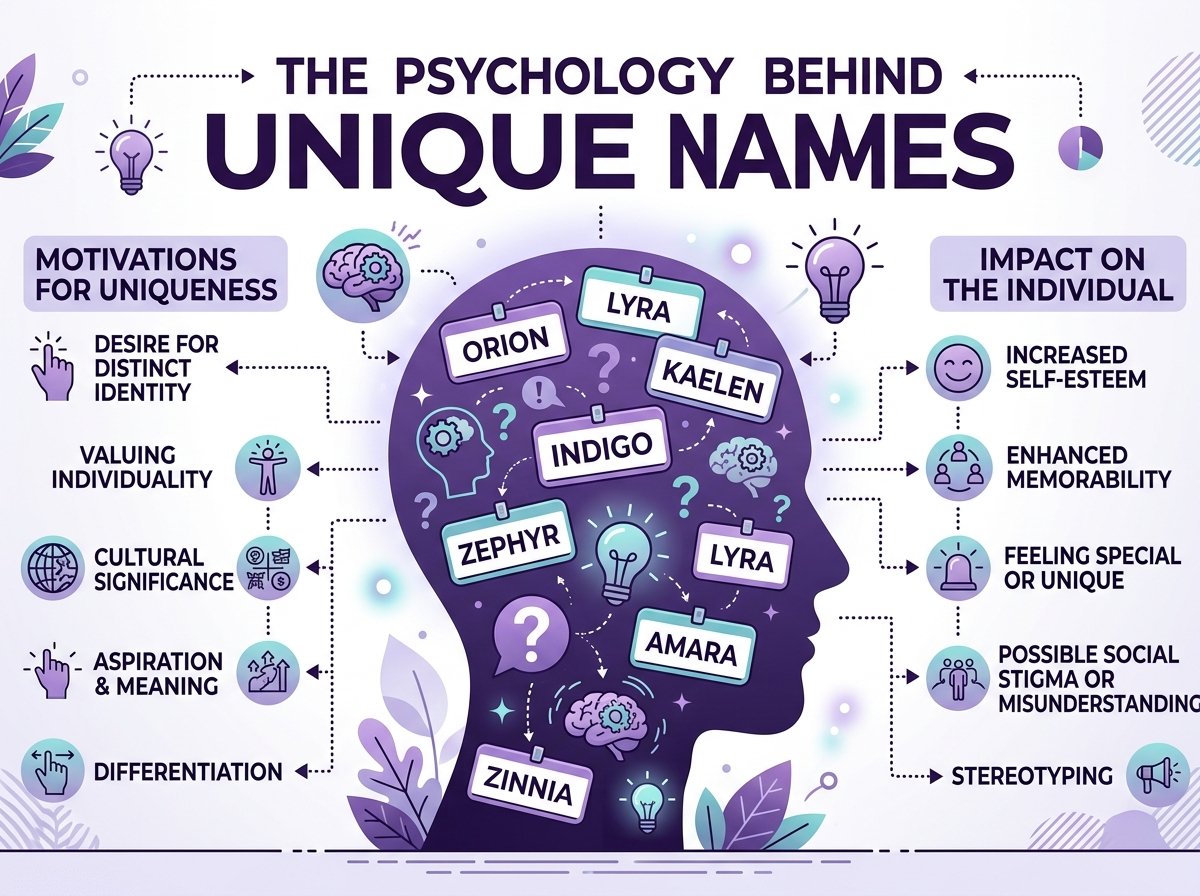
A 2023 study from the Journal of Personality and Social Psychology found something fascinating — people with uncommon names tend to develop a stronger sense of individuality by their teenage years. That single finding opens up an entire world of questions. Does your name actually shape who you become? Can a name that’s hard to pronounce hold someone back, or does it push them forward?
Here’s the thing. Your name is the very first label the world gives you. Before you walk, talk, or form a single opinion, your name is already doing psychological work — both on you and on everyone who hears it.
Whether you’re a parent agonizing over a baby name, someone curious about why parents choose rare names today, or a person who’s always felt different because of their own unusual name, this article is for you. We’re going to unpack what psychology, neuroscience, and sociology actually tell us about unique names — and you might be surprised by what the research reveals.
What Makes a Name “Unique” in Psychological Terms?
Before we get into the psychology, let’s clarify something. “Unique” doesn’t just mean weird or unheard of. Psychologists look at name uniqueness on a spectrum.
A name can be unique because it’s:
- Extremely rare (fewer than 100 people in the country share it)
- A creative spelling of a common name (like “Jaxyn” instead of “Jackson”)
- Borrowed from another culture or language
- Completely invented by the parents
- An old-fashioned name that’s fallen out of use
The Social Security Administration (SSA) in the U.S. tracks baby name data going back to the 1880s. If a name doesn’t appear in at least 5 births in a given year, it doesn’t even make it into their records. That’s one baseline for rarity. You can explore what actually makes a name rare or common to understand these patterns better.
Quick Fact: According to SSA data from 2024, roughly 27% of babies now receive names that fall outside the top 1,000 — a number that’s been climbing steadily since the 1990s.
Psychologically, the “uniqueness” of a name is also relative. A name like “Priya” might be extremely common in India but feel highly distinctive in a small town in Iowa. Context matters enormously, and researchers always account for the social environment around a name.
The Identity Effect: How a Unique Name Shapes Who You Are
Names as Identity Anchors
Psychologist Jean Twenge, known for her research on generational differences, has argued that the rise of unique baby names tracks closely with a broader cultural shift toward individualism. Parents aren’t just naming a child — they’re making a statement about that child’s identity before the child can even speak.
And that statement sticks.
Your name becomes what psychologists call an “identity anchor.” It’s the first piece of self-concept you internalize. By age 3 or 4, children recognize their name as deeply personal. By age 7 or 8, they start forming opinions about whether they like their name or not. And those opinions ripple outward into self-esteem, social behavior, and even career ambitions.
The “Name-Letter Effect”
Here’s a weird one. Research by psychologist Jozef Nuttin back in the 1980s discovered that people have an unconscious preference for the letters in their own name. This is called the Name-Letter Effect, and it’s been replicated across dozens of cultures and languages.
People with unique names often have unique letters or combinations in their names. Some researchers suggest this creates a subtly different relationship with language itself — a quiet, almost invisible reminder that “I’m different.”
Unique Names and the Need to Explain
If you’ve got a name like “Zephyrine” or “Caius,” you’ve probably spent a lifetime explaining it. Spelling it out on the phone. Correcting pronunciations. Watching people’s eyebrows go up.
That repeated experience does something to your psychology. It forces self-awareness early. Kids with unusual names learn to “present” themselves — to tell a mini-story about who they are — much earlier than kids named Emma or James.
Pro Tip for Parents: If you’re choosing a unique name, prepare your child with a positive narrative about it. “Your name means ___” or “We chose it because ___” gives them a story to tell with confidence, not embarrassment.
What Science Says: Do Unique Names Help or Hurt?
This is the big question. And honestly, the answer is complicated — because research points in both directions.
The Case FOR Unique Names
1. Stronger sense of individuality
A 2009 study in the journal Social Psychological and Personality Science found that people with uncommon names scored higher on measures of personal uniqueness and creative self-expression. They literally saw themselves as more distinct from the crowd.
2. Increased creativity
Some research suggests that having a name that doesn’t fit the norm primes people to think outside the box. If your name is already “different,” the psychological barrier to being different in other ways is lower.
3. Memorability advantage
In professional settings, a distinctive name can actually be an asset. Recruiters and colleagues are more likely to remember a “Zara” than a “Sarah” — assuming the name is easy enough to pronounce. This memorability can affect your career in subtle but real ways.
The Case AGAINST Unique Names
1. The “weird name” stigma
Let’s be honest. Research from 2017 published in the British Journal of Psychology showed that people make snap judgments about names. Names perceived as “too unusual” or “trying too hard” can trigger negative first impressions — even before the person is met.
2. Mispronunciation fatigue
Constantly correcting people is exhausting. A study conducted by researchers at NYU found that people whose names are frequently mispronounced report lower feelings of belonging in new social groups. This effect is especially strong in childhood and adolescence.
3. Implicit bias in hiring
This is a well-documented problem. A landmark study by Marianne Bertrand and Sendhil Mullainathan (2004) showed that resumes with “white-sounding” names received 50% more callbacks than identical resumes with “Black-sounding” names. Name uniqueness intersects with race, ethnicity, and class in ways that carry real economic consequences.
⚠️ Important Note: The bias isn’t the name’s fault — it’s the system’s fault. But it’s a reality that parents, especially from marginalized communities, often have to weigh.
The Parent’s Psychology: Why Do People Choose Unique Names?
Let’s flip the lens. What drives a parent to choose a name nobody else has?
The Desire for Distinctiveness
Psychologist Jonah Berger, author of Invisible Influence, explains that people constantly balance two competing needs: the need to belong and the need to be unique. Baby naming sits right at this intersection.
Parents who lean toward unique names are often expressing what Berger calls “optimal distinctiveness.” They want their child to stand out — but not so much that the child becomes an outcast. It’s a tightrope.
Social Media and the “Brandification” of Names
Here’s a modern twist. In 2025, parents are increasingly thinking about their child’s future online presence. A unique name means a unique Google search result. It means an available Instagram handle. It means your kid won’t be confused with 47 other “Michael Johnsons” on LinkedIn.
This “social media influence on baby names” phenomenon has genuinely changed naming patterns. Parents are, sometimes unconsciously, treating their child’s name like a personal brand.
Cultural and Spiritual Motivations
In many cultures, names carry spiritual weight. A name might be chosen through prayer, consultation with elders, or astrological calculations. The psychology here isn’t just about standing out — it’s about connection to heritage, meaning, and identity.
For example, in many African cultures, children are named based on the day of the week they’re born or the circumstances surrounding their birth. These names are unique in a Western context but deeply traditional in their own culture. You can see how different countries approach unique naming across the globe.
Parental Narcissism — A Controversial Theory
Some psychologists have proposed a more uncomfortable theory: that choosing a very unusual name is sometimes a form of parental narcissism. The parent is using the child’s name to signal their own creativity, taste, or status.
Did You Know? A 2013 study in Social Psychological and Personality Science found a modest but statistically significant correlation between parents who scored high on narcissism measures and the likelihood of choosing an unusual baby name. But — and this matters — correlation isn’t causation. Most parents who pick unique names are simply trying to give their child something special.
The “Name Pronunciation” Effect on Social Belonging
This deserves its own section because it’s one of the most practical, real-world consequences of having an unusual name.
Easy vs. Hard to Pronounce
Psychologist Adam Alter from NYU has studied what he calls “processing fluency” — how easily our brains can process information. Names that are easy to pronounce, regardless of how common they are, trigger more positive feelings in the listener.
This means a unique name like “Kai” (short, clear, phonetically simple) will generally be received more warmly than “Xochitl” (beautiful, meaningful — but challenging for English speakers).
The Belonging Gap
When someone repeatedly hears their name mangled, it creates what psychologists call a “micro-exclusion.” Each mispronunciation sends a tiny signal: You don’t quite fit here. Over time, these micro-exclusions add up.
Research from a 2020 study at Stanford found that students whose names were consistently mispronounced by teachers reported feeling less connected to their school, even when the teachers were otherwise warm and supportive.
What Can You Do?
- If you have a hard-to-pronounce name, a phonetic guide in your email signature or LinkedIn profile helps
- If you’re meeting someone with an unfamiliar name, ask once, listen carefully, and practice it
- Parents can choose names that are meaningful and phonetically accessible in their primary community
Unique Names and Personality: Is There a Real Link?
People love to ask: do rare names actually affect personality? The honest answer requires some nuance.
The “Implicit Egotism” Theory
Psychologist Brett Pelham’s research on “implicit egotism” suggests people are unconsciously drawn to things that resemble their names. People named Dennis are slightly overrepresented among dentists. People named Louis are slightly more likely to live in St. Louis.
While these effects are small and debated, the underlying idea is real — your name subtly influences your sense of self, and that sense of self influences your choices.
Unique Names → Unique Behavior?
A 2021 study from the University of Pennsylvania found that children with uncommon names were slightly more likely to exhibit non-conformist behavior in school — not in a negative way, but in terms of creative problem-solving and willingness to disagree with the majority.
The researchers proposed two explanations:
- Selection effect: Parents who choose unusual names may raise children with values that encourage independence
- Name effect: The name itself, through repeated social feedback, trains the child to be comfortable with being “different”
Most likely, it’s a combination of both.
The Self-Fulfilling Prophecy of Names
Here’s where things get really interesting. There’s a psychological concept called the Dorian Gray Effect — the idea that your name can create expectations, and you gradually grow into those expectations.
If your name sounds strong, people treat you as strong. If it sounds creative, people expect creativity. Over years and decades, these expectations shape behavior.
A person named “Maverick” might internalize the rebellious, independent spirit associated with that word. A person named “Serenity” might unconsciously develop calmer behavioral patterns. The evidence for this is still emerging, but the theoretical framework is solid.
Common Myths About Unique Names — Debunked
Myth 1: “Kids with unusual names get bullied more”
Reality: Bullying research shows that name-based teasing is common for all names — not just unusual ones. Kids named “Richard” get teased just as much as kids named “Zephyr,” just for different reasons. The risk factor isn’t the name — it’s the child’s social environment and support system.
Myth 2: “Unique names mean parents are uneducated”
Reality: Actually, research from the U.S. and U.K. shows that highly educated parents are more likely to choose unusual names. They tend to pull from literature, history, mythology, and foreign languages. The assumption that unique names signal low education is a bias, not a fact.
Myth 3: “A unique name will hold your child back professionally”
Reality: This is partially true (because of hiring bias), but the effect diminishes significantly once a person is in the door. And in creative, entrepreneurial, or public-facing careers, a distinctive name can actually be an advantage. Many professionals also discover that certain names sound rich or successful due to cultural associations — not actual merit.
Myth 4: “You should always choose a safe, common name”
Reality: “Safe” names come with their own psychological cost — anonymity. People with extremely common names sometimes struggle with feeling interchangeable or unremarkable. There’s a clear tension between common names and unique names that every parent navigates differently.
The Cultural Shift: Why Unique Names Are More Popular Than Ever
The Individuality Economy
We’re living in an era where personal branding is currency. From TikTok handles to startup names, being distinctive is valued. This cultural backdrop makes unique names feel less risky and more desirable than they did in the 1950s or 1960s, when conformity was the dominant social norm.
You can see this shift clearly when you look at most popular names by decade from 1950 to 2020. The concentration at the top has dropped dramatically. In 1950, the top 10 names accounted for a huge percentage of all births. By 2020, the distribution had flattened out massively.
Globalization and Name Borrowing
Parents today have access to names from every culture on earth. A family in Ohio might name their daughter “Anara” (Kazakh origin). A couple in London might choose “Bodhi” (Sanskrit). This cross-cultural borrowing has expanded the pool of “acceptable” unique names enormously.
Celebrity Influence
Let’s not pretend this isn’t a factor. When Elon Musk named his child X Æ A-12 (later modified to X Æ A-Xii), it generated global conversation about naming norms. Celebrity naming choices — from Apple (Gwyneth Paltrow) to North (Kim Kardashian) to Blue Ivy (Beyoncé) — have pushed the boundaries of what people consider “normal.” Check out how celebrity names become trending to see this effect in action.
Practical Advice: Choosing a Unique Name Wisely
If you’re a parent considering a unique name for your child, here’s what psychology research actually suggests:
✅ Do:
- Choose a name with clear pronunciation — uniqueness doesn’t require confusion
- Give your child a positive story behind the name
- Consider how the name works across contexts (school, work, travel)
- Check how many people already share that name to gauge true rarity
- Think about nicknames — a long unique name with an easy short form gives your child flexibility
❌ Avoid:
- Names that are intentionally misspelled for no reason (it adds lifelong hassle with zero benefit)
- Names that sound like jokes or puns when combined with your surname
- Choosing a name purely for shock value
- Ignoring how the name will function in your child’s actual daily environment
Pro Tip: Say the full name out loud — first, middle, and last — 10 times. Imagine a teacher calling it during attendance. Imagine a CEO introducing themselves with it. If it works in both scenarios, you’ve probably found a winner.
FAQ Section
Does having a unique name make you more confident?
Not automatically. Research shows that children with unique names who receive positive reinforcement about their name tend to develop higher confidence. But a unique name alone doesn’t create confidence — the narrative around the name matters more. If parents frame the name as special and meaningful, the child internalizes that positivity.
Can a unique name affect your chances of getting hired?
Yes, but the effect is more about bias than about the name itself. Studies show that names associated with certain racial or ethnic groups face discrimination in hiring. For names that are unique but culturally “neutral,” the effect is much smaller. Once you’re past the resume stage, a distinctive name can actually help you stand out positively.
Are unique names more popular now than in the past?
Absolutely. SSA data shows a clear trend: the percentage of babies receiving top-100 names has been declining since the 1980s. Parents today are drawing from a wider pool of names, influenced by global culture, social media, and a growing comfort with individuality. The way name popularity changes over time tells a fascinating story about shifting cultural values.
Do people with unique names have different personalities?
Research suggests modest effects. People with uncommon names tend to score slightly higher on measures of openness and non-conformity. But these are tendencies, not guarantees. Your name is one of hundreds of factors shaping your personality — genetics, upbringing, environment, and personal experiences all play much larger roles.
Is it better to give a child a unique or common name?
There’s no universal answer. The “best” name depends on your cultural context, your values, and the specific name you’re considering. Psychology doesn’t say unique is better or worse — it says the fit between the name, the child, and the environment is what matters most.
Your Name Is Your First Story
Every name carries weight. A common name connects you to a shared identity, a sense of belonging, a cultural tribe. A unique name sets you apart, gives you a story to tell, and signals that someone — your parents — saw you as one of a kind before you even opened your eyes.
The psychology behind unique names isn’t about good or bad. It’s about understanding how deeply a name can shape perception, identity, and life experience. And whether your name is shared by millions or belongs to only you, the most powerful thing you can do is own it.
Curious about your own name’s rarity? You can check if your name is truly unique and find out exactly where you stand. Because understanding your name is, in a very real way, understanding a piece of yourself.