
How Name Trends Spread Across States

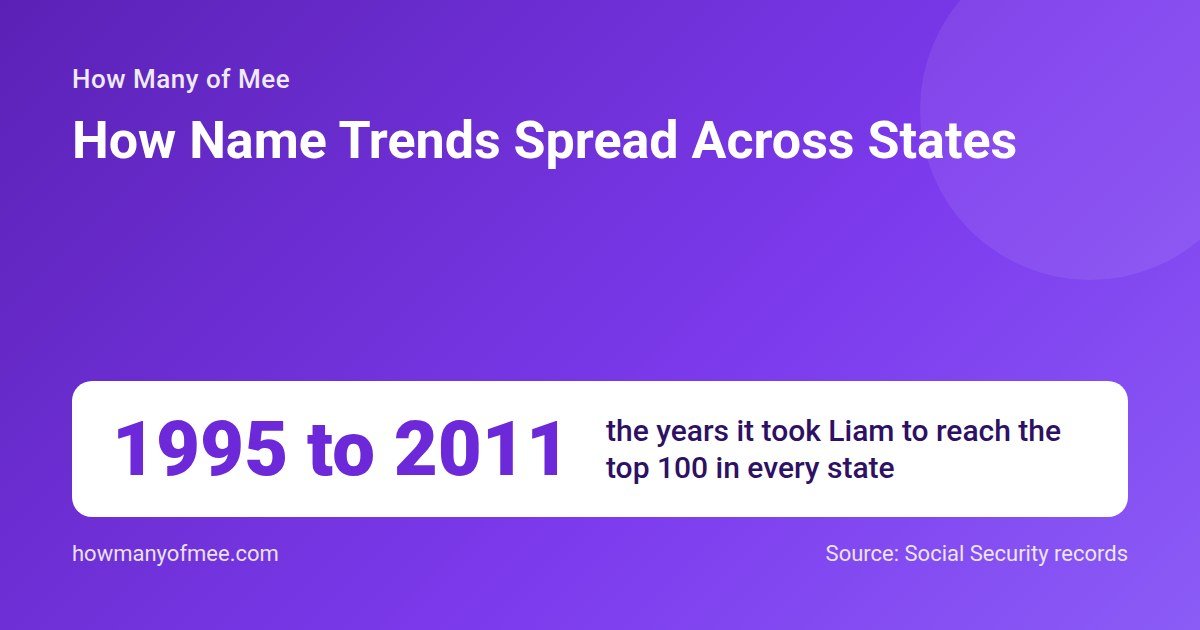
A baby named Liam is born in California. Two years later, Liam tops the charts in Ohio, Tennessee, and Maine. Coincidence? Not even close.

Baby names travel like weather patterns — they start in one region, pick up speed, and slowly roll across the entire country. Sometimes this takes a decade. Sometimes it happens in a single year thanks to a viral TikTok video or a hit Netflix show.

Here’s what most people don’t realize: your “unique” baby name choice probably started trending in another state 3-5 years before it reached yours. The Social Security Administration (SSA) data shows clear patterns of how names hop from coastal cities to the heartland, or sometimes travel the opposite direction.

If you’ve ever wondered how name popularity changes over time, you already know that names rise and fall. But the geographic journey of a name? That’s a whole different story — and a fascinating one.

Let’s break down exactly how this happens, why certain states lead naming trends, and what forces push a name from one corner of the country to another.


How Baby Names Actually Travel: The Geography of Naming

Think about the last time a new restaurant chain opened in your town. Chances are, it existed in New York or Los Angeles years before it reached you. Baby names work the same way.

Researchers at the University of Edinburgh studied SSA data going back decades and found something striking: names follow predictable geographic paths. A name doesn’t just randomly pop up everywhere at once. It spreads — almost like a wave — from specific origin points.

The Coastal-to-Inland Pattern

The most common pattern looks like this:

  • A name gains popularity in California or New York
  • It spreads to neighboring states within 2-3 years
  • Midwestern states pick it up 3-5 years later
  • Southern and rural states adopt it 5-7 years later

Take the name Mason, for example. It started climbing the ranks in Oregon and Washington around 2005. By 2008, it was popular in Colorado and Arizona. By 2011, it was the #2 name nationally. The entire journey from regional favorite to national sensation took roughly six years.

This pattern isn’t random. It follows population migration routes, media market overlap, and cultural connectivity between regions.

The Reverse Pattern: Southern Names Moving North

Not every name starts on the coasts. Some names originate in the South and travel northward.

Brantley is a perfect example. It showed up in Georgia and Alabama birth records years before parents in Michigan or Pennsylvania considered it. Country music culture, Southern lifestyle content on social media, and migration patterns all pushed it northward.

Names tied to specific regional cultures often follow this reverse path. If you’re curious about why some names suddenly become popular, regional cultural influence is one of the biggest reasons.


The “Trendsetter” States: Who Leads and Who Follows?

Not all states play the same role in naming trends. Some states consistently lead, while others consistently follow. The data makes this very clear.

States That Start Trends

California is the single biggest trendsetter for baby names in the U.S. There are solid reasons for this:

  • Largest population (more than 39 million people)
  • Extreme cultural diversity
  • Entertainment industry influence
  • High immigration bringing global name influences
  • Tech culture that values innovation — even in names

New York comes in second, largely because of its media influence and immigrant communities that introduce names from dozens of cultures.

Oregon and Washington often lead trends for nature-inspired and gender-neutral names. Names like Sage, River, and Rowan showed up in Pacific Northwest birth records years before they went national. The growing popularity of gender-neutral names that are trending often traces back to this region.

Texas is interesting because it acts as both a trendsetter AND a trend follower. Its massive Hispanic population introduces Spanish-origin names that spread nationwide, while it also picks up coastal trends faster than most Southern states. You can explore the most popular names in Texas to see this dual role in action.

States That Follow Trends

Some states consistently adopt names 5-7 years after they peak on the coasts:

  • West Virginia
  • Mississippi
  • Wyoming
  • Kentucky
  • Montana

This isn’t about intelligence or awareness. It’s about cultural connectivity. States with smaller populations, less immigration, and fewer connections to major media markets simply receive cultural signals later.

Did You Know? A 2023 study analyzing SSA data found that the average “name lag” between California and West Virginia is approximately 6.2 years. A name that peaks in California today will likely peak in West Virginia around 2031.


What Forces Push Names Across State Lines?

Names don’t spread by magic. Specific, identifiable forces carry them from one state to another. Understanding these forces explains why some names spread fast and others crawl.

1. Migration and Population Movement

When people physically move from one state to another, they carry their naming preferences with them.

The massive migration from California to Texas, Arizona, Idaho, and Tennessee over the past decade has directly influenced naming trends in those destination states. Parents who moved from Los Angeles to Nashville brought names like Luna, Kai, and Aria with them.

Census data from 2020-2024 shows clear correlations: states receiving the most California transplants saw faster adoption of names that were already popular there.

2. Media Markets and Entertainment

Here’s something most people overlook: media markets don’t follow state borders.

A family in southern New Hampshire watches Boston TV. A family in northern Kentucky watches Cincinnati stations. The content they consume — including celebrity culture, local news stories about babies, and advertising — shapes their naming choices.

This is why you’ll often see a name spread in clusters that match media markets rather than clean state-by-state patterns. The influence of celebrity names that became trending spreads partly through these overlapping media zones.

3. Social Media and Digital Culture

Before 2010, a name took years to cross the country. Social media compressed this timeline dramatically.

Instagram name reveal posts, TikTok “names I’m considering” videos, and Pinterest baby name boards create a nationwide conversation that didn’t exist twenty years ago. A mom in Alabama sees the same viral baby name content as a mom in Seattle.

But here’s the twist: social media hasn’t made naming trends uniform across all states. It’s made them faster, yes. But regional preferences still hold strong because social media algorithms show you content from people similar to you — often in your geographic area.

The impact of how social media influences baby names is real, but it’s more nuanced than “everyone sees the same thing.”

4. University and Military Connections

This one surprises people. College students and military families are powerful carriers of naming trends.

A student from a small town in Kansas attends UCLA, absorbs California naming culture, returns home, and names their child something that won’t trend in Kansas for another five years. Military families stationed in different parts of the country create similar cross-pollination.

Universities with large out-of-state student populations — places like the University of Michigan, Ohio State, and UT Austin — become naming trend mixing bowls.

5. Religious and Cultural Networks

Some names spread through religious communities rather than geographic proximity.

The name Ezekiel, for instance, spread through evangelical Christian networks that span multiple states. Its geographic spread pattern matches the distribution of specific church denominations rather than the typical coastal-to-inland pattern.

Similarly, the popularity of the most popular Muslim names in the USA follows the geography of Muslim American communities — concentrated in Michigan (Dearborn), Minnesota (Minneapolis), Texas (Houston), and New York.


Real Case Studies: Tracking Names Across the Map

Theory is helpful, but seeing real examples makes the pattern click. Here are three names and exactly how they traveled across the United States.

Case Study 1: Aria

  • 2005-2008: Rare name, appeared mainly in California and New York birth records
  • 2010: The TV show Pretty Little Liars premiered (character named Aria)
  • 2011-2013: Spread rapidly through East Coast and West Coast states
  • 2014-2016: Midwestern states saw major increases
  • 2017-2019: Became a top-20 name nationally
  • 2020-present: Started declining on the coasts while still rising in some rural states

This is a textbook example of the “coastal origin + media accelerant” pattern. The name existed before the show, but the show turbocharged its spread.

Case Study 2: Maverick

  • 2008-2012: Popular primarily in Texas and the Southwest
  • 2013-2015: Spread into Southeastern states
  • 2016-2018: Picked up in Midwestern states
  • 2022: Top Gun: Maverick movie pushed it into top-50 nationally
  • 2023-2025: Strong across virtually all states

Maverick followed a different pattern — it started in the South/Southwest (likely tied to cowboy culture and individual identity values) and moved outward. The movie didn’t start the trend; it supercharged an existing one.

Case Study 3: Amara

  • 2010-2014: Appeared primarily in states with large African and Nigerian American communities (Maryland, Texas, Georgia)
  • 2015-2018: Spread to neighboring states and urban areas
  • 2019-2022: Entered top-200 nationally
  • 2023-present: Growing in states with limited African diaspora communities

Amara’s spread follows immigrant community networks first, then jumped into the broader naming pool through cultural crossover. This is a pattern we see with many names from countries with the most unique names.


The “Name Lag” Effect: Why Your State Might Be Years Behind

One of the most interesting findings in naming research is the “name lag” — the gap between when a name peaks in trendsetter states and when it peaks in follower states.

Average Name Lag by Region

RegionAverage Lag Behind California
Pacific Northwest1-2 years
Mountain West2-3 years
Northeast Urban1-3 years
Midwest3-5 years
Deep South4-6 years
Rural Appalachia5-7 years

What This Means for Parents

If you live in the Midwest and think you’ve found a unique name, check if it was popular in California or New York five years ago. Chances are, other parents in your state are having the same “unique” idea right now.

You can use SSA data and tools to check if your name is truly unique before committing to it. What feels fresh in your area might already be overused nationally.

Pro Tip: If you want a genuinely uncommon name, look at what’s declining on the coasts. Those names haven’t hit their peak yet in many inland states, but they’re already being abandoned by trendsetters. OR look at what’s just starting in trendsetter states — you’ll be early to the wave in your region.


Common Myths About How Name Trends Spread

There’s plenty of misinformation floating around about baby name trends. Let’s clear up a few things.

Myth 1: “One Celebrity Appearance Creates a National Trend Overnight”

Reality: Celebrity influence is real, but it almost always accelerates an existing trend rather than creating one from zero. The name Khaleesi didn’t come from nowhere — fantasy naming was already a growing trend. Game of Thrones just gave it a specific focus point.

Myth 2: “The Internet Made All Name Trends Uniform Across States”

Reality: Regional differences are smaller than they were in 1970, but they’re still significant. SSA data from 2024 shows that the #1 name in California and the #1 name in Alabama are frequently different. The most popular names in California look different from those in the Deep South.

Myth 3: “Parents Are All Just Copying Each Other”

Reality: Most parents believe they chose their baby’s name independently. And in a way, they did — they just don’t realize that the same cultural forces that influenced them also influenced thousands of other parents simultaneously. It’s parallel discovery, not copying.

Myth 4: “Unusual Names Don’t Spread — They Stay Niche”

Reality: Today’s unusual name is tomorrow’s mainstream name. The name Harper was considered quirky and literary in 2004. By 2015, it was in the top 10. Every common name was once an unusual name that started spreading. Some of the rarest baby names ever recorded could be future chart-toppers.


How Technology and Data Are Changing the Spread Pattern

The way names spread in 2025 looks very different from how they spread in 1990. Technology has changed the game in several important ways.

Algorithm-Driven Discovery

Baby name apps and websites now suggest names based on your preferences. These algorithms create feedback loops: they recommend trending names, which makes those names trend even harder.

If a name-recommendation algorithm starts suggesting “Elara” to thousands of users simultaneously, it can create artificial popularity spikes that weren’t possible in the pre-digital era. The role of AI and data in predicting future baby names is growing every year.

Real-Time Awareness

Parents today can check SSA data, Google Trends, and BabyCenter popularity rankings before choosing a name. This creates an interesting paradox:

  • Some parents see a name trending and pick it because it’s popular (social proof)
  • Other parents see a name trending and avoid it because it’s popular (uniqueness seeking)

Both reactions influence how names spread geographically.

Micro-Communities Online

Facebook groups, Reddit communities like r/namenerds, and TikTok “name tok” create communities where parents share naming ideas across state lines. These communities speed up the geographic spread while also creating niche micro-trends that stay within specific subcultures.


How Different Generations Have Experienced Name Spread

The speed and pattern of name spreading has changed dramatically across generations. Understanding this helps you see where things are headed.

1950s-1970s: The Slow Spread Era

Names traveled at the speed of physical migration and national TV (three channels). A name could take 10-15 years to cross the country. The most popular names by decade from 1950-2020 show remarkable regional stability during this period.

1980s-1990s: The Cable TV Acceleration

Cable TV introduced hundreds of channels and created more cultural connection points. The spread timeline shortened to 5-8 years. Names like Brandon and Ashley still showed clear geographic wave patterns, but the waves moved faster.

2000s-2010s: The Internet Compression

The internet cut the spread time to 3-5 years. Blog culture and early social media created new channels for name discovery. Parents started researching names online instead of just using family names or names they heard locally.

2020s: The Nearly-Simultaneous Era

Social media has compressed spread times to 1-3 years for many names. Some names now appear to trend almost simultaneously across all states. But “almost” is the key word — geographic patterns still exist, just on a shorter timeline.

Gen Z names show the most geographic uniformity of any generation, while millennial names that are disappearing show the old regional patterns most clearly.


What Predicts Which Direction a Name Will Spread?

Can you predict where a name will go next? Actually, yes — to some degree.

Factors That Predict a Name’s Geographic Path

Cultural origin of the name: Hispanic names spread from Southwest to other regions. Scandinavian names spread from the Upper Midwest (Minnesota, Wisconsin). African-origin names spread from specific metro areas with large Black communities.

The “type” of name: Nature names (River, Sage, Willow) spread from the Pacific Northwest. Biblical names spread through the Bible Belt first. Surnames-as-first-names (Carter, Kennedy) spread from the South.

Socioeconomic associations: Names perceived as “upper class” tend to start in wealthier coastal zip codes and trickle down economically and geographically. Why certain names sound rich or successful is deeply connected to this geographic spread pattern.

Sound patterns: Names ending in “-a” for girls (Aria, Luna, Nora) have spread faster than names ending in “-ie” or “-y” in recent years. Names with hard consonant starts for boys (K, T, B) spread differently than soft starts (L, N, M).


FAQ Section

Do all baby names spread from coast to coast?

No. Some names spread from the South northward, some spread from specific ethnic communities outward, and some appear in the middle of the country first. The coast-to-inland pattern is the most common pattern, but it’s not the only one. Religious names, cultural names, and regionally rooted names often follow completely different paths.

How long does it take for a trending name to reach all 50 states?

It depends on the name and the era. Before the internet, it could take 10-15 years. Today, most names reach all 50 states within 3-7 years. Social media has dramatically shortened the timeline, but rural and culturally isolated areas still experience a significant lag. Names connected to a massive media event (like a blockbuster movie) can spread across all states within 1-2 years.

Can you predict the next big baby name trend by watching specific states?

Yes, to some extent. Watching baby name data from California, New York, Oregon, and Washington gives you a preview of what will likely trend nationally in the coming years. If a name cracks the top 50 in California but isn’t yet in the top 200 nationally, there’s a good chance it’ll rise across other states within 3-5 years. The SSA releases state-level data annually, and tools powered by the science of name statistics make this tracking easier than ever.

Why do some states always seem “behind” on name trends?

States with smaller populations, lower immigration rates, less urbanization, and fewer connections to national media markets naturally receive cultural trends later. It’s not about being behind — it’s about cultural transmission speed. A state like Wyoming (population ~580,000) has fewer connection points to national trend currents than a state like California (population ~39 million). Strong local traditions and family naming customs also slow the adoption of new trends.

Does the spread of name trends affect how common or rare a name feels?

Absolutely. A name might feel unique in your state but already be very common nationally. The timing mismatch between states means that what makes a name rare or common depends heavily on where you live. A name that’s declining in New York might just be peaking in your area, giving you a false sense of its uniqueness.


Your Name Choice Is Part of a Bigger Wave

Every time a parent picks a name, they think it’s a deeply personal choice. And it is. But it’s also part of a geographic wave that’s been building for years, traveling from one state to another through migration patterns, media influence, social networks, and cultural connections.

Knowing how name trends spread doesn’t make your choice less meaningful. It actually empowers you. You can check whether your “unique” pick is already trending in trendsetter states. You can anticipate whether a name will feel dated by the time your child starts school. You can even look ahead at what’s just starting to rise on the coasts if you want to be ahead of the curve in your area.

The next time you hear a baby name and think “where did that come from?” — the answer is almost always another state, a few years ago. Names are travelers, and the map of their journey tells you more about American culture than almost any other data point.

Check how many people already share your name — you might be surprised by what the numbers tell you about where your own name has traveled.

Leave a Comment