
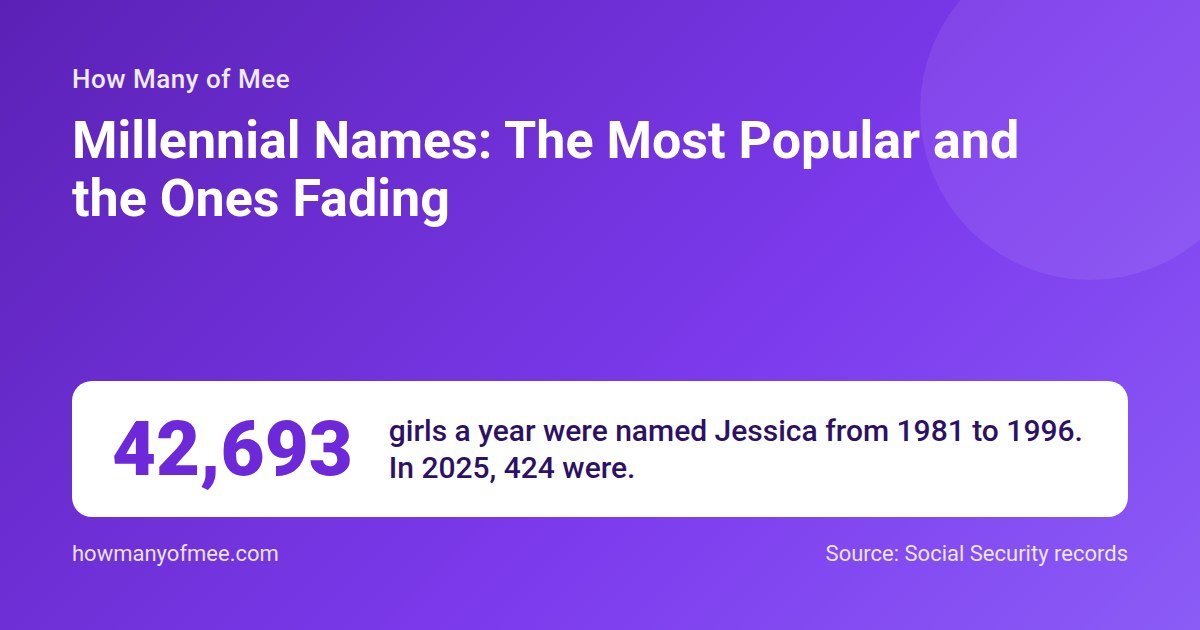
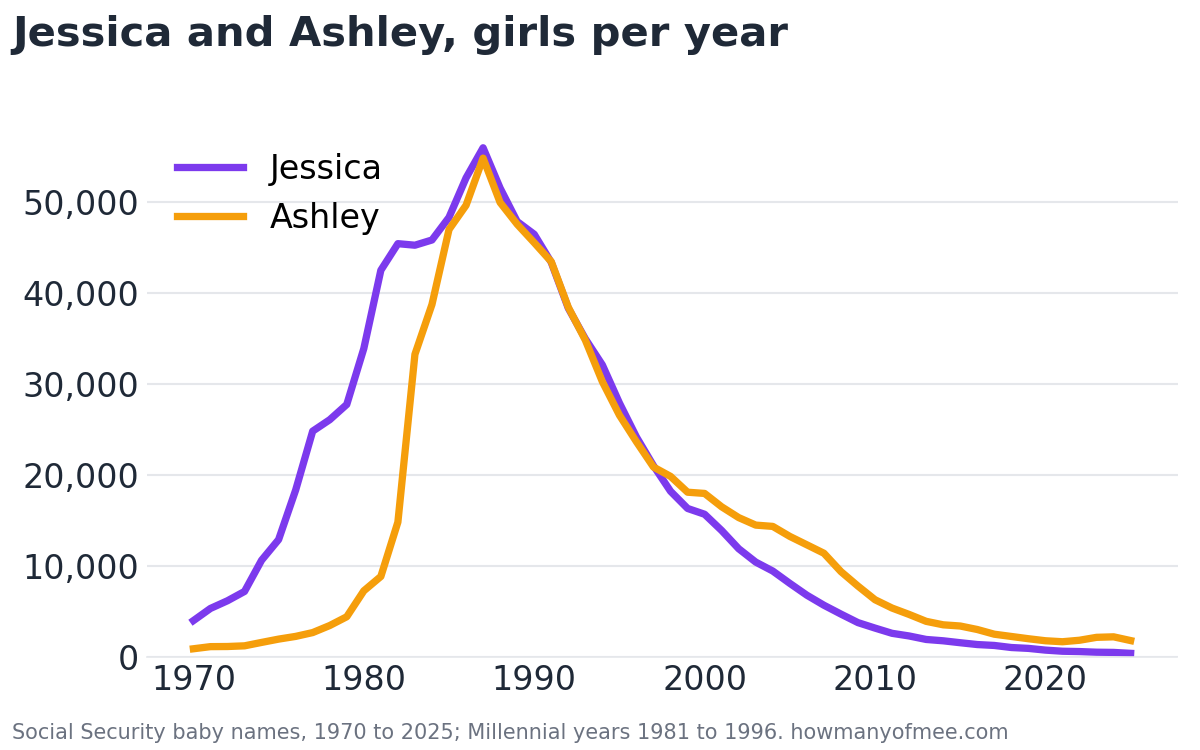
In the Millennial birth years, 1981 to 1996, about 42,693 girls a year were named Jessica. In 2025, 424 were, and the name ranked #665. Many of the most popular names of those years are now rare choices for babies. This guide lists the 50 most popular Millennial names for girls and boys with their meanings, the #1 names of each year, which names have fallen furthest, and how many people still have them.
The years follow the Pew Research Center’s definition of the Millennial generation. Each name’s Millennial figure is its average number of babies per year from 1981 to 1996.
What Are the Most Popular Millennial Girl Names?
The 50 names given to the most girls born from 1981 to 1996, with their meanings from Behind the Name where it gives one and their rank among girls born in 2025:
| Name | Meaning | Babies, 1981 to 1996 | Rank in 2025 |
|---|---|---|---|
| 1. Jessica | – | 683,088 | #665 |
| 2. Ashley | ash tree clearing | 587,801 | #164 |
| 3. Jennifer | – | 497,433 | #586 |
| 4. Amanda | lovable, worthy of love | 492,127 | #493 |
| 5. Sarah | lady, princess, noblewoman | 411,570 | #90 |
| 6. Stephanie | crown | 324,207 | #557 |
| 7. Elizabeth | my God is an oath | 306,163 | #17 |
| 8. Brittany | – | 300,958 | #928 |
| 9. Nicole | form of Nicholas | 296,510 | #383 |
| 10. Emily | form of Emil | 281,561 | #34 |
| 11. Samantha | flower | 280,825 | #151 |
| 12. Megan | pearl | 265,009 | #889 |
| 13. Melissa | bee | 259,420 | #420 |
| 14. Lauren | from Laurentum | 251,208 | #401 |
| 15. Rachel | ewe | 246,585 | #250 |
| 16. Heather | heather | 233,454 | #1264 |
| 17. Amber | – | 233,318 | #520 |
| 18. Danielle | God is my judge | 212,976 | #549 |
| 19. Tiffany | form of Theophania | 206,210 | #880 |
| 20. Rebecca | join, tie, snare | 205,194 | #350 |
| 21. Michelle | form of Michel | 204,880 | #465 |
| 22. Christina | a Christian | 190,516 | #770 |
| 23. Kimberly | city of Kimberley | 188,473 | #303 |
| 24. Laura | laurel | 175,918 | #379 |
| 25. Amy | beloved | 171,613 | #257 |
| 26. Kayla | – | 170,271 | #364 |
| 27. Courtney | – | 168,832 | #2335 |
| 28. Crystal | crystal | 168,502 | #1145 |
| 29. Katherine | – | 163,383 | #186 |
| 30. Erin | form of Eireann | 151,084 | #833 |
| 31. Sara | form of Sarah | 147,909 | #198 |
| 32. Mary | form of Maria | 140,593 | #125 |
| 33. Kelly | – | 140,366 | #852 |
| 34. Andrea | manly, masculine | 137,449 | #235 |
| 35. Angela | form of Angel | 133,144 | #408 |
| 36. Victoria | victory | 132,001 | #54 |
| 37. Erica | form of Eric | 129,384 | #1399 |
| 38. Taylor | tailor | 127,442 | #403 |
| 39. Hannah | favor or grace | 126,647 | #56 |
| 40. Kristen | form of Kristin | 118,708 | #1999 |
| 41. Jamie | form of James | 117,624 | #858 |
| 42. Chelsea | landing place for chalk or limestone | 116,724 | #851 |
| 43. Lisa | my God is an oath | 110,356 | #991 |
| 44. Allison | form of Alison | 109,731 | #103 |
| 45. Jasmine | climbing plant with fragrant flowers | 108,568 | #206 |
| 46. Maria | – | 107,648 | #87 |
| 47. Lindsey | Lincoln island | 107,011 | #1369 |
| 48. Alyssa | form of Alicia | 106,633 | #453 |
| 49. Katie | form of Kate | 105,051 | #646 |
| 50. Anna | form of Hannah | 105,041 | #107 |
What Are the Most Popular Millennial Boy Names?
The 50 names given to the most boys born from 1981 to 1996, with their meanings from Behind the Name where it gives one and their rank among boys born in 2025:
| Name | Meaning | Babies, 1981 to 1996 | Rank in 2025 |
|---|---|---|---|
| 1. Michael | who is like God? | 949,495 | #21 |
| 2. Christopher | bearing Christ | 784,352 | #68 |
| 3. Matthew | gift of Yahweh | 679,718 | #32 |
| 4. Joshua | Yahweh is salvation | 606,015 | #66 |
| 5. David | beloved | 532,367 | #35 |
| 6. Daniel | God is my judge | 518,190 | #22 |
| 7. James | – | 503,506 | #6 |
| 8. Andrew | manly, masculine | 465,547 | #73 |
| 9. John | Yahweh is gracious | 463,642 | #23 |
| 10. Joseph | he will add | 459,967 | #29 |
| 11. Robert | bright fame | 446,477 | #92 |
| 12. Ryan | descendant of Rían | 433,652 | #99 |
| 13. Justin | – | 428,204 | #233 |
| 14. Brandon | hill covered with broom | 406,835 | #261 |
| 15. Nicholas | – | 398,090 | #112 |
| 16. William | – | 378,886 | #9 |
| 17. Jonathan | Yahweh has given | 355,211 | #89 |
| 18. Anthony | – | 351,348 | #46 |
| 19. Jacob | – | 308,584 | #43 |
| 20. Jason | to heal | 308,176 | #165 |
| 21. Kevin | – | 297,868 | #221 |
| 22. Brian | – | 296,894 | #339 |
| 23. Eric | – | 287,200 | #273 |
| 24. Tyler | tiler of roofs | 274,888 | #220 |
| 25. Kyle | narrows, channel, strait | 271,420 | #509 |
| 26. Thomas | twin | 268,308 | #34 |
| 27. Zachary | form of Zacharias | 260,369 | #216 |
| 28. Steven | crown | 258,079 | #271 |
| 29. Adam | man | 257,743 | #101 |
| 30. Timothy | honoring God | 237,521 | #203 |
| 31. Aaron | – | 221,986 | #80 |
| 32. Benjamin | – | 221,690 | #11 |
| 33. Richard | brave power | 212,266 | #234 |
| 34. Alexander | – | 210,685 | #30 |
| 35. Jeremy | form of Jeremiah | 194,955 | #292 |
| 36. Charles | man | 186,347 | #48 |
| 37. Jeffrey | form of Geoffrey | 182,809 | #552 |
| 38. Cody | descendant of Cuidightheach | 177,849 | #318 |
| 39. Mark | form of Marcus | 173,425 | #245 |
| 40. Patrick | nobleman | 173,316 | #235 |
| 41. Nathan | he gave | 167,615 | #63 |
| 42. Sean | form of Seán | 165,616 | #489 |
| 43. Stephen | crown | 163,759 | #383 |
| 44. Jose | – | 160,908 | #95 |
| 45. Jordan | – | 158,086 | #131 |
| 46. Austin | form of Augustine | 150,922 | #113 |
| 47. Samuel | – | 150,841 | #18 |
| 48. Travis | form of Travers | 148,155 | #434 |
| 49. Paul | – | 138,416 | #262 |
| 50. Dustin | from a surname | 135,100 | #729 |
What Was the Top Millennial Name Each Year?
| Year | Top girl name | Top boy name |
|---|---|---|
| 1981 | Jennifer (57,046) | Michael (68,750) |
| 1982 | Jennifer (57,120) | Michael (68,216) |
| 1983 | Jennifer (54,353) | Michael (68,004) |
| 1984 | Jennifer (50,564) | Michael (67,735) |
| 1985 | Jessica (48,345) | Michael (64,934) |
| 1986 | Jessica (52,682) | Michael (64,235) |
| 1987 | Jessica (55,992) | Michael (63,664) |
| 1988 | Jessica (51,556) | Michael (64,171) |
| 1989 | Jessica (47,887) | Michael (65,415) |
| 1990 | Jessica (46,486) | Michael (65,321) |
| 1991 | Ashley (43,477) | Michael (60,810) |
| 1992 | Ashley (38,460) | Michael (54,410) |
| 1993 | Jessica (34,993) | Michael (49,571) |
| 1994 | Jessica (32,122) | Michael (44,477) |
| 1995 | Jessica (27,941) | Michael (41,409) |
| 1996 | Emily (25,150) | Michael (38,373) |
Michael was the top boy name in every Millennial year. For girls, four names took turns at #1: Jennifer, Jessica, Ashley and Emily.
Which Millennial Girl Names Are Disappearing?
Of the 50 most popular girls’ names of the Millennial years, these are given least often now, compared with then:
| Name | Per year, 1981 to 1996 | In 2025 | 2025 vs. then |
|---|---|---|---|
| Courtney | 10,552 | 78 | 0.7% |
| Jessica | 42,693 | 424 | 1.0% |
| Heather | 14,591 | 177 | 1.2% |
| Kristen | 7,419 | 96 | 1.3% |
| Brittany | 18,810 | 281 | 1.5% |
| Jennifer | 31,090 | 501 | 1.6% |
| Megan | 16,563 | 301 | 1.8% |
| Crystal | 10,531 | 202 | 1.9% |
| Erica | 8,086 | 156 | 1.9% |
| Amanda | 30,758 | 601 | 2.0% |
Courtney has fallen the furthest: 78 girls got the name in 2025, 0.7% of its Millennial yearly average.
Are Millennial Boy Names Disappearing Too?
Less so. These are the 10 of the 50 most popular boys’ names that are given least often now:
| Name | Per year, 1981 to 1996 | In 2025 | 2025 vs. then |
|---|---|---|---|
| Kyle | 16,964 | 594 | 3.5% |
| Dustin | 8,444 | 365 | 4.3% |
| Jeffrey | 11,426 | 544 | 4.8% |
| Brandon | 25,427 | 1,326 | 5.2% |
| Brian | 18,556 | 979 | 5.3% |
| Justin | 26,763 | 1,512 | 5.6% |
| Sean | 10,351 | 616 | 6.0% |
| Eric | 17,950 | 1,256 | 7.0% |
| Steven | 16,130 | 1,261 | 7.8% |
| Travis | 9,260 | 732 | 7.9% |
The fastest-falling Millennial boys’ name, Kyle, kept 3.5% of its yearly average, several times the share of the fastest-falling girls’ names. For how the top names changed from one generation to the next, see the names by decade.
Are Millennial Names Still Common?
Yes, among adults. These names aren’t disappearing from the population; the people who have them are grown up:
| Name | People alive | Average age |
|---|---|---|
| Jessica | 1,019,821 | 36.9 |
| Jennifer | 1,394,097 | 45.3 |
| Amanda | 747,666 | 38.4 |
| Brandon | 742,477 | 31.6 |
| Justin | 754,068 | 33.4 |
| Kyle | 468,041 | 33.2 |
About 1,019,821 people alive in the US are named Jessica. While few babies get these names, the average age of the people who have them keeps rising.
Look Up a Millennial Name
- Type the name in the search box on the home page.
- Its chart shows babies given the name in every year since 1880, so you can see when it peaked and how fast it fell.
- Its page shows about how many people have the name today, their average age and its rarity tier.
For the names that came after, see the most popular Gen Z names.