
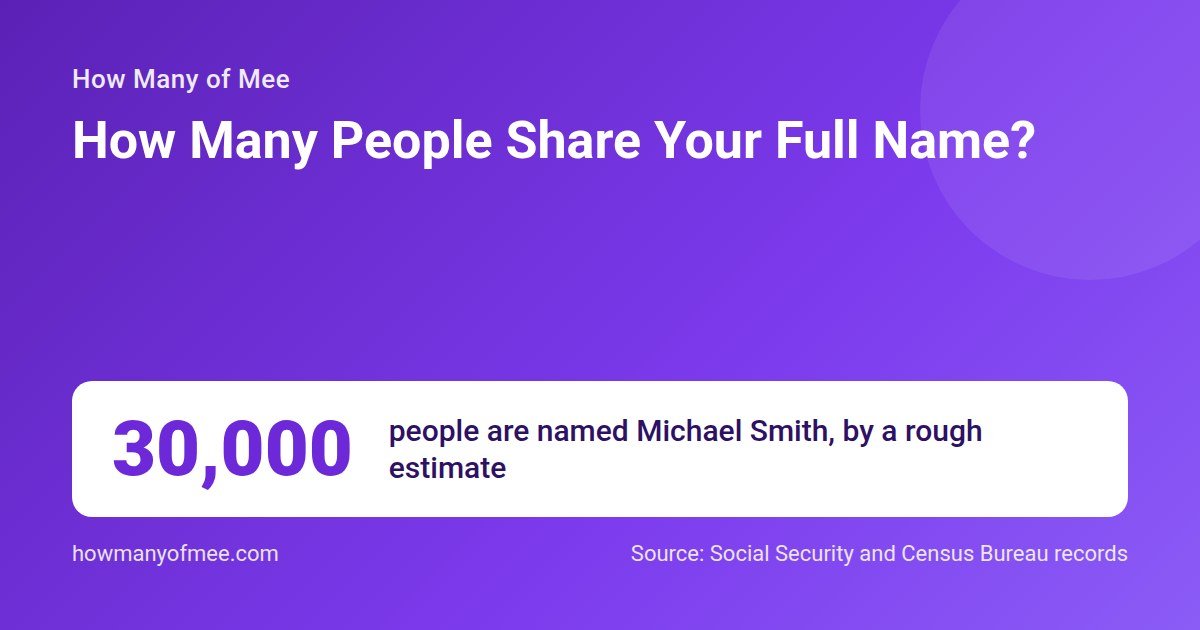
There are roughly 8 billion people on this planet. And yet, most of us walk around thinking our name is ours — like a personal brand no one else carries. Here’s the reality check: if your name is James Smith, about 38,000+ other Americans alone share that exact full name with you. That’s enough to fill a small stadium.
But what if your name is something less common? What if you’re Zephyr Kowalski or Priya Bhattacharya? Does anyone else on Earth carry the same first-last combo?
This question isn’t just a fun curiosity. People want to know this for real, practical reasons — identity theft concerns, social media presence, professional branding, or just that funny itch of wondering, “Am I the only me out there?” If you’ve ever checked how many people have your name in the world, you already know the answer can be surprising.
Let’s break this down — how name sharing actually works, what decides whether you’re one-of-a-kind or one-of-thousands, and how you can actually find out your number.
How Does Full Name Sharing Even Work?
Your full name is a combination of two separate data points: your first name and your surname (last name). Each has its own frequency in the population. When you combine them, you get a probability — a rough estimate of how many people carry that exact pair.
Think of it like a math problem.
If your first name is shared by 4.7 million Americans (like “James”) and your last name is shared by 2.4 million (like “Smith”), the overlap creates a large group of people with the identical full name. The U.S. Census Bureau and the Social Security Administration (SSA) both track this kind of data, and tools like HowManyOfMe.com use it to calculate estimates.
But here’s the twist: The calculation isn’t just simple multiplication. It depends on:
- Geographic distribution — Are both the first and last names common in the same regions?
- Ethnic and cultural patterns — Some first names naturally pair with certain surnames more often.
- Generational trends — A name like “Karen Johnson” was far more common among Baby Boomers than among Gen Z babies.
- Gender alignment — “Ashley” as a male name was popular in the UK decades ago but became a female name in the U.S., changing the full-name math entirely.
So your full name isn’t just a random pairing. It reflects culture, era, geography, and family history all at once.
What Makes a Full Name Common or Rare?
Not all name combinations are created equal. Some full names pop up hundreds of thousands of times. Others? Literally once on the entire planet.
The “Common + Common” Effect
Pair a top-10 first name with a top-10 last name, and you’re practically guaranteed thousands of name twins. Names like:
- James Smith — ~38,000+ in the U.S.
- Maria Garcia — ~30,000+ in the U.S.
- Robert Johnson — ~25,000+ in the U.S.
- Mary Williams — ~20,000+ in the U.S.
These combos are so frequent that people with these names regularly get each other’s mail, medical records, and even credit reports mixed up. It’s not just an inconvenience — it’s an identity nightmare.
If you’re curious about which first names drive this pattern, check out the most common male names in the USA and most common female names in the USA for the full picture.
The “Rare + Common” Sweet Spot
Now take a less popular first name and pair it with a common surname. Something like “Declan Williams” or “Zara Johnson.” You’ll probably find a handful of people — maybe 5 to 50 — sharing that full name. It’s uncommon enough to feel personal, but not so rare that you’re completely alone.
The “Rare + Rare” Unicorn Zone
Combine an unusual first name with an uncommon last name — say, “Thessaly Okonkwo” or “Cassian Bhattacharya” — and there’s a real chance you’re the only person with that exact full name on Earth. Understanding what makes a name rare or common can help you figure out where your own name falls on this spectrum.
Quick Fact: According to data analysis from the U.S. Census and SSA records, approximately 57,000 unique first names and 6.3 million unique last names exist in the United States alone. That means there are billions of possible full-name combinations — but the population clusters heavily around a small fraction of them.
How to Find Out How Many People Share Your Full Name
Alright, the fun part. You actually want a number. Here’s how to get one.
Method 1: Use a Name Frequency Tool
Websites like HowManyOfMe.com pull from U.S. Census data and SSA name records to estimate how many Americans share your exact first + last name combination. You just type in your name and get an instant estimate.
Keep in mind: These tools are estimates, not exact counts. Census data has sampling limitations, and it doesn’t perfectly capture recent immigrants, name changes, or very new baby names.
Method 2: Search Yourself on Social Media and Google
Do a quoted search on Google — put your full name in quotation marks like “Your Full Name” — and see what comes up. Check LinkedIn, Facebook, and Instagram. You might be surprised.
Some people discover they share their name with a doctor in another state, a college athlete, or even someone with a criminal record (which is why this matters more than you’d think).
Method 3: Check the SSA Baby Names Database
The Social Security Administration publishes name data going back to 1880. You can search how popular your first name was in your birth year, which gives you a sense of how many people your age share your first name. To understand the broader picture, you can explore the science of name statistics and how these databases actually work.
Method 4: Look at Surname Frequency Data
Your last name carries a lot of weight in this equation. The Census Bureau tracks surname frequency — Smith, Johnson, Williams, Brown, and Jones are the top five in the U.S. If your surname is less common, like Kowalczyk or Nakamura, your full-name twin count drops dramatically. You can find out how many people have your surname separately to understand your last name’s contribution to the equation.
Pro Tip: If you find zero results for your full name in search tools, there’s a good chance you’re the only one — or one of very few. That makes your name essentially a personal trademark. But don’t assume it means no one ever had your name. Records from before digital databases (pre-1930s) are incomplete.
Why Your Full Name Is More or Less Unique Than You Think
People tend to have one of two wrong assumptions:
Wrong assumption #1: “My name is super common — everyone has it.”
Not necessarily. Even if your first name is popular (like “Emily” or “Michael”), your full name might be quite rare depending on your surname. “Michael Chen” is common. “Michael Thorvaldsen”? Probably not.
Wrong assumption #2: “My name is totally unique — no one else has it.”
You’d be surprised. Even unusual-sounding names can have duplicates. There are multiple people named “Storm Silverberg” and “Phoenix Black” out there. Pop culture, fiction, and naming trends create coincidental overlaps you wouldn’t expect.
The Decade Factor
Here’s something most people don’t consider: name popularity shifts wildly by decade. “Linda” was the #1 girl’s name in the 1950s — over 1.4 million baby girls got that name in that decade alone. But almost no one names their daughter Linda today.
So if your name is “Linda Martinez,” most of your name twins are probably between 65 and 75 years old. A 25-year-old Linda Martinez? Much rarer. You can see these shifts clearly when you look at the most popular names by decade from 1950 to 2020.
The Cultural Crossover Effect
Names don’t exist in isolation — they carry cultural DNA. “Muhammad Ali” is a common full name across many Muslim-majority countries and diaspora communities. “José Rodriguez” appears frequently across Latin America and the U.S. “Wei Zhang” shows up millions of times in China.
When cultures overlap geographically (like in the U.S., UK, or Canada), full-name sharing increases unpredictably. Someone named “Aiden Patel” might seem unlikely, but in multicultural cities like London, Houston, or Toronto, these cross-cultural combos are becoming more common every year.
The Real-World Impact of Sharing a Full Name
This isn’t just trivia. Sharing a full name with other people can create real problems — and some unexpected benefits.
The Problems
The Unexpected Benefits
Did You Know? A Swedish man named “Mohamed Ali” was denied a U.S. visa in the early 2000s because his name matched entries on a security watchlist. He shared his name with the legendary boxer — and apparently with many others on government databases. Name sharing isn’t always fun and games.
Common Myths About Name Sharing — Debunked
Myth 1: “If I Google my name and nothing comes up, I’m the only one.”
False. Many people have minimal or zero online presence. Older generations, people in rural areas, and those who actively avoid social media won’t show up in a Google search — but they still exist. Census data captures people that Google doesn’t.
Myth 2: “Unusual spelling makes my name unique.”
Not exactly. “Jaycen” instead of “Jason” might feel different, but name-counting databases often normalize spellings. Plus, how name trends spread across states shows that creative spellings follow predictable patterns — your “unique” version might be shared by hundreds of others who had the same idea.
Myth 3: “My last name is rare, so no one shares my full name.”
Your last name might be rare in the U.S. but common elsewhere. “Kowalski” sounds unusual in Alabama but is one of the most common surnames in Poland. Global name sharing extends way beyond your country’s borders.
Myth 4: “Name sharing doesn’t affect me in any practical way.”
We covered this above — credit reports, background checks, medical records. It absolutely can affect you. And with increasing digitization, the problem is growing, not shrinking.
Myth 5: “Parents today are giving more unique names, so this problem is going away.”
It’s true that parents increasingly choose rare names for their children. But “unique” first names often get paired with common surnames, and the growing population means even uncommon names can still produce duplicates over time. The problem is shifting shape, not disappearing.
How Your Name Compares Globally
This is where things get wild. Everything we’ve discussed so far has been U.S.-focused. Zoom out to the whole world, and the numbers change dramatically.
China and India together hold about 2.8 billion people, and their naming conventions create enormous name-sharing clusters. In China, where roughly 85% of the population shares just 100 surnames, and popular given names recycle heavily, a name like “Wei Zhang” or “Fang Li” might be shared by hundreds of thousands of people.
In India, naming conventions vary by region, religion, and language. Some names like “Raj Kumar” or “Priya Sharma” are shared by tens of thousands, while names from smaller linguistic communities might be nearly unique.
In the Arabic-speaking world, names like “Mohamed Ahmed” are extraordinarily common, potentially shared by millions globally. If you’re curious about the data behind this, the analysis of the most common Arabic names breaks this down in more detail.
Latin America adds another dimension — many people carry two surnames (paternal + maternal), which dramatically reduces full-name sharing. “Carlos García López” is far more specific than just “Carlos García.”
Quick Fact: Iceland uses patronymic naming — your last name is literally your father’s first name plus “-son” or “-dóttir.” So a father named Jón might have a son named “Ólafur Jónsson” and a daughter named “Sigríður Jónsdóttir.” This system means last names shift every generation, creating a totally different name-sharing dynamic.
What If You Want to Be the Only One With Your Name?
Some people genuinely care about name uniqueness — for personal branding, professional reasons, or just ego (no judgment). Here’s what actually works:
If you’re naming a child:
- Pair an uncommon first name with your surname and check tools like HowManyOfMe.com before finalizing.
- Look at the rarest baby names ever recorded for inspiration — but make sure the name is still pronounceable and won’t cause lifelong headaches.
- Consider the full initials, too. You don’t want your kid to be “A.S.S.” on monogrammed towels.
If you’re an adult:
- You can legally change your name in most U.S. states for $150–$500 through a simple court petition.
- Some professionals use a middle name or initial to differentiate — “John D. Rockefeller” versus “John Rockefeller.”
- Adding a professional suffix (MD, PhD, CPA) to your name in professional contexts helps distinguish you from name twins.
If you’re building a brand:
- Check domain name availability, social media handles, and Google search results before committing to a professional name.
- Some creators adopt pen names or stage names specifically to avoid name-sharing conflicts. Smart move.
The Psychology of Sharing Your Name
There’s a weird emotional reaction that happens when you discover someone else has your exact full name. For some people, it feels like a minor identity crisis — “Wait, I’m not the only [my name]?” For others, it’s genuinely exciting, like finding a long-lost twin.
Psychologists who study the psychology behind unique names have found that people with rare names tend to have a stronger sense of individual identity — but also report more instances of their names being mispronounced or misspelled, which creates its own frustration.
Interestingly, people who discover they share their name with someone famous react in polarized ways. Sharing a name with a beloved celebrity? Fun party trick. Sharing a name with a convicted criminal? Genuinely distressing.
And there’s the “nominative determinism” angle — the half-serious theory that your name influences your career and life path. If you’ve got five other “David Millers” showing up in your professional field, it can create confusion but also a strange sense of camaraderie.
FAQ Section
How can I find out exactly how many people share my full name?
You can use tools like HowManyOfMe.com, which pulls from U.S. Census Bureau and SSA data to give you an estimate. For global estimates, no single tool is perfectly accurate, but combining census databases from multiple countries gives you a rough picture. Keep in mind these are statistical estimates, not exact headcounts. You can start by checking if your name is truly unique using available online tools.
Does sharing a full name with someone cause legal problems?
It can. Credit report mix-ups, mistaken identity in background checks, and even wrongful legal actions have been documented. The CFPB and FTC both acknowledge “mixed files” as a real consumer problem, particularly for people with common names like John Smith or Maria Rodriguez. Using your middle name or initial in legal and financial documents is one simple protective step.
What’s the most common full name in the United States?
Based on SSA and Census data analysis, James Smith is consistently estimated as the most common male full name in the U.S. (approximately 38,000+ individuals), while Maria Garcia and Mary Smith compete for the most common female full name. These estimates shift slightly depending on the data source and year of analysis.
Can two people with the same full name live in the same city?
Absolutely — and it happens more often than you’d think. In large cities like New York, Los Angeles, or Chicago, there can be dozens of people with the same common full name living within the same zip code. This creates particular headaches for mail delivery, medical records, and law enforcement databases.
Is name sharing more or less common than it used to be?
It’s complicated. Baby name diversity has increased since the 1990s — parents are choosing from a wider pool of names than previous generations did. But the global population has also grown massively, and immigration patterns bring common names from different cultures into the same countries. So while any single name is less dominant than it used to be, the sheer number of people means name-sharing still happens frequently.
Your Name, Your Identity — But Maybe Not Yours Alone
Here’s the thing about your full name: it feels deeply personal, almost like a part of your DNA. But statistically, it’s just a combination of two data points drawn from a limited pool. Some combinations are shared by tens of thousands. Others belong to just one person on the planet.
Knowing where your name falls on that spectrum isn’t just fun bar trivia. It has real implications for your privacy, your professional identity, your financial records, and even your safety. If you share your name with thousands of others, take proactive steps — use your middle initial in important documents, monitor your credit report regularly, and establish a clear online presence that distinguishes you from your name twins.
And if you’re one of the lucky (or intentional) few whose full name is truly one-of-a-kind? Enjoy it. That kind of uniqueness is getting rarer in a world of 8 billion people — even as baby name creativity is at an all-time high.
Either way, your name is only part of who you are. The person behind it? That’s always one of a kind.
