
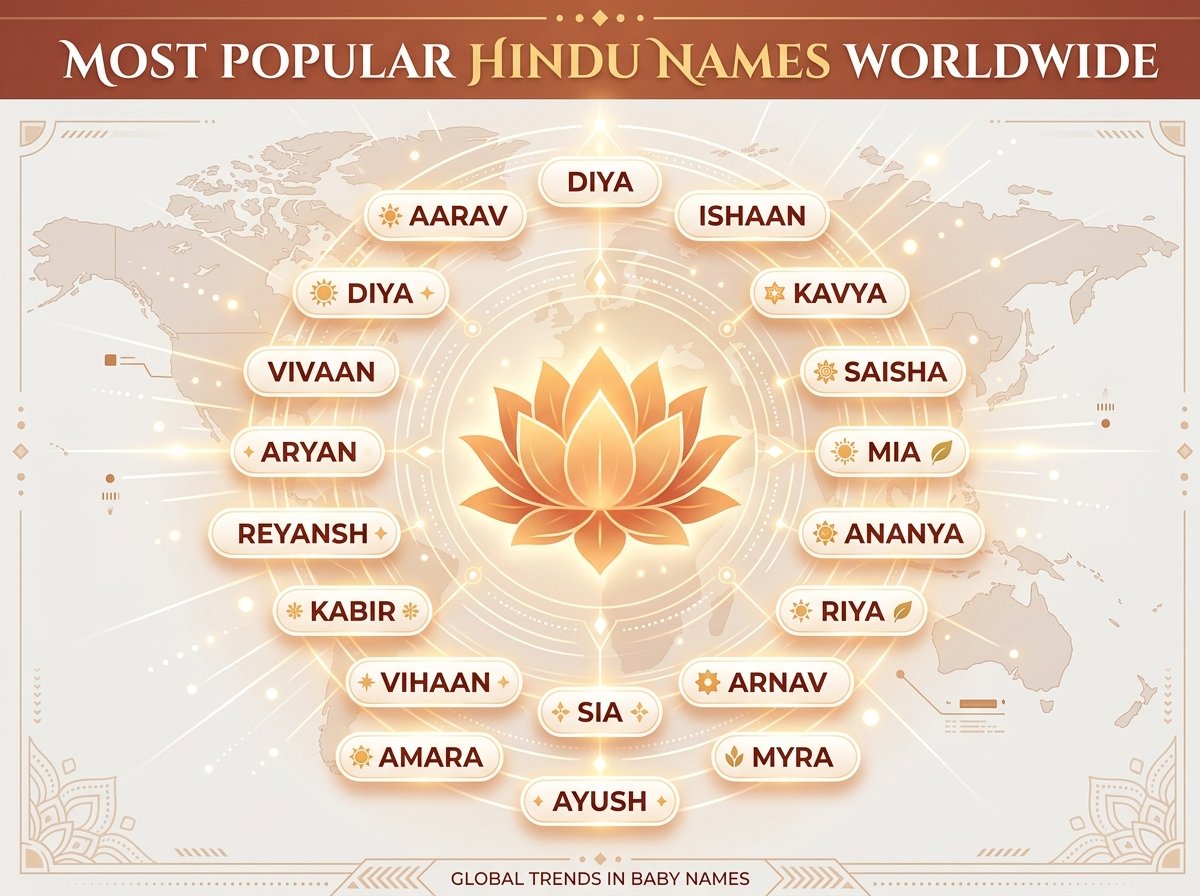
Over 1.2 billion Hindus live across the globe today. That’s roughly 15% of the entire world’s population. And here’s the interesting part — Hindu names aren’t just popular in India anymore. You’ll find kids named Arjun in London, Priya in Toronto, Arya in New York, and Dev in Sydney.
Hindu names carry something deeper than just a label. They hold mythology, philosophy, nature, and spirituality — all packed into a few syllables. Whether you’re an expecting parent looking for the perfect name, someone curious about your own name’s meaning, or just fascinated by naming traditions, this guide covers everything you need.
Let’s break down the most popular Hindu names worldwide, what they actually mean, and why certain names keep showing up generation after generation.
Why Hindu Names Have Global Appeal
Hindu names aren’t just Indian names. They’ve traveled far beyond South Asia, and there are real reasons behind this.
Sanskrit roots give them a universal sound. Names like Arya, Maya, and Kavi sound natural in English, Spanish, and French too. Parents from non-Hindu backgrounds often pick these names simply because they sound beautiful — without even knowing the Sanskrit meaning.
Meaning matters to modern parents. A 2023 BabyCenter survey showed that over 68% of parents now prioritize meaning over trendiness. Hindu names are loaded with meaning. Every single name connects to a virtue, a deity, an element of nature, or a philosophical concept. That’s a big draw.
Bollywood and global Indian diaspora play a role too. With over 30 million Indians living outside India, Hindu names naturally spread through communities, schools, and workplaces worldwide. If you’re curious about how name popularity changes over time, the Indian diaspora effect is a textbook example.
Pop culture adds fuel. The name Arya exploded globally after Game of Thrones — but it was already a popular Hindu name meaning “noble.” Similarly, characters in Marvel, Netflix shows, and bestselling novels have introduced Hindu-origin names to Western audiences.
Most Popular Hindu Boy Names Worldwide
Here’s a carefully curated list of Hindu boy names that are popular not just in India, but across the USA, UK, Canada, Australia, and the Middle East.
Aarav
Meaning: Peaceful, wise
Origin: Sanskrit
Aarav has been the #1 baby name in India for several years running. It’s short, easy to pronounce in any language, and carries a calm, positive meaning. You’ll find this name trending in the USA and UK too, especially among NRI families.
Arjun
Meaning: Bright, shining, white
Origin: Sanskrit (Mahabharata)
Named after the legendary warrior from the Mahabharata, Arjun is a name that parents associate with bravery, focus, and skill. It’s popular across India, Southeast Asia, the UK, and North America. The spelling variation “Arjuna” appears in Indonesian culture too — showing just how far this name has traveled.
Vivaan
Meaning: Full of life, first rays of the morning sun
Origin: Sanskrit
Vivaan has surged in popularity since 2015. It’s fresh, modern-sounding, and doesn’t feel “old-fashioned” — which makes it a hit with millennial and Gen Z parents. It ranked among the most searched baby names on Google in recent years.
Dev
Meaning: God, divine
Origin: Sanskrit
Short, strong, and universal. Dev works perfectly as a standalone name or as part of longer names like Devraj, Devesh, or Devang. It’s one of those most common one-word names that people across cultures find easy to remember.
Rohan
Meaning: Ascending, growing
Origin: Sanskrit
Rohan is genuinely global. It’s popular in India, Ireland (where it has separate Celtic roots), and across the English-speaking world. This dual-origin appeal makes it one of the most cross-cultural Hindu names out there.
Advait
Meaning: Unique, one without a second
Origin: Sanskrit (Advaita Vedanta philosophy)
This name comes directly from the Advaita philosophy of non-duality taught by Adi Shankaracharya. It’s gained massive popularity in the last decade because parents love the idea of their child being “one of a kind.”
Krishna
Meaning: Dark, all-attractive
Origin: Sanskrit (Hindu deity)
Krishna is timeless. It’s been popular for thousands of years and shows no signs of slowing down. From India to Fiji to Trinidad (which has a large Hindu population), Krishna remains a top choice. The name connects directly to Lord Krishna — one of the most beloved figures in Hindu mythology.
Reyansh
Meaning: Ray of light (from the sun god)
Origin: Sanskrit
Reyansh cracked the top baby names lists in India, USA, and UAE around 2018-2020. It sounds modern, has a bright meaning, and connects to Surya (the Sun God). Parents who want something fresh but rooted in tradition gravitate toward this one.
Did You Know? The name Reyansh didn’t appear in any major baby name database before 2010. Its rise from obscurity to one of the most popular Hindu names is a perfect example of why some names suddenly become popular.
Most Popular Hindu Girl Names Worldwide
Hindu girl names often draw from goddesses, nature, music, and beauty. Here are the ones you’ll hear in nurseries and classrooms across the globe.
Aanya / Anaya
Meaning: Aanya means “graceful” or “inexhaustible”; Anaya means “caring” or “God answered”
Origin: Sanskrit
Both names have exploded globally. Aanya ranked in the top 500 baby names in the UK and USA in recent years. They’re soft, feminine, easy to spell, and carry beautiful meanings. Win-win for any parent.
Saanvi
Meaning: Goddess Lakshmi, knowledge
Origin: Sanskrit
Saanvi entered the US Social Security Administration’s top 1000 baby names list — a significant milestone for a Hindu name. It’s a direct reference to Goddess Lakshmi, which makes it spiritually meaningful for Hindu families while being perfectly accessible for international settings.
Priya
Meaning: Beloved, dear one
Origin: Sanskrit
Priya is probably the most universally recognized Hindu girl name outside India. It’s been popular since the 1970s and hasn’t faded. You’ll find Priyas in corporate boardrooms, universities, and hospitals across every continent. Its simplicity is its superpower.
Diya
Meaning: Lamp, light
Origin: Sanskrit/Hindi
Short, sweet, and full of symbolism. A diya is the clay lamp lit during Diwali and other Hindu ceremonies. The name represents hope, illumination, and warmth. It works beautifully in English-speaking countries because of its easy pronunciation.
Myra
Meaning: Beloved, admirable (also linked to Sanskrit “Mira”)
Origin: Sanskrit/Multiple origins
Myra is interesting because it exists independently in Greek and English naming traditions too. But in Hindu families, it’s often chosen as a modern spelling of Mira — after the legendary devotional poet Mirabai. This cross-cultural overlap makes it hugely popular worldwide.
Ishita
Meaning: One who desires, superior, powerful
Origin: Sanskrit
Ishita connects to the concept of mastery and greatness. It’s popular in India, Singapore, and among Indian communities in North America. Parents love it because it sounds graceful but carries a strong meaning.
Aisha / Ayesha
Meaning: Living, prosperous (also used in Islamic tradition)
Origin: Sanskrit/Arabic
Here’s a name that bridges Hindu and Muslim naming traditions. In Sanskrit, “Aisha” connects to concepts of life and prosperity. It’s enormously popular in South Asia, the Middle East, and Western countries alike. You can check out most popular Muslim names in the USA to see how this crossover works.
Arya
Meaning: Noble, honorable
Origin: Sanskrit
Arya deserves special mention. It was already a classic Hindu name before Game of Thrones catapulted it into mainstream Western consciousness. Post-2011, Arya appeared on baby name lists across 40+ countries. It’s gender-neutral in some cultures too, which adds to its appeal — similar to other gender-neutral names that are trending right now.
Hindu Names Popular by Region Outside India
Hindu names don’t spread evenly across the world. Different names dominate in different regions based on local diaspora communities, cultural adaptation, and pronunciation ease.
United States & Canada
Top picks: Arjun, Aarav, Saanvi, Priya, Rohan, Maya, Kiran
The North American Indian diaspora — over 5 million strong — keeps these names in regular circulation. Many of these names also appear in SSA data for baby names registered annually.
United Kingdom
Top picks: Aryan, Aanya, Krishna, Dev, Ishaan
Britain’s long historical connection with India means Hindu names have been part of the cultural fabric for generations. Names like Dev and Aanya regularly make UK top baby name lists.
Australia & New Zealand
Top picks: Aadhya, Vivaan, Aria (variation of Arya), Riya
Australia’s growing Indian community — now the largest immigrant group — has pushed Hindu names into mainstream recognition. Schools in Melbourne and Sydney have multiple kids named Vivaan or Aadhya in a single class.
Southeast Asia (Indonesia, Malaysia, Singapore)
Top picks: Rama, Sita, Arjuna, Devi, Surya
These regions have ancient Hindu-Buddhist cultural roots. Indonesia’s national epic is the Ramayana. Names like Rama, Sita, and Arjuna aren’t seen as “Indian” there — they’re local cultural heritage.
Caribbean & Fiji
Top picks: Krishna, Lakshmi, Ram, Radha, Ganesh
Hindu communities in Trinidad, Guyana, Suriname, and Fiji have preserved traditional naming patterns for over 150 years. You’ll find names here that might sound old-fashioned in modern India but remain deeply popular in these communities.
Middle East (UAE, Saudi Arabia, Qatar)
Top picks: Aarav, Reyansh, Saanvi, Aanya, Advait
The massive Indian expat workforce in Gulf countries means Hindu names are everywhere. These tend to skew modern and trendy — parents here often pick the newest popular names from India.
The Mythology Connection: Why Ancient Names Still Win
Here’s something fascinating about Hindu naming culture. Names that are 3,000+ years old still top popularity charts. Why?
Because Hindu mythology isn’t treated as “ancient history.” It’s a living, breathing part of daily life. Grandparents tell Ramayana stories at bedtime. Mahabharata is on TV every weekend. Festivals celebrate these characters annually.
So when a parent names their child Arjun, they’re not picking a “retro” name. They’re connecting their kid to a warrior who represents discipline, focus, and moral courage. When they choose Sita, they’re honoring resilience, grace, and devotion.
Some mythology-connected names that never go out of style:
- Ram — the ideal man, duty, righteousness
- Lakshmi — wealth, prosperity, beauty
- Ganesh — wisdom, new beginnings, remover of obstacles
- Hanuman — strength, devotion, loyalty
- Durga — power, protection, fierce compassion
- Saraswati — knowledge, arts, music
These names don’t fade because the stories behind them are retold every single generation. That’s a built-in renewal system that most naming traditions don’t have.
Pro Tip: If you’re choosing a mythology-based Hindu name, research the full story behind it. Knowing the narrative adds depth to your choice and gives your child a story to grow into.
Modern Trends in Hindu Baby Naming
Hindu naming isn’t stuck in the past. There are clear modern shifts happening right now.
Trend 1: Short is King
Two-syllable names dominate. Aarav, Vivaan, Myra, Diya, Dev, Riya — parents want names that are quick to say and easy to spell in international settings. The era of Dharmendra and Chandrakanta is giving way to crisp, punchy names.
Trend 2: Unique Spellings
Parents now tweak traditional spellings for uniqueness. Aadvik instead of Advait. Kiaan instead of Kian. Saanvi with double “a” instead of Sanvi. This connects to the broader trend of why parents choose rare names today.
Trend 3: Meaning Over Tradition
Older generations named kids after grandparents or family deities. Today’s parents Google meanings, check numerology, and want names that “feel right.” The meaning has become more important than family tradition.
Trend 4: Global Compatibility
Hindu parents living abroad — or even in India — increasingly want names that work in English. A name like “Shree” might get mispronounced as “Shree” vs. “Shri.” So parents pick names like Arya, Maya, or Neil that need zero explanation in any country.
Trend 5: Gender-Neutral Options
Names like Kiran (ray of light), Arya (noble), and Daksh (efficient) are being used for both boys and girls. This mirrors the global trend toward gender-neutral naming.
Common Myths About Hindu Names — Debunked
Myth 1: “Hindu names are hard to pronounce”
Not true at all. Names like Dev, Maya, Priya, Arya, and Kavi are as easy as any English name. The “hard to pronounce” label usually applies to longer traditional names — but modern Hindu names are designed for global ears.
Myth 2: “You must follow astrology to pick a Hindu name”
Many Hindu families do consult astrologers who suggest name letters based on the baby’s birth star (nakshatra). But it’s a tradition, not a rule. Plenty of Hindu parents pick names purely based on meaning and sound.
Myth 3: “Hindu names are only religious”
While many names connect to deities, thousands of Hindu names come from nature (Vayu = wind, Prithvi = earth), qualities (Dhairya = patience), celestial bodies (Tara = star), and abstract concepts (Ananda = bliss). The range is enormous.
Myth 4: “The same names are popular everywhere in India”
India has 28 states and 22 official languages. A popular name in Tamil Nadu (like Karthik) might be uncommon in Punjab (where Harpreet dominates). Hindu naming varies hugely by region, language, and community. To understand what makes a name rare or common, geography is a critical factor.
How to Choose the Right Hindu Name
If you’re actively searching for a Hindu name — for your baby, a character in your novel, or just personal curiosity — here’s a practical framework.
Step 1: Decide your priority.
What matters most? Meaning? Sound? Uniqueness? Family tradition? Knowing your priority narrows the field instantly.
Step 2: Check global pronunciation.
Say the name out loud in English. Ask a non-Indian friend to read it. If they get it right on the first try, you’ve got a globally friendly name.
Step 3: Research the full meaning.
Don’t just stop at “it means light.” Dig into the Sanskrit root, the mythological connection, and any regional variations. Some names have layered meanings that make them even more special.
Step 4: Check popularity.
Want something unique? Look at how many people share your chosen name before committing. You might discover that your “unique” choice is actually shared by 50,000 people — or that your “common” pick is rarer than you thought.
Step 5: Test it with the surname.
A beautiful first name can sound awkward with certain last names. Say the full name out loud. Write it down. Check the initials — you don’t want them spelling something unintended.
Step 6: Sleep on it.
Seriously. Don’t rush. A name is for life. Give yourself a week with the name. If you still love it after seven days, it’s probably the one.
Quick Reference Table: Top 20 Hindu Names Worldwide
| Rank | Boys | Meaning | Girls | Meaning |
|---|---|---|---|---|
| 1 | Aarav | Peaceful | Aanya | Graceful |
| 2 | Arjun | Bright | Saanvi | Goddess Lakshmi |
| 3 | Vivaan | Full of life | Priya | Beloved |
| 4 | Reyansh | Ray of light | Diya | Lamp |
| 5 | Krishna | All-attractive | Arya | Noble |
| 6 | Advait | Unique | Myra | Beloved |
| 7 | Dev | Divine | Anaya | Caring |
| 8 | Rohan | Ascending | Ishita | Superior |
| 9 | Vihaan | Dawn | Aadhya | First power |
| 10 | Aditya | Sun | Riya | Singer |
The Cultural Weight Behind a Hindu Name
Something worth understanding — a Hindu name isn’t just an identity tag. In Hindu tradition, the naming ceremony (Namkaran) is one of the 16 sacred samskaras (life rituals). It typically happens on the 11th or 12th day after birth.
During Namkaran, the family priest may suggest letters based on the child’s birth nakshatra. The father whispers the chosen name into the baby’s ear. It’s an intimate, meaningful ritual that treats naming as a spiritual act.
Even Hindu families who skip the formal ceremony still put deep thought into names. Your name is considered your first identity — your first gift from your parents — and it’s expected to guide your personality and path.
That cultural weight is why Hindu parents agonize over names more than you might expect. It’s not just about “what sounds nice.” It’s about what energy, story, and aspiration you’re attaching to your child.
FAQ Section
What is the most popular Hindu baby name in the world right now?
As of 2024-2025 data, Aarav (for boys) and Aanya/Saanvi (for girls) are consistently ranked as the most popular Hindu baby names globally. Aarav has held the top position in India for several consecutive years and appears on baby name lists in the USA, UK, UAE, and Canada.
Are Hindu names only used by Hindu families?
No. Many Hindu-origin names are used by families of other faiths and cultures. Names like Maya, Arya, Kiran, and Tara have crossed cultural boundaries entirely. In Indonesia and Bali, Hindu-origin names are common among the general population regardless of religion. The universal appeal of Sanskrit meanings makes these names accessible to everyone.
How do I find out if my Hindu name is rare or common worldwide?
You can start by checking how many people have your name in the world. Tools like this estimate the global frequency of your first name and surname combination. You can also explore what makes a name rare or common to understand the factors behind name distribution patterns.
Do Hindu names have to start with a specific letter based on astrology?
Traditionally, yes — many Hindu families consult a priest or astrologer who assigns a starting letter based on the baby’s nakshatra (birth star). For example, a baby born under the Ashwini nakshatra might get a name starting with “Chu,” “Che,” “Cho,” or “La.” But this is a cultural tradition, not a strict requirement. Many modern Hindu parents skip this step entirely.
Why do some Hindu names become popular outside India?
Three big reasons: the global Indian diaspora (30+ million people), cross-cultural sound appeal of Sanskrit names, and pop culture exposure through Bollywood, Hollywood, and streaming content. Names like Arya got a massive boost from Game of Thrones, while the growing visibility of Indian-origin CEOs, actors, and athletes has normalized Hindu names in Western countries.
Your Name Carries a Story
Every Hindu name is, at its core, a tiny piece of a massive civilization’s philosophy. Whether it’s the bravery of Arjun, the light of Diya, the peace of Aarav, or the nobility of Arya — these names connect children to stories that have been told for thousands of years.
And that connection isn’t getting weaker. It’s getting stronger. As the Indian diaspora grows, as Sanskrit names keep crossing cultural borders, and as parents everywhere search for names with real depth, Hindu names will only become more globally present.
If you’re picking a name right now, take your time. Check the meaning. Say it out loud. Research the story behind it. And if you’re curious about how your chosen name stacks up globally, check how many people share your full name — you might be surprised.
The right name feels like it was always meant to be yours. Trust that feeling.