
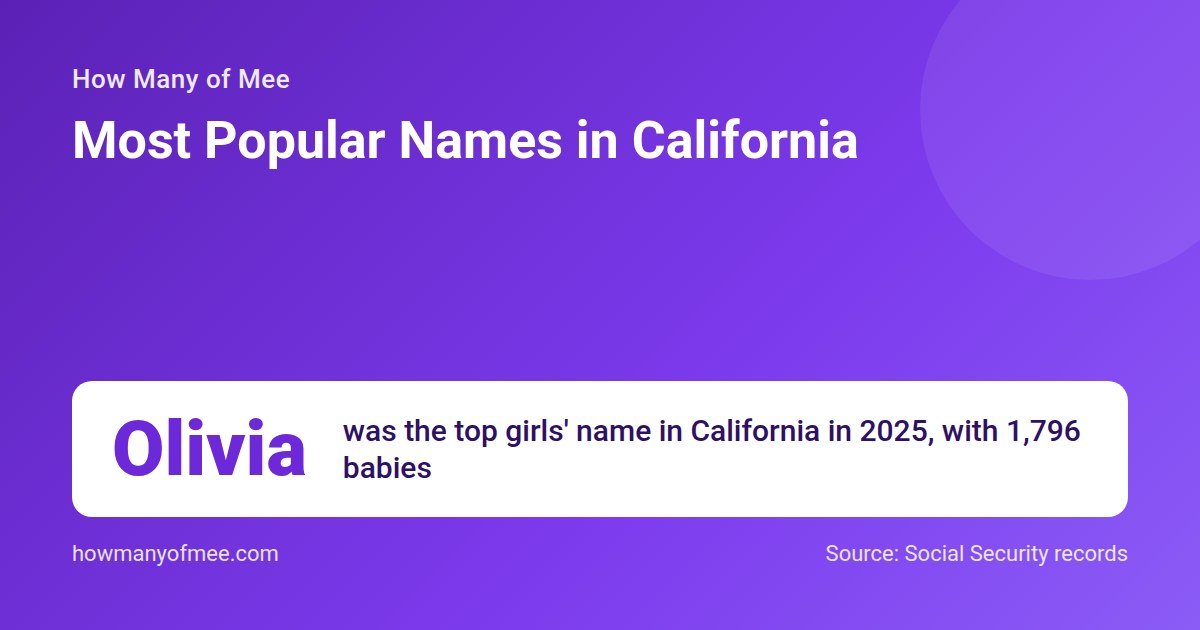
Most Popular Names in California

California welcomed over 420,000 babies in 2023 alone — and every single one of those little humans needed a name. That’s a LOT of parents scrolling through baby name lists at 2 AM, debating between Liam and Mateo, or Emma and Olivia.

But here’s what makes California different from, say, Texas or Ohio. This state is a melting pot. You’ve got Latino families in East LA, tech-industry parents in San Francisco, farming communities in the Central Valley, and entertainment industry families in Hollywood — all picking names based on their own cultures, values, and trends.

So what names actually dominate in California? Which ones are rising fast? And why does California’s name list look so different from the rest of the country?

I spent hours digging into the latest Social Security Administration (SSA) data, California Department of Public Health records, and real parent discussions to put together something genuinely useful. Whether you’re an expecting parent, a name nerd, or just curious — you’ll find some surprising stuff here.

And if you’re wondering how many people already share a name you’re considering, that’s worth checking too before you commit.

Let’s get into it.


H2: The Top 10 Most Popular Boy Names in California (2024–2025)

California’s boy name list has shifted dramatically over the past decade. Names that dominated in the 2000s — like Jacob and Michael — have dropped, and a whole new set has taken over.

Based on the most recent SSA data and California birth records, here are the top 10 boy names:

  1. Liam — Still holding strong at #1 for several years running
  2. Noah — A close second, consistent favorite
  3. Mateo — This is where California stands out from national trends
  4. Oliver — Climbing fast, especially in coastal cities
  5. Sebastian — Hugely popular among Latino and non-Latino families alike
  6. Lucas — Cross-cultural appeal keeps it near the top
  7. Levi — A quieter riser that’s gained serious ground
  8. Ethan — Slightly declining but still top 10
  9. Daniel — A classic that refuses to leave the list
  10. Alexander — Timeless and still going strong

H3: Why Mateo and Sebastian Rank Higher in California

Here’s the thing that surprises people from other states. Mateo ranks #3 in California but sits around #8 or #9 nationally. Sebastian tells a similar story.

Why? California’s population is roughly 40% Hispanic or Latino according to U.S. Census data (2023). That’s the largest share of any state by raw numbers. Names like Mateo, Santiago, Diego, and Sebastian have deep roots in Spanish-speaking cultures, and they’ve crossed over beautifully — non-Latino parents love them too.

This crossover effect is something you don’t see as strongly in states like Montana or Vermont. California’s demographics literally reshape its name charts.

Quick Fact: If you compare California’s most common male names with the national list, you’ll notice at least 3–4 names that differ, almost entirely because of cultural influence.

H3: Names That Just Missed the Top 10

A few boy names sit right at the edge and could break in any year:

  • Santiago — Rising rapidly, especially in Southern California
  • Theodore — A vintage name making a strong comeback
  • Benjamin — Classic, steady, never flashy but always present
  • Ezra — Short, punchy, and climbing nationally too
  • Julian — Another cross-cultural favorite

H2: The Top 10 Most Popular Girl Names in California (2024–2025)

Girl names in California follow some national trends but with distinct local flavor. Here’s what the latest data shows:

  1. Olivia — The reigning queen, nationally and in California
  2. Emma — Tight competition with Olivia for years
  3. Mia — Much higher in California than in most states
  4. Sophia — Slightly declining but firmly in the top 5
  5. Camila — A name that reflects California’s Latino heritage
  6. Luna — One of the fastest risers of the decade
  7. Isabella — Classic, romantic, and cross-cultural
  8. Amelia — Vintage vibes meeting modern taste
  9. Sofia — Yes, both Sophia AND Sofia make the list (different spelling, different communities)
  10. Aria — Short, melodic, and very 2020s

H3: Luna’s Extraordinary Rise

Let’s talk about Luna for a second. In 2005, Luna didn’t even crack California’s top 100. By 2015, it was in the top 30. By 2023, it hit the top 10.

What happened? A few things all at once:

  • Cultural resonance — Luna means “moon” in Spanish and Italian, which appeals to California’s multilingual families
  • Pop culture — Luna Lovegood from Harry Potter gave the name a boost starting in the mid-2000s
  • Celebrity influence — Chrissy Teigen and John Legend named their daughter Luna in 2016, and searches spiked immediately
  • Sound trend — Two-syllable names ending in “a” are dominating girl charts right now

If you’re curious about why some names suddenly become popular, Luna is the textbook example.

H3: The Sophia vs. Sofia Split

This is a uniquely California phenomenon. Both Sophia and Sofia appear in the state’s top rankings, which doesn’t happen in most other states.

  • Sophia is preferred by English-speaking families, Greek communities, and some Asian American families
  • Sofia is the traditional Spanish and Italian spelling, favored by Latino families

Combined, they’d easily claim the #1 girl name spot in California. But the SSA counts them as separate names, so they split the vote.

Did You Know? The most popular female names in the USA list handles this differently than state-level data, which is why national rankings can be misleading if you don’t account for spelling variations.


H2: How California’s Popular Names Differ From National Trends

California isn’t just another state on the name charts. It’s a trendsetter — and sometimes a complete outlier. Here’s how it stands apart.

H3: The Latino Influence Factor

I mentioned this earlier, but it deserves its own section because the impact is massive.

Names that rank significantly higher in California compared to the national average:

NameCA Rank (approx.)National Rank (approx.)
Mateo#3#8
Camila#5#12
Santiago#12#28
Diego#18#56
Valentina#15#30

That gap between the California rank and the national rank tells the whole story. California’s Latino community doesn’t just participate in name trends — it shapes them. Many names that start trending heavily in California eventually climb the national charts 3–5 years later.

Pro Tip: If you want to predict which names will trend nationally in the next few years, watch California’s list closely. The state has historically been a leading indicator for name trends across the country.

H3: The Tech & Entertainment Effect

Silicon Valley and Hollywood don’t just produce movies and apps. They produce name trends.

Parents in the Bay Area tend to gravitate toward:

  • International names (think Kai, Aria, Soren)
  • Gender-neutral options (like Avery, Riley, and Rowan)
  • Short, modern names (Mila, Leo, Zoe)

Parents in the LA entertainment industry often pick names that are:

  • Distinctive but not weird (think celebrity baby names like Story, Bear, or Bodhi)
  • Old Hollywood glamour (Audrey, Vivian, Clark)

These pockets of influence ripple outward. When a name catches fire in LA or San Francisco, it often spreads to Sacramento, San Diego, and then nationally.

Want to see how celebrity names become trending picks? The California connection is real.

H3: The Asian American Influence

California is home to the largest Asian American population in the U.S. — over 6 million people. This shows up in the name data too, though often in subtle ways.

You’ll see names like:

  • Ethan and Ryan — popular among Chinese American and Korean American families because they’re easy to pronounce across languages
  • Aiden — similarly cross-cultural
  • Mei, Hana, Sakura — less common on the overall charts but present in specific regions (San Francisco, parts of LA, San Jose)

Many Asian American parents choose names that work in both English and their heritage language. That’s why “universally pronounceable” names tend to do well in California.


H2: Popular Names in California by Region

California is huge — literally the third-largest state by area. A baby born in Humboldt County lives a very different life than one born in Beverly Hills. And their names reflect that.

H3: Southern California (LA, San Diego, Orange County)

Southern California leans heavily into:

  • Latino-influenced names — Mateo, Santiago, Camila, Valentina
  • Entertainment-influenced names — more willingness to go unique or trendy
  • Beach-culture vibes — Kai, Ocean, and Sunny actually appear more here

H3: Northern California (Bay Area, Sacramento)

The Bay Area trends toward:

  • International and tech-friendly names — short, global, easy to spell
  • Gender-neutral picksgender-neutral names that are trending are disproportionately popular in SF
  • Classics with a twist — Theodore instead of Thomas, Eleanor instead of Elizabeth

H3: Central Valley & Inland Areas

More conservative name choices here:

  • Traditional American names — James, William, Elizabeth, Grace
  • Biblical names — stronger presence of names like Joshua, Caleb, Hannah, and Abigail
  • Country-influenced picks — names like Wyatt, Maverick, and Savannah do better here than on the coast

This regional variation is fascinating because it shows how geography, economics, and community demographics all shape naming patterns within the same state.


H2: How California’s Popular Names Changed Over the Decades

Nothing stays the same in baby naming. The names that defined California in 1980 are completely different from today’s chart-toppers.

H3: The 1980s and 1990s

The undisputed champions of this era:

  • Boys: Michael, Christopher, Joshua, David, Daniel
  • Girls: Jennifer, Jessica, Ashley, Amanda, Stephanie

Michael was SO dominant in the ’80s that California alone produced tens of thousands of baby Michaels every year. Jessica and Jennifer were almost equally dominant for girls.

H3: The 2000s Shift

Something interesting happened around 2000–2010:

  • Boys: Jacob took over from Michael. Ethan, Joshua, and Daniel stayed strong. Angel entered California’s top 10 (rarely seen in other states’ top lists).
  • Girls: Emily dethroned Jessica. Isabella exploded thanks partly to the Twilight book series (2005). Sophia began its climb.

H3: The 2010s to Now

The current era brought:

  • Shorter names (Mia, Liam, Leo, Kai)
  • Cross-cultural names (Mateo, Luna, Aria)
  • Vintage revivals (Oliver, Theodore, Amelia)
  • Old-fashioned names making a comeback became a real movement, not just a quirky choice

If you want to see how name popularity changes over time in more detail, the patterns are genuinely surprising. Names move in cycles of roughly 80–100 years — the “grandmother rule.” A name falls out of fashion, skips two generations, then comes back feeling fresh.


H2: Common Myths About Popular Names in California

Let me clear up a few things people get wrong.

H3: Myth #1 — “Everyone in California Picks Weird Names”

No. Just no. The most popular names in California are remarkably similar to national favorites. Liam, Olivia, Noah, Emma — these aren’t exotic or unusual. The stereotype of California parents all naming their kids “Sunshine Moonbeam” is wildly exaggerated.

Yes, you’ll find more creative names in certain communities (especially in entertainment-adjacent circles). But the data shows that most California parents play it pretty safe.

H3: Myth #2 — “A Popular Name Means Your Kid Will Be One of Five in Class”

This used to be true. In 1985, Michael was given to roughly 4.5% of all boys. Today, Liam — the #1 name — goes to only about 1.5% of boys.

Name diversity has exploded. Parents today choose from a much wider pool, so even the “most popular” name is less concentrated than it was decades ago. Your son named Liam might be the only Liam in his class, or he might have one classmate with the same name. But five Liams in one classroom? Very unlikely.

H3: Myth #3 — “The Popularity List is Just About Baby Names”

Nope. When we talk about “most popular names,” we can mean two different things:

  • Most popular baby names (given to newborns in a specific year)
  • Most common names in the population (among all living Californians)

The most common names among all California residents right now are probably still Michael, Maria, David, and Jennifer — because there are millions of adults with those names. The most popular names for new babies are different.

You can check how many people share your full name to see where you fall in the bigger picture.


H2: Tips for Choosing a Name if You Live in California

If you’re actually picking a name for your baby (and you’re in California), here are some real-world considerations.

H3: Think About Classroom Diversity

California classrooms are incredibly diverse. Your child’s classmates might speak Spanish, Mandarin, Korean, Tagalog, Vietnamese, or Hindi at home. A name that’s easy to pronounce across multiple languages can save your kid years of corrections.

Names like Leo, Mia, Maya, and Kai work beautifully across cultures. Names with unusual letter combinations or silent letters might cause confusion.

H3: Consider the Bilingual Factor

If your family speaks more than one language — and nearly half of California families do — pick a name that works in both. Many parents specifically choose names that cross the English-Spanish bridge:

  • Daniel (works perfectly in both)
  • Sofia/Sophia (same)
  • Adrian (same)
  • Elena (same)

H3: Check the Popularity Before Committing

You might love a name without realizing it’s the #1 pick this year. Or you might think a name is super unique when it’s actually climbing fast.

The SSA’s website lets you look up any name’s ranking by state and year. And tools like how to check if your name is truly unique can give you a broader perspective.

H3: Don’t Chase Trends Too Hard

Here’s my honest advice: pick a name you genuinely love, not one that feels trendy right now. Trends fade. The name Nevaeh (heaven spelled backward) exploded in the mid-2000s — it’s already declining. Names that feel “of the moment” can feel dated in 20 years.

Classic names with staying power (like Alexander, Elizabeth, James, Catherine) never sound dated. If you go trendy, that’s okay too — just go in with your eyes open.


H2: What’s Coming Next? Name Trends Predicted for California (2025–2030)

Based on current trajectory, rising names, and cultural shifts, here’s what I expect to see climb in California over the next few years.

H3: Rising Boy Names to Watch

  • Kai — Already popular, still climbing
  • Ezra — Short, strong, and crossing cultural lines
  • Santiago — Could crack the top 10 soon
  • Theo — The informal version of Theodore is gaining its own momentum
  • Atlas — Part of the mythology name trend
  • Enzo — Italian origin, huge in California’s diverse communities

H3: Rising Girl Names to Watch

  • Isla — Scottish origin, riding the two-syllable-ending-in-“a” wave
  • Emilia — Slightly different from Amelia, gaining its own identity
  • Maeve — Irish origin, short and punchy
  • Nova — Space-themed names are having a moment
  • Eloise — Vintage charm coming back strong
  • Valentina — Already high, still rising

H3: Broader Trends

A few patterns are shaping up:

  • Nature names are growing (River, Sage, Willow, Jasper)
  • Mythology and literature names are gaining ground (Atlas, Persephone, Calliope)
  • Shorter names keep winning — one and two syllables dominate
  • The letter “O” in boy names is having a moment (Oliver, Oscar, Owen, Otto)

Some predictions about future baby name trends using data suggest that these patterns will accelerate, not slow down.


FAQ Section

What is the #1 most popular baby name in California right now?

For boys, Liam has held the #1 spot for several consecutive years based on SSA data. For girls, Olivia leads the pack. Both names also rank #1 nationally, but California’s top 10 differs from the national list once you get past the top 2–3 positions.

Why are California’s popular names different from other states?

California’s unique demographics drive the difference. With roughly 40% Hispanic/Latino population, the largest Asian American community in the U.S., and major cultural hubs like LA and San Francisco, the state’s name preferences reflect its incredible diversity. Names like Mateo, Camila, and Santiago rank much higher in California than they do nationally.

Are popular names a bad choice for my baby?

Not at all. Popular names are popular for good reasons — they sound good, they age well, and they’re familiar without being boring. The fear of “too many kids with the same name” is largely outdated because name diversity has increased so much. Even the #1 name today is given to a much smaller percentage of babies than the #1 name in the 1980s or 1990s. Pick what you love.

How can I find out if a specific name is popular in California?

The Social Security Administration (SSA) maintains a free, searchable database at ssa.gov where you can look up any name’s popularity by state, year, and gender. California’s Department of Public Health also releases birth data that can give you more localized information.

Do California name trends spread to other states?

Yes, frequently. California often acts as a leading indicator for national name trends. Names that gain popularity in California — especially those influenced by Latino culture or tech/entertainment communities — tend to show up in other states’ top lists 3–5 years later. Tracking California’s trends is actually a solid way to predict where national naming is headed.


Final Thoughts

California’s name landscape is really a mirror of the state itself — diverse, evolving, and shaped by dozens of different cultures blending together. Whether you’re drawn to a classic like Daniel or a rising star like Mateo, the names California parents choose tell a story about who lives there and what matters to them.

If you’re picking a name right now, use the data as a guide, not a rulebook. Check the rankings, think about how the name sounds in your family’s languages, and trust your gut. The “perfect” name is the one that feels right when you say it out loud — not the one that sits at #1 on a list.

One thing you can do right now: find out how many people already have the name you’re considering. It’s a fun reality check — and it might just help you decide.

Leave a Comment