
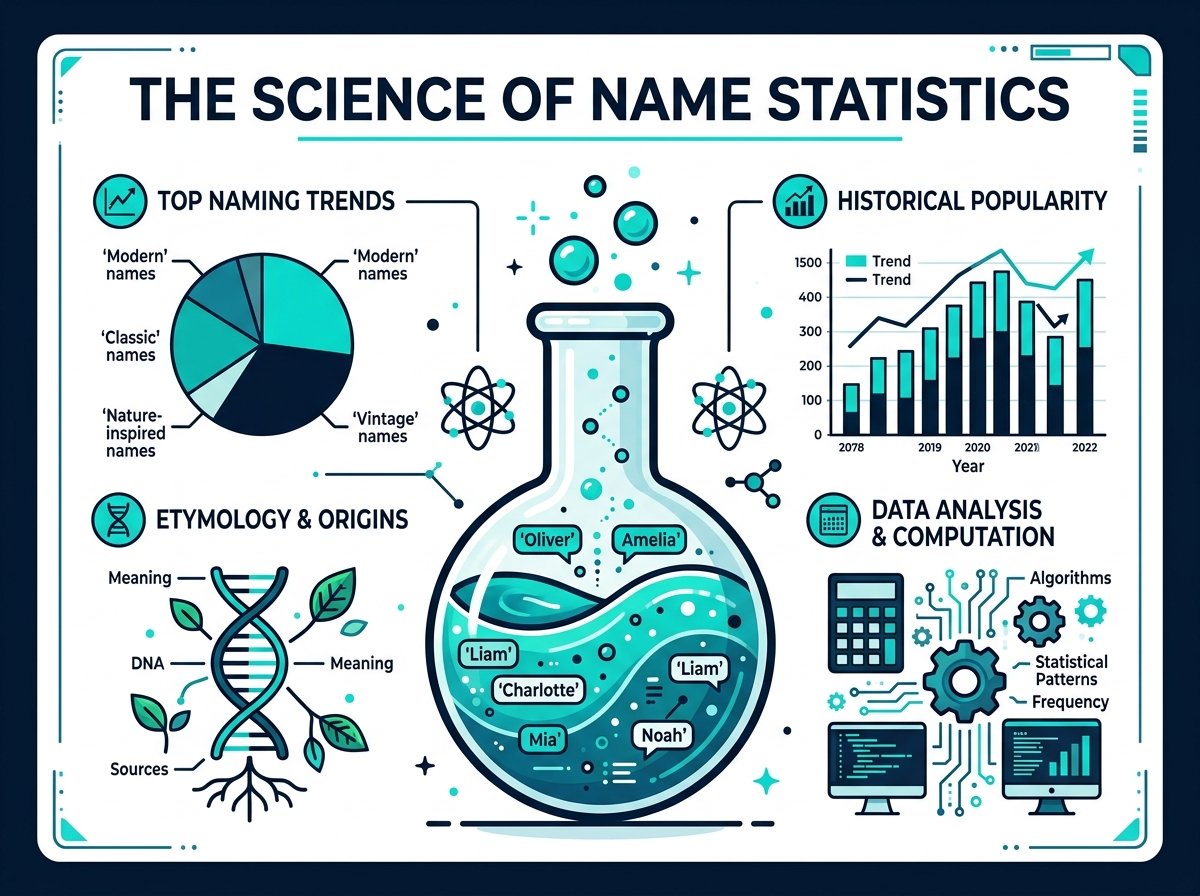
Right now, about 4.4 babies are born every single second across the globe. Each one gets a name. And behind every naming decision — whether it’s “Liam” or “Zaraiah” — there’s a massive ocean of data telling a story most people never hear.
Name statistics isn’t just about counting how many Jennifers exist. It’s a real science. Researchers, governments, data analysts, and even marketers use name data to track cultural shifts, predict trends, study immigration patterns, and understand human psychology.
You might think a name is just a name. But when you look at the numbers — really look at them — you’ll find patterns that explain everything from why your grandma’s name vanished for 60 years to why suddenly every other kid at the playground is called “Olivia.”
This article breaks down how name statistics actually work. Where does the data come from? What methods do researchers use? And what can these numbers genuinely tell us about society, culture, and even your own identity? Let’s get into it.
What Exactly Are Name Statistics?
Name statistics refer to the systematic collection, analysis, and interpretation of data about personal names — both first names and surnames. Think of it as the math behind naming culture.
At its core, this field answers questions like:
- How many people share a specific name?
- How has a name’s popularity changed over decades?
- Which names are growing, declining, or staying flat?
- What regional, ethnic, or cultural patterns exist in naming?
Quick Fact: The U.S. Social Security Administration (SSA) has tracked baby name data since 1880. That’s over 140 years of naming records — one of the longest continuous datasets on human behavior anywhere.
Name statistics sit at the intersection of demography (population science), linguistics (language patterns), sociology (cultural behavior), and increasingly, data science and machine learning.
And no, this isn’t just an academic exercise. Parents use name statistics to pick names. Businesses use them for customer targeting. Genealogists use them to trace family histories. Even legal professionals use name frequency data in identity verification cases.
If you’ve ever searched for how many people have your name, you’ve already touched the surface of this science.
Where Does Name Data Actually Come From?
Good data needs good sources. Name statistics rely on several key data pipelines, and understanding them helps you judge how reliable any name stat really is.
Government Birth Records
The biggest and most reliable source. In the United States, the SSA collects name data from every Social Security card application. Since almost every American gets a Social Security number, this dataset captures nearly the entire population.
Important detail: The SSA only publishes names that appear at least 5 times in a given year. So if a name was given to just 3 babies in 2024, it won’t show up in public data. This is a privacy measure, but it means the rarest names stay invisible in official stats.
Other countries have their own equivalents:
- UK: The Office for National Statistics (ONS) publishes annual baby name rankings
- France: INSEE tracks prénoms (first names) going back decades
- Australia: State-level registries publish name data independently
- India: Census data captures name patterns, though less systematically for first names
Census Data
Census records capture both first names and surnames across entire populations. The U.S. Census Bureau provides surname frequency data that tells you how many people share your surname and where those families are concentrated geographically.
Census data is especially powerful for studying last names because birth records focus primarily on first names.
Hospital and Vital Records
Local and state-level vital statistics offices record births, deaths, and marriages. These records often include name data that feeds into larger national databases.
Digital and Crowdsourced Data
Social media platforms, baby name websites, search engine queries, and forums like Reddit generate massive amounts of informal name data. While less “official,” this data captures real-time trends faster than government records.
Google Trends, for instance, can show you a spike in searches for a particular baby name weeks before any official data reflects the trend. You can explore the most searched baby names on Google to see this real-time effect.
Pro Tip: Always check the source behind any name statistic. Government data (SSA, Census) is the gold standard. Social media data is useful for spotting trends early but isn’t statistically rigorous.
The Methods Behind Name Analysis
Raw data is meaningless without proper analysis. Here’s how researchers and data scientists actually study name statistics.
Frequency Analysis
The most basic method. You count how many times a name appears in a dataset and rank names accordingly. The SSA’s annual “Top Baby Names” list is pure frequency analysis.
But raw frequency can be misleading. “James” might rank #1 in total count across all years, but that’s partly because it’s been popular for over a century. A name like “Liam” might have a shorter history but a higher peak concentration.
That’s why researchers also look at proportional frequency — what percentage of all babies in a given year received a specific name. This adjusts for population growth and gives a fairer comparison across eras.
Did You Know? In 1880, the #1 name “John” was given to 8.1% of all baby boys. In 2023, the #1 name “Liam” was given to only about 1% of boys. Names are more diverse now than ever before. The most popular name today is far less dominant than the most popular name a century ago.
Time-Series Analysis
This method tracks a name’s popularity over time — year by year, decade by decade. Plotting a name on a timeline reveals whether it’s rising, falling, cyclical, or one-hit.
Some patterns researchers have identified:
- Classic names (William, Elizabeth) show slow, steady curves with minor dips
- Trendy names (Brayden, Nevaeh) show sharp spikes followed by steep drops
- Revival names (Hazel, Theodore) show a U-shape — popular once, dormant for decades, then popular again
You can see these patterns clearly when you look at how name popularity changes over time. The shapes of these curves tell you a lot about how culture drives naming behavior.
Geographic Distribution Analysis
Names aren’t equally popular everywhere. “José” dominates in Texas and California but barely registers in Vermont. “Saoirse” clusters in areas with Irish-American populations.
Researchers use geographic mapping to study:
- Regional naming preferences
- Immigration and migration patterns
- Cultural enclaves and their influence on naming
- How name trends spread across states — which often follows predictable geographic paths
A name might start trending on the West Coast, move to urban centers in the Midwest, and reach the Southeast five to seven years later. Tracking this spread pattern helps demographers understand cultural diffusion.
Cluster Analysis and Pattern Recognition
More advanced statistical methods group names by shared characteristics. For example, names ending in “-aiden” (Aiden, Jayden, Brayden, Cayden) form a phonetic cluster that rose and fell together.
Cluster analysis helps answer questions like:
- Do names with certain sounds trend together?
- Are short names (3–4 letters) becoming more or less popular?
- Do names that sound “rich” or “successful” share phonetic traits?
Machine Learning and Predictive Models
This is the newest frontier. Data scientists now build algorithms that predict which names will trend next, based on historical patterns, phonetic features, cultural events, and even social media activity.
These models look for “leading indicators” — early signals that a name is about to take off. A name appearing in a hit TV show, being chosen by a celebrity, or gaining traction on parenting forums can all trigger prediction algorithms.
Curious about this? Check out how AI and data predict future baby names for a deeper look at where this technology is heading.
What Name Statistics Reveal About Society
Here’s where it gets really interesting. Name data doesn’t just tell you about names. It tells you about people — their values, fears, aspirations, and social dynamics.
Cultural Identity and Immigration
Name patterns are one of the clearest markers of cultural identity. When immigrant communities settle in a new country, their naming patterns tell a story of assimilation, resistance, and hybrid identity.
First-generation immigrants often give children traditional names from their home culture. Second-generation parents might choose names that work in both cultures (“Sara” works in English, Arabic, and Hindi). Third-generation families often shift toward mainstream names, though many are now reclaiming traditional names as a statement of pride.
The popularity of Muslim names in the USA, Hindu names worldwide, and Pakistani names globally all reflect these immigration and identity patterns.
Social Class Signals
Researchers like sociologist Stanley Lieberson studied how names “trickle down” through social classes. A name might start among upper-class families, get adopted by the middle class, then spread to working-class families — at which point upper-class families abandon it.
This cycle takes roughly 20–30 years and explains why some names feel “dated” to specific eras and class associations.
Real Example: The name “Madison” was virtually unused as a girl’s name before the 1984 movie Splash. It first caught on among affluent, educated families. By the 2000s, it had peaked across all demographics. By 2020, it was already declining — a textbook trickle-down curve.
Gender Fluidity
Name statistics track how gender associations shift. Names like Ashley, Lindsay, and Dana were originally male names that crossed over to female use. Once a name becomes predominantly female, male usage almost always drops to near zero — it rarely goes the other way.
This one-directional gender shift is one of the most consistent patterns in name statistics. Researchers call it the “contamination” effect (their word, not mine) — parents stop using a name for boys once it “sounds female.”
Today, gender-neutral names are trending as more parents deliberately choose names without strong gender associations. Names like Avery, Riley, and Quinn are now split fairly evenly between boys and girls.
Media and Pop Culture Impact
Name statistics provide hard proof of how media shapes behavior. The name “Arya” barely existed in SSA records before Game of Thrones premiered in 2011. By 2019, it was a Top 100 girl’s name.
Similarly, celebrity names that became trending show measurable spikes tied to specific fame events — album releases, award shows, viral moments.
The effect works in reverse too. After a public scandal, a celebrity’s name can drop measurably in baby name charts. Researchers have documented this with names like “Katrina” (after the 2005 hurricane) and “Alexa” (after Amazon’s voice assistant made the name feel less personal).
Common Myths About Name Statistics — Debunked
Myth #1: “Popular names are getting MORE popular”
Reality: The opposite is true. Name diversity has exploded. In the 1950s, the top 10 boys’ names accounted for about 30% of all boys born. Today, the top 10 cover less than 8%. Parents are choosing from a much wider pool, and you can see this shift clearly when exploring the most popular names by decade from 1950 to 2020.
Myth #2: “Name statistics are perfectly accurate”
Reality: They’re very good but not perfect. The SSA data misses names given fewer than 5 times. Census data relies on self-reporting. Spelling variations (Kaitlyn vs. Caitlin vs. Katelyn) fragment what is essentially the same name into separate entries, making each variant look less popular than the name actually is.
Some researchers now use “sound-alike” grouping to combine spelling variants, which gives a more accurate picture of true popularity.
Myth #3: “Rare names are getting rarer”
Reality: Actually, more parents than ever are choosing unusual names. The “long tail” of name distribution has grown dramatically. There are more unique names being given today than at any point in recorded history. Understanding what makes a name rare or common helps explain why “rare” is a relative concept that shifts with every generation.
Myth #4: “Name popularity is random”
Reality: Name trends follow surprisingly predictable patterns. Researchers have shown that name popularity follows mathematical models similar to fashion trends and even epidemic spread. A name “infects” a social network, spreads through exposure, peaks when saturation occurs, and declines as people seek novelty. It’s not random at all — it’s social physics.
Practical Uses of Name Statistics (That Actually Matter)
So who actually uses this data, and for what?
Parents Choosing Baby Names
The most obvious use case. Parents check name rankings to decide if they want a popular name (social belonging) or a rare one (individual identity). They check trends to avoid choosing a name that’s about to peak and feel “overused” within five years. If you’re in this boat, you might want to look at the most overused baby names right now before committing.
Identity Verification and Fraud Detection
Banks, government agencies, and tech companies use name frequency data in identity verification. If someone claims to be “John Smith” — one of the most common names in America — that requires different verification protocols than someone named “Xander Beauregard,” because the chances of name overlap are vastly different.
Genealogy and Ancestry Research
Name statistics help genealogists trace family origins. Surname distribution maps reveal where a family name originated, how it migrated, and which regions still have concentrations of that name today. The difference between first name and surname popularity matters a lot in genealogical research because surnames follow completely different statistical patterns than first names.
Marketing and Customer Analytics
Businesses use name data for customer segmentation. A name can (probabilistically) indicate age range, cultural background, and even geographic region. A customer named “Gertrude” is statistically likely to be in a very different demographic than a customer named “Skyler.”
Warning: Using name data for profiling raises serious ethical questions. It’s a tool that can inform or discriminate, depending on how it’s applied.
Academic Research
Economists, psychologists, and sociologists use name data to study bias, discrimination, and social outcomes. The famous study by Marianne Bertrand and Sendhil Mullainathan (2004) used name statistics to demonstrate racial discrimination in hiring — résumés with “white-sounding” names received 50% more callbacks than identical résumés with “Black-sounding” names.
This research shows that name statistics aren’t just abstract numbers. They connect directly to real-world outcomes, including whether your name can affect your career.
The Tools and Databases You Can Actually Use
You don’t need a statistics degree to explore name data. Several tools make this accessible to everyone:
- SSA Baby Names Database (ssa.gov): Free, searchable, covers 1880–present
- Behind the Name: Tracks etymology, usage, and popularity across countries
- Nameberry and BabyCenter: Real-time trending data from user searches
- HowManyOfMe.com: Estimates how many people share your exact name in the U.S.
- Forebears.io: Global surname distribution maps
- Google Trends: Real-time search interest in specific names
Pro Tip: Cross-reference multiple sources. The SSA tells you official registrations, Google Trends tells you what people are searching, and Nameberry tells you what expecting parents are actively considering. Together, these paint a much fuller picture than any single source.
If you want to check whether your own name is truly one-of-a-kind, here’s a guide on how to check if your name is truly unique.
The Future of Name Statistics
This field is evolving fast. Here’s where things are headed:
Real-time data: Government agencies are moving toward faster publication of name data. Instead of waiting a full year for SSA stats, we may soon see quarterly or even monthly updates.
Global integration: Right now, most name databases are country-specific. Projects are underway to create unified global name databases that can track cross-border naming patterns.
AI-powered prediction: Machine learning models are getting better at predicting name trends 3–5 years before they peak. These models analyze social media posts, entertainment content, and even baby name forum discussions to identify rising names before they hit official records.
Deeper cultural analysis: Researchers are combining name statistics with social media sentiment analysis, economic data, and cultural event tracking to understand not just what names are popular but why they become popular in specific moments.
Ethical frameworks: As name data gets used more in AI systems (facial recognition, automated hiring tools, credit scoring), the need for ethical guidelines around name-based profiling is growing. Expect more regulation and academic debate on this front.
FAQ
How are name statistics collected in the United States?
The primary source is the Social Security Administration (SSA), which records names from Social Security card applications. Since nearly every American receives an SSN, this captures almost the complete population. Names must appear at least 5 times in a year to be included in public datasets, which means extremely rare names stay unpublished for privacy protection. Census data supplements this with surname frequency and geographic distribution information.
Can name statistics predict future baby name trends?
Yes, to a degree. Data scientists use time-series analysis and machine learning to identify early signals of rising names. Factors like phonetic similarity to current popular names, appearance in media, celebrity usage, and search engine trends all serve as predictive indicators. These models aren’t perfect, but they can forecast broad trends with reasonable accuracy 2–5 years out. Revival patterns — old names cycling back — are especially predictable because they follow consistent generational rhythms.
Why do some names become popular suddenly and then disappear?
This pattern — called a “fad name” curve — happens because of what researchers call the “exposure-saturation-abandonment” cycle. A name gets exposure through media, a celebrity, or cultural events. Parents adopt it, creating a spike. Once the name feels “too common” or strongly associated with a specific era, new parents avoid it, causing a sharp decline. Names with strong cultural triggers (TV characters, one-hit celebrities) are most prone to this pattern. You can read more about why some names suddenly become popular and what drives these spikes.
Are name statistics different for first names versus surnames?
Absolutely. First names are subject to fashion, personal choice, and cultural trends — they change significantly from generation to generation. Surnames, on the other hand, are inherited and change much more slowly. Surname statistics reflect migration patterns, marriage practices, and historical population movements rather than personal taste. The statistical methods for analyzing each are quite different, and understanding the distinction matters for anyone doing genealogical or demographic research.
Your Name Is More Than a Label
Every name carries data — a hidden fingerprint of when you were born, where your family came from, what your parents valued, and what cultural forces shaped their decision. Name statistics give us the tools to read that fingerprint.
Whether you’re a parent picking the perfect name, a researcher studying cultural patterns, or just someone curious about how many people share your name — the science behind these numbers is both deeper and more accessible than most people realize.
Next time you hear a name, try thinking about it as a data point. What does it tell you about the person’s generation? Their cultural background? Their parents’ values? Once you start seeing names through a statistical lens, you’ll notice patterns everywhere.
And if you want to start exploring your own name’s data story, try finding out how many people have your name in the world. You might be surprised by what the numbers reveal.