
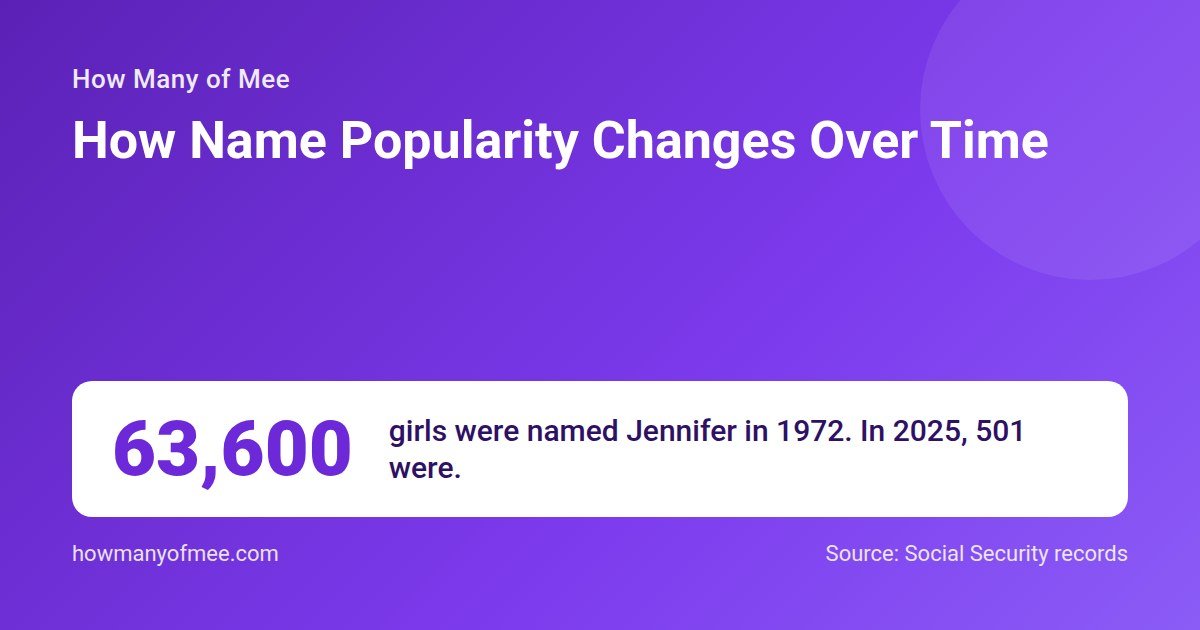
The name “Jennifer” ruled America for 15 straight years — from 1970 to 1984, it was the #1 baby girl name. Today? Barely 1,000 babies get that name each year. That’s a 97% drop.
Think about that for a second. Your parents probably spent weeks picking your name, believing it was perfect. But names don’t stay frozen in time. They rise, they peak, they fade — almost like fashion trends. The name your grandparents thought was timeless might sound outdated now. And the name that feels fresh today? Give it 30 years.
So what actually drives these shifts? Why do some names dominate for decades while others disappear in a flash? And can you predict what makes a name rare or common before it happens?
This article breaks down exactly how name popularity changes over time — backed by real SSA data, cultural patterns, and some surprises you probably didn’t expect.
The Life Cycle of a Name: How Popularity Actually Works
Every name follows a pattern. It’s not random. Researchers who study onomastics (the study of names) have found that names move through predictable stages — almost like a product life cycle.
Stage 1: The Discovery Phase
A name starts appearing in small pockets. Maybe a character on a TV show has it. Maybe a musician makes it cool. At this point, fewer than 500 babies per year get this name nationally.
Example: The name “Aria” barely existed before 2010. It sat quietly in the SSA database with a few hundred uses per year.
Stage 2: The Rapid Rise
Suddenly, the name catches fire. Parents hear it, love it, and start using it. Word spreads. The name jumps hundreds of spots in rankings within just 2-3 years.
Example: After “Game of Thrones” premiered in 2011, “Aria” (and its spelling variant “Arya”) shot from #172 to the top 20 in under five years.
Stage 3: The Peak
The name hits its highest point. Everyone knows multiple kids with that name. It feels ubiquitous. This peak can last anywhere from 1 year to 20+ years, depending on the name type.
Stage 4: The Decline
Parents start avoiding the name precisely because it’s too common. They want something fresher. The name begins its slow descent.
Stage 5: The “Dated” Phase
The name now belongs to a specific generation. Hearing it instantly makes you think of a certain age group. Think “Shirley” (1930s), “Karen” (1960s), or “Brittany” (1990s).
Stage 6: The Potential Revival
Here’s where it gets interesting. Some names — after spending 60-80 years in decline — come back. Old-fashioned names making a comeback is a real and measurable phenomenon. Names like Hazel, Theodore, and Eleanor have all completed this full cycle.
Did You Know? The average “hot” baby name takes about 20 years to go from obscurity to peak popularity, then another 40-60 years to fully cycle back.
What Drives Name Popularity? The 7 Biggest Factors
Names don’t change popularity in a vacuum. Specific, identifiable forces push names up or pull them down. Let’s look at what actually moves the needle.
1. Pop Culture and Entertainment
This is the single most powerful force in modern name trends. Movies, TV shows, music, and now streaming content directly shape what parents name their babies.
Real data points:
- “Khaleesi” — not even a real name, it’s a fictional title — was given to over 500 babies in 2018
- After Disney’s “Frozen” (2013), the name “Elsa” actually dropped because parents associated it too strongly with the character
- “Maverick” surged after Top Gun’s sequel in 2022, jumping into the top 40
The speed of pop culture influence has increased dramatically. In the 1950s, a popular movie might influence names over 5-10 years. Today, a viral Netflix series can shift naming patterns within months. You can see why some names suddenly become popular almost overnight because of this acceleration.
2. Celebrity Influence
Celebrities affect name trends in two distinct ways:
Direct influence — Parents name babies after the celebrity. When Beyoncé became a global icon, the name (and its variants) appeared more frequently.
Indirect influence — Celebrities give their own children unusual names, and those names trickle into the mainstream. When Gwyneth Paltrow named her daughter “Apple” in 2004, it didn’t start a trend for “Apple” specifically. But it normalized the idea of using unconventional word-names for babies.
Check out how celebrity names that became trending have reshaped naming patterns over the last few decades.
3. Sound Patterns and Phonetic Trends
Here’s something most people don’t realize — name popularity isn’t just about individual names. It’s about sounds.
Certain sounds become trendy, and multiple names riding that sound wave rise together:
- 1980s-90s: Names ending in “-ica” or “-ika” (Jessica, Monica, Erica)
- 2000s: Names ending in “-den” or “-aiden” (Aiden, Jayden, Brayden, Cayden)
- 2010s: Names ending in “-a” for boys (Noah, Elijah, Ezra, Joshua)
- 2020s: Names with soft, vowel-heavy sounds (Liam, Mia, Ava, Kai)
Linguist Laura Wattenberg, creator of the Baby Name Wizard, calls this the “sound of the era.” Parents might think they’re choosing a unique name, but they’re actually gravitating toward the same phonetic palette as thousands of other parents.
4. Generational Avoidance
This is the “grandparent rule.” Parents almost never name their child after their own generation’s popular names. You won’t find many Millennial parents naming their daughter “Ashley” or “Amanda” — those names feel too much like their own peers.
But go back one more generation? That’s fair game. Names that were popular with great-grandparents feel fresh again because nobody in the child’s immediate social circle has them.
That’s why names like Evelyn, Arthur, Clara, Henry, and Violet have all surged in the 2020s. They skipped the parents’ generation entirely and landed back in style.
5. Social and Political Shifts
Names reflect the culture they’re born in. Social movements, immigration patterns, and political climates all leave fingerprints on naming data.
Some patterns:
- After major wars, patriotic and traditional names surge
- Immigration waves introduce new names into the national data (Maria, Mohammed, Priya)
- Gender equality movements have pushed gender-neutral names that are trending into the mainstream — names like Riley, Avery, Quinn, and Charlie are now used almost equally across genders
- Cultural pride movements increase usage of heritage-specific names
6. The Uniqueness Drive
Modern parents — especially Millennials and Gen Z — place a premium on individuality. The SSA data proves it: the top 10 names today account for a much smaller percentage of all babies compared to the 1950s.
In 1950, about 30% of all boys were named one of the top 10 names. By 2024, that number dropped below 8%. Parents are deliberately spreading out, choosing from a wider pool than ever before. Why parents choose rare names today ties directly into this cultural shift toward standing out.
7. Social Media and the Internet
This is the newest factor, and its impact is still growing. Parents now Google potential baby names before committing. They check Instagram, TikTok, and Reddit. They run the name through tools that check if your name is truly unique.
How social media influences baby names goes beyond just trend-spotting. A viral TikTok video mocking a name can tank its popularity. A beloved “momfluencer” announcing her baby’s name can spike interest overnight.
Pro Tip: If you’re picking a baby name and want to gauge its trajectory, check the SSA’s Baby Names database (ssa.gov/oact/babynames/) and look at the last 5 years of data. A name climbing 50+ spots per year is still on its way up. A name that peaked 2-3 years ago is likely starting its descent.
Decade-by-Decade: How America’s Favorite Names Shifted
Let’s walk through the actual data. This isn’t guesswork — this comes from the Social Security Administration’s database of every registered birth in the United States.
1950s: The Era of Conformity
Top boys: James, Robert, John, Michael, David
Top girls: Mary, Linda, Patricia, Susan, Deborah
Names were narrow. A small group of names dominated massively. If you met a woman born in the 1950s, there was nearly a 1-in-10 chance her name was Mary. The culture valued fitting in, and naming choices reflected that.
1970s: The Jennifer Explosion
Top boys: Michael, Christopher, Jason, David, James
Top girls: Jennifer, Amy, Melissa, Michelle, Kimberly
Jennifer appeared seemingly from nowhere — it ranked #20 in the 1960s and then held the #1 spot for a decade and a half. Michael stayed dominant on the boys’ side for an astonishing 44 years (1954-1998).
1990s: The Rise of Variety
Top boys: Michael, Christopher, Matthew, Joshua, Jacob
Top girls: Jessica, Ashley, Emily, Samantha, Sarah
Something shifted here. While the top names were still popular, the total percentage of babies receiving top-10 names started declining. Parents began experimenting more.
2000s-2010s: The Aiden Takeover
Top boys: Jacob, Ethan, Michael, Aiden, Jayden
Top girls: Emily, Madison, Emma, Olivia, Hannah
The “-aiden” sound family exploded. At one point in the mid-2000s, if you combined Aiden, Jayden, Brayden, Cayden, Hayden, and all their spelling variants, they collectively represented one of the biggest naming phenomena in American history.
2020s: The Current Landscape
Top boys: Liam, Noah, Oliver, James, Elijah
Top girls: Olivia, Emma, Charlotte, Amelia, Sophia
You can explore the most popular names by decade from 1950 to 2020 to see the full picture. The trend is clear: more diversity, shorter names, softer sounds, and a noticeable return to vintage picks.
Names That Switched Genders Over Time
Here’s a fascinating pattern most people overlook. Some names have completely switched from one gender to another — and this shift almost always goes in one direction: from masculine to feminine.
Classic examples:
- Ashley — Originally a boys’ name (think Ashley Wilkes in Gone With the Wind, 1939). By the 1980s, it was almost exclusively a girls’ name.
- Lindsay — A boys’ name in the 1940s-60s. Now overwhelmingly female.
- Dana — Started male, shifted female by the 1960s.
- Avery — Was 98% male in the 1990s. Now split nearly 50/50, trending female.
Why does this happen in one direction? Researchers suggest it’s because parents of boys avoid names they perceive as “becoming feminine,” but parents of girls readily adopt names with masculine energy.
This creates a one-way valve. Once a name tips toward female usage past a certain threshold (usually around 30-40% female), it accelerates rapidly toward full female adoption. The names that changed gender popularity over time are a perfect case study in how cultural perception shapes naming behavior.
Common Myths About Name Popularity (Debunked)
Myth 1: “Classic Names Never Go Out of Style”
Reality: Even the most “timeless” names experience significant fluctuations. “John” was the #1 or #2 boys’ name for most of American history. In 2024, it doesn’t even crack the top 20. It still gets used — but at a fraction of its former dominance.
The only truly stable names are the ones that maintain moderate, consistent popularity without ever peaking too high. Names like “Elizabeth” and “William” come closest, but even they show clear decade-to-decade variation.
Myth 2: “Popular Names Become Popular Because They’re Beautiful”
Reality: Name aesthetics are almost entirely subjective and era-dependent. “Gertrude” was a top-20 name in 1900. Does it sound beautiful to you now? Probably not. But it did to people in 1900.
What we perceive as a “pretty” name is heavily influenced by what’s currently popular. You’re not objectively evaluating the name — you’re responding to its cultural associations.
Myth 3: “Unique Names Are a Modern Invention”
Reality: Unusual names have existed throughout American history. The SSA data shows that in every decade, there are names given to only a handful of babies. What’s changed isn’t the existence of unique names — it’s the percentage of parents choosing them. That percentage has increased significantly since the 1980s. You can look at some of the rarest baby names ever recorded to see just how creative parents have been across every era.
Myth 4: “Government Databases Track All Name Trends Perfectly”
Reality: The SSA only started tracking names consistently in 1935 (when Social Security numbers became widespread). Anything before that relies on Census data and state-level records, which are incomplete. Also, the SSA only publishes data for names given to at least 5 babies of one gender in a given year. Names below that threshold — which number in the thousands — are excluded from public data.
Regional Differences: Names Don’t Trend Evenly
Name popularity doesn’t spread like a uniform wave across the country. It moves regionally, often starting on the coasts and working inward — though not always.
Key regional patterns:
- Southwestern states adopt Spanish-influenced names at much higher rates (Santiago, Mateo, Valentina)
- Southern states hold onto traditional and Biblical names longer than the national average
- Pacific Northwest and Northeast tend to adopt trendy names 2-3 years before the national curve
- Texas and California, being the two largest states by births, disproportionately influence national rankings
The name “Liam” provides a perfect case study. It appeared in the Northeast first, became trendy in California about 2 years later, and reached peak adoption in Midwestern states about 4 years after that. How name trends spread across states shows this geographic ripple effect clearly.
Quick Fact: The most popular names in Texas and the most popular names in California overlap significantly — but the order and the speed of adoption differ noticeably.
How to Predict Where a Name Is Headed
Can you actually forecast whether a name will rise or fall? Not with perfect accuracy — but with surprisingly good odds if you know what to look for.
Signs a Name Is About to Peak:
- It’s been climbing steadily for 5-7 years
- It appears on multiple “trending baby names” lists
- You personally know 3+ babies/toddlers with that name
- It shows up in pop culture (TV characters, celebrity babies)
- It appears in the SSA top 20 for the first time
Signs a Name Has Peaked and Will Decline:
- It’s been in the top 10 for 5+ consecutive years
- Parents start saying “I love that name, but it’s too popular now”
- Parenting forums show backlash against it
- Comedians or memes reference it as “every kid’s name”
- Spelling variants start appearing (parents want the sound but not the “common” version)
Signs a Name Might Come Back:
- It was last popular 70-100 years ago
- It has a vintage, elegant sound
- It appears in period films or shows (think Downton Abbey boosting Edith, Cora, and Violet)
- Lifestyle bloggers and influencers start using it
How AI and data predict future baby names is becoming a real field now. Data scientists use pattern recognition to forecast which names will trend 5-10 years from now.
The Speed of Change Is Accelerating
One thing the data makes crystal clear: names cycle faster now than they used to.
The numbers tell the story:
- 1900-1950: A top name could hold its position for 30-50 years (Mary, John, Robert)
- 1960-1990: Top name cycles shortened to 10-15 years (Jennifer, Jason, Jessica)
- 2000-present: A name can peak and begin declining within 5-8 years (Nevaeh, Jayden, Aria)
Why the acceleration? Information travels faster. A name can go from “undiscovered gem” to “overused” in just a few years because parents have access to the same data, the same social media, and the same pop culture simultaneously.
This creates an interesting paradox. The more tools parents have to find unique names, the faster those “unique” names become common — which makes them feel less unique — which makes parents abandon them sooner.
FAQ Section
How often does the SSA update its baby name data?
The Social Security Administration releases its annual baby name data every May, covering all births from the previous calendar year. The data includes every name given to at least 5 babies of one gender in that year. You can access it free at ssa.gov/oact/babynames/.
Do names become popular and unpopular at the same rate?
No — and this is a crucial insight. Names typically rise to popularity much faster than they decline. A name might rocket from obscurity to the top 10 in 5-7 years, but the decline from peak to “dated” usually takes 20-40 years. The rise is sharp; the fall is gradual.
Can a name with negative associations recover?
It depends on the severity. Names associated with historical villains (Adolf, for instance) rarely recover. Names linked to temporary scandals or negative pop culture moments can bounce back after a generation. The name “Alexa” dropped significantly after Amazon’s virtual assistant launched in 2014 — whether it recovers depends on how long the product stays dominant.
Why do some names stay consistently popular without big peaks or drops?
Names like Elizabeth, James, and Alexander maintain steady popularity because they’re deeply embedded in cultural and religious traditions, have multiple nickname options, and don’t carry strong generational associations. They never become trendy enough to trigger the avoidance response.
Is it possible to predict the #1 baby name 10 years from now?
Not with certainty, but patterns offer strong hints. Look at names currently ranked #50-#150 that are rising 20+ spots per year. Also watch what influencers and celebrities are naming their children. Data scientists using name statistics and analysis have gotten reasonably close with 5-year predictions.
Your Name Tells a Story About When You Were Born
Here’s the thing that makes name popularity so fascinating — your name isn’t just a label. It’s a timestamp. It carries the culture, the trends, the hopes, and the anxieties of the exact moment your parents chose it.
A “Linda” was probably born in the 1950s. A “Brittany” screams 1990s. And someday, “Liam” and “Olivia” will immediately signal “early 2020s” to whoever hears them.
That doesn’t make any name better or worse. It makes every name a small piece of social history.
If you’re curious about your own name’s journey — where it’s been, how many people share it, and where it might be headed — check how many people have your name. You might be one of millions. Or you might be one of a handful. Either way, your name connected you to a moment in time that will never repeat exactly the same way again.
And honestly? That’s pretty cool.
