
The name “James” dominated American hospitals in 1950. By 2020, it didn’t even crack the top 5. That single shift tells you something fascinating — names aren’t random. They’re shaped by culture, celebrities, world events, and even TV shows your parents were watching.
Think about it. Your name carries a timestamp. Someone named Linda? Probably born in the 1950s. A Jessica? Almost certainly an ’80s or ’90s kid. An Olivia? She’s likely still in school right now.
Over the past seven decades, baby name trends in the United States have swung dramatically. Classic names rose, fell, and sometimes came back around. Entirely new names appeared out of nowhere. And some once-dominant names practically vanished.
This article walks you through the most popular names by decade from 1950 to 2020, based on U.S. Social Security Administration (SSA) data. You’ll see exactly what parents chose, why certain names exploded in popularity, and what these patterns reveal about American culture across generations.
Whether you’re picking a name for your baby, researching your own name’s history, or just plain curious — you’re going to find some surprises here.
Why Do Baby Name Trends Change Over Time?
Before we jump into the decade-by-decade breakdown, let’s talk about why names shift at all. It’s not random. Several forces push names in and out of favor.
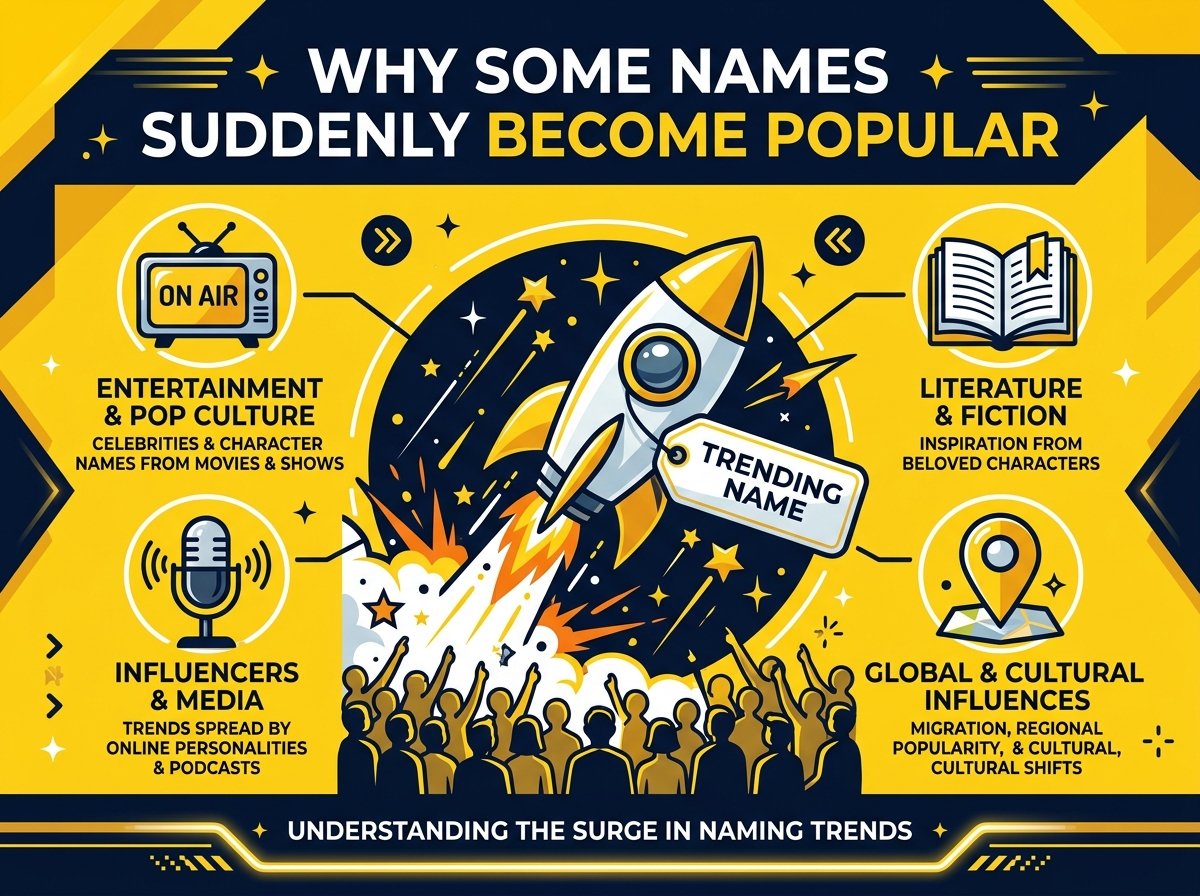
Cultural icons matter — a lot. When a celebrity, fictional character, or public figure captures the public imagination, their name tends to spike. Elvis didn’t just change music. He changed birth certificates across the country.
Generational rebellion plays a role too. Parents often avoid names that feel “too common” from their own childhood. That’s why names like Gary and Deborah — huge in the 1950s — feel almost extinct among today’s newborns. You can explore why some names suddenly become popular for a deeper look at these triggers.
Immigration patterns, religious traditions, and regional preferences also shape the list. A name popular in Texas might not even register in Vermont. Name trends spread across states at different speeds, almost like a cultural wave.
And here’s something most people don’t realize: the very concept of “popular” has changed. In the 1950s, the #1 name might claim 5–6% of all babies. By 2020, the #1 name captures barely 1%. Parents today spread their choices across thousands of options. Popularity itself has become less concentrated.
Now, let’s look at what actually topped the charts — decade by decade.
The 1950s: The Era of Classic, Strong Names
The post-World War II baby boom was in full swing. America was building suburbs, watching brand-new television sets, and having a lot of babies. The names parents picked reflected stability, tradition, and a certain no-nonsense confidence.
Top Boys’ Names (1950s)
| Rank | Name | Approximate Births |
|---|---|---|
| 1 | James | 846,000+ |
| 2 | Robert | 832,000+ |
| 3 | John | 803,000+ |
| 4 | Michael | 790,000+ |
| 5 | David | 771,000+ |
Top Girls’ Names (1950s)
| Rank | Name | Approximate Births |
|---|---|---|
| 1 | Mary | 625,000+ |
| 2 | Linda | 565,000+ |
| 3 | Patricia | 451,000+ |
| 4 | Susan | 440,000+ |
| 5 | Deborah | 430,000+ |
What stands out? These names are short, traditional, and overwhelmingly biblical or Anglo-Saxon in origin. James, John, Robert, and Mary had been popular for decades before the 1950s. They weren’t trendy choices — they were safe, trusted, and familiar.
Did You Know? The name “Linda” went from barely used in the 1930s to the #1 girls’ name by 1947. A single popular song — “Linda” (1946) — helped spark the craze. That’s how celebrity influence shapes baby names in real time.
The 1950s also gave us names like Barbara, Karen, Richard, and Gary in huge numbers. If you’re wondering how many people share your name and you were born in this era, chances are the answer is “quite a few.”
The 1960s: Tradition Meets Transition
The 1960s started with Eisenhower and ended with Woodstock. Culturally, the decade was a bridge between old-school America and the counterculture explosion. Baby names reflected that tension.
Top Boys’ Names (1960s)
| Rank | Name |
|---|---|
| 1 | Michael |
| 2 | David |
| 3 | John |
| 4 | James |
| 5 | Robert |
Top Girls’ Names (1960s)
| Rank | Name |
|---|---|
| 1 | Lisa |
| 2 | Mary |
| 3 | Susan |
| 4 | Karen |
| 5 | Kimberly |
Michael officially took the #1 spot for boys and wouldn’t let go for a very long time. On the girls’ side, Lisa surged out of nowhere to dominate the decade — partly thanks to the name’s appearance on the soap opera “As The World Turns.”
The 1960s also saw the first hints of name diversity. Parents began experimenting slightly more, though the top 10 still looked pretty traditional. Names like Jennifer were quietly building momentum, ready to explode in the next decade.
Quick Fact: The name Karen peaked in 1965. Nearly 33,000 baby girls received the name that year alone. Today, it barely appears in the top 500. Name popularity changes over time in ways that would shock most people.
The 1970s: Jennifer Rules Everything
If you grew up in the late 1970s or early 1980s, you probably knew at least three Jennifers. This name didn’t just top the charts — it dominated them in a way few names ever have.
Top Boys’ Names (1970s)
| Rank | Name |
|---|---|
| 1 | Michael |
| 2 | Christopher |
| 3 | Jason |
| 4 | David |
| 5 | James |
Top Girls’ Names (1970s)
| Rank | Name |
|---|---|
| 1 | Jennifer |
| 2 | Amy |
| 3 | Melissa |
| 4 | Michelle |
| 5 | Kimberly |
Michael held firm at #1 for boys for the entire decade. The real story was the rise of Christopher and Jason — names that felt slightly fresher than the old James/Robert/John trio.
For girls, Jennifer was unstoppable. The name held the #1 position from 1970 all the way to 1984 — a 15-year reign that’s almost unmatched in SSA history. The movie “Love Story” (1970) played a huge role, making the name feel romantic, modern, and aspirational.
Pro Tip: If your name peaked in the 1970s and you want to check just how common it is, try looking up how many people have your name. The numbers for Jennifer and Michael from this era are staggering.
The ’70s also introduced something new: unisex name experiments. Names like Kelly, Tracy, and Dana started appearing for both boys and girls. This was the beginning of a trend that would grow significantly in later decades.
The 1980s: Pop Culture Takes the Wheel
MTV launched in 1981. “The Cosby Show” debuted in 1984. Movies like “The Breakfast Club” and “Dirty Dancing” defined a generation. Pop culture had always influenced names, but the 1980s kicked that influence into high gear.
Top Boys’ Names (1980s)
| Rank | Name |
|---|---|
| 1 | Michael |
| 2 | Christopher |
| 3 | Matthew |
| 4 | Joshua |
| 5 | David |
Top Girls’ Names (1980s)
| Rank | Name |
|---|---|
| 1 | Jessica |
| 2 | Jennifer |
| 3 | Amanda |
| 4 | Ashley |
| 5 | Sarah |
Jessica dethroned Jennifer, and Amanda and Ashley climbed fast. What’s interesting about these names is their sound. Notice the soft vowels, the flowing syllables. The 1980s clearly favored names that sounded feminine and melodic for girls.
Michael remained #1 for boys — its fourth consecutive decade at the top. But Joshua and Matthew signaled a shift toward biblical names with a slightly softer feel than the hard-sounding Robert and Richard of earlier decades.
Did You Know? The name Ashley was primarily a boys’ name before the 1980s. The character Ashley Wilkes in “Gone With the Wind” was male. By the ’80s, it had crossed over almost entirely to girls — a perfect example of names that changed gender popularity over time.
The 1980s were also when regional differences started becoming more noticeable. Hispanic names like Jose and Maria were climbing fast in states like California and Texas, while the top-10 national lists remained largely Anglo-Saxon.
The 1990s: The Jessica-to-Emily Pipeline
The 1990s felt like a naming identity crisis in the best possible way. Old classics were fading. New favorites were emerging. And parents started caring — really caring — about finding something that felt special.
Top Boys’ Names (1990s)
| Rank | Name |
|---|---|
| 1 | Michael |
| 2 | Christopher |
| 3 | Matthew |
| 4 | Joshua |
| 5 | Jacob |
Top Girls’ Names (1990s)
| Rank | Name |
|---|---|
| 1 | Jessica |
| 2 | Ashley |
| 3 | Emily |
| 4 | Sarah |
| 5 | Samantha |
The big story here? Jacob entered the boys’ top 5 for the first time, quietly positioning itself for a #1 takeover in 1999 that would last over a decade. And for girls, Emily was climbing fast.
The 1990s also saw the first wave of “creative spelling.” Kaitlyn, Ashleigh, Brittney — parents wanted familiar sounds but unique looks. This was the decade where the psychology behind unique names really started influencing mainstream choices.
Michael finally lost his grip at the very end of the decade. After holding #1 for roughly 40 years across four decades (with a couple of brief interruptions), it was dethroned by Jacob in 1999. End of an era.
Pro Tip: The 1990s marked the beginning of what researchers call “the uniqueness premium” — parents actively avoiding top-10 names because they seemed too common. This is why the percentage of babies getting the #1 name started dropping sharply.
The 2000s: The Internet Changes Everything
Google was born. Social media started. Parents could now search name popularity data before making their choice. And that access to information fundamentally changed naming behavior.
Top Boys’ Names (2000s)
| Rank | Name |
|---|---|
| 1 | Jacob |
| 2 | Michael |
| 3 | Joshua |
| 4 | Matthew |
| 5 | Ethan |
Top Girls’ Names (2000s)
| Rank | Name |
|---|---|
| 1 | Emily |
| 2 | Madison |
| 3 | Emma |
| 4 | Olivia |
| 5 | Hannah |
Jacob and Emily ruled the 2000s with remarkable consistency. But look at the girls’ list — Madison didn’t even exist as a first name before the 1984 movie “Splash,” where Daryl Hannah’s character chose it from a street sign. By the 2000s, it was the #2 girls’ name in America. That’s the power of pop culture.
Emma and Olivia were also rising fast, setting the stage for the next decade’s dominance. These names have a distinctly “vintage revival” feel — old-fashioned names that parents rediscovered and made new again. The trend of old-fashioned names making a comeback was in full swing.
The 2000s brought another major shift: cultural diversity in the top 100. Names like Angel, Diego, Sofia, and Aiden began appearing regularly. The American naming landscape was becoming genuinely multicultural.
How the Internet Changed Naming
Before the internet, parents chose names based on family tradition, regional trends, and whatever sounded nice. Starting in the 2000s, they could:
- Check SSA popularity rankings instantly
- Read baby name forums and blogs
- Discover names from other cultures
- Deliberately avoid “overused” names
This digital awareness accelerated the decline of name concentration. The most searched baby names on Google became a new way to track real-time trends.
The 2010s: Liam Takes Over, Diversity Wins
The 2010s were defined by social media, streaming TV, and a radical shift toward global name choices. Instagram, Netflix, and YouTube exposed parents to names from cultures they’d never encountered before.
Top Boys’ Names (2010s)
| Rank | Name |
|---|---|
| 1 | Noah |
| 2 | Liam |
| 3 | Jacob |
| 4 | Mason |
| 5 | William |
Top Girls’ Names (2010s)
| Rank | Name |
|---|---|
| 1 | Emma |
| 2 | Olivia |
| 3 | Sophia |
| 4 | Isabella |
| 5 | Ava |
Noah and Liam battled for #1 through the decade. Liam — originally an Irish short form of William — felt fresh, strong, and international. Its rise coincided with Liam Neeson’s action-movie fame and Liam Hemsworth’s Hunger Games popularity.
For girls, Emma took the crown, followed closely by Olivia, Sophia, and Isabella. Notice a pattern? Every single top-5 girls’ name ends in a vowel sound. The 2010s heavily favored names that felt soft, classic, and internationally recognizable.
The Twilight Effect deserves special mention. The “Twilight” book and film series (2008–2012) pushed Isabella, Jasper, Emmett, Rosalie, and Alice significantly up the charts. Celebrity and fictional character names had never been more powerful.
Did You Know? The name Mason jumped from #72 in 2009 to #2 by 2011. Why? Kourtney Kardashian named her son Mason in December 2009. One celebrity baby announcement moved a name 70+ positions. That’s how social media influences baby names in the modern era.
The 2010s also saw the explosion of gender-neutral names. Names like Riley, Avery, Harper, and Quinn became popular for both boys and girls. Gender-neutral names that are trending reflected broader cultural conversations about gender and identity.
The 2020s: Where We Are Now
The early 2020s data (2020–2024 SSA records) show some fascinating patterns. COVID-19, social justice movements, streaming entertainment, and a deeper emphasis on individuality are all leaving fingerprints on the name charts.
Top Boys’ Names (2020–2024)
| Rank | Name |
|---|---|
| 1 | Liam |
| 2 | Noah |
| 3 | Oliver |
| 4 | James |
| 5 | Elijah |
Top Girls’ Names (2020–2024)
| Rank | Name |
|---|---|
| 1 | Olivia |
| 2 | Emma |
| 3 | Charlotte |
| 4 | Amelia |
| 5 | Sophia |
Liam is the undisputed king of the 2020s so far, and Olivia has locked down the girls’ #1 spot with remarkable consistency. But the surprises are further down the list.
Oliver jumped into the boys’ top 3, and James made a comeback — both names that feel decidedly vintage. On the girls’ side, Charlotte and Amelia are riding a massive “old-world elegance” wave.
Elijah cracking the top 5 is noteworthy too. Biblical names are making a strong return, but parents are picking the less obvious ones — Elijah over John, Ezra over Mark, Naomi over Ruth.
What’s Shaping 2020s Name Choices?
- Streaming shows: Characters from Bridgerton, Wednesday, and other hit series are influencing picks
- Vintage revival: Names from the 1900s–1920s are cycling back
- Cultural pride: Parents choosing names that reflect their heritage
- Uniqueness obsession: The #1 name now represents less than 1% of all births
- Sound preferences: Short, strong names for boys (Liam, Kai, Leo); flowing, vowel-rich names for girls
The most popular Gen Z names look radically different from what Millennials were given, and that gap keeps widening.
Names That Disappeared (And Ones Making a Comeback)
Some names from the 1950s–1970s have essentially vanished from modern birth certificates. Others are staging surprising comebacks.
Names That Faded Away
- Gary — Top 10 in the 1950s, now below #600
- Linda — #1 in the 1950s, now below #700
- Deborah — Top 5 in the 1950s, now nearly off the charts
- Todd — Popular through the ’70s, now extremely rare for newborns
- Tammy — Peaked in the late 1960s, virtually unused today
Names Staging a Comeback
- Theodore — Barely used in the 1980s–1990s, now back in the top 25
- Eleanor — Down and out for decades, now climbing fast
- Henry — Felt “old man-ish” in the 1990s, now a top-10 contender
- Hazel — Almost extinct by 1990, now a trendy choice
- Arthur — Rising steadily after decades in the wilderness
If you had a millennial name that’s now disappearing, don’t worry — it might come back in style 30 years from now. Names tend to cycle in roughly 100-year patterns.
Pro Tip: The “100-year rule” suggests that names need about three generations to feel fresh again. Your great-grandmother’s name might sound dated to your parents but trendy to you. That’s exactly what’s happening with names like Evelyn, Clara, and Violet right now.
What Makes a Name Dominate an Entire Decade?
Not every popular name manages to own an entire decade. Some flash brightly for two or three years and fade. Others — like Michael, Jennifer, or Liam — sustain their dominance for 10+ years.
What separates a briefly trendy name from a decade-defining one?
It has to work across demographics. Michael succeeded because it sounded equally natural in the South, the Northeast, among different ethnicities, and across economic classes. Names that feel too tied to one region or group rarely sustain long-term #1 status.
It can’t be too unusual. Decade-dominators are always easy to spell, easy to pronounce, and familiar-sounding. You’ll never see Xander or Juniper hold #1 for a full decade — they’re too “niche” for mainstream dominance.
It needs cultural reinforcement. Michael had Michael Jordan, Michael Jackson, Michael J. Fox. Emma had “Friends” (Emma was Ross and Rachel’s baby), Jane Austen’s “Emma,” and Emma Watson. A name needs multiple cultural touch points to stay on top.
Understanding what makes a name rare or common helps you see these patterns clearly. It’s never just one factor — it’s a combination of sound, timing, culture, and accessibility.
The Decade-by-Decade Pattern: A Visual Summary
Here’s a quick at-a-glance view of #1 names across seven decades:
| Decade | #1 Boys’ Name | #1 Girls’ Name |
|---|---|---|
| 1950s | James | Mary |
| 1960s | Michael | Lisa |
| 1970s | Michael | Jennifer |
| 1980s | Michael | Jessica |
| 1990s | Michael → Jacob | Jessica → Emily |
| 2000s | Jacob | Emily |
| 2010s | Noah / Liam | Emma |
| 2020s | Liam | Olivia |
Notice how slowly boys’ names change compared to girls’ names. Michael held #1 for roughly four decades. On the girls’ side, the #1 name shifted almost every decade. Researchers believe this reflects stronger pressure on girls’ names to feel “current” and “fresh,” while boys’ names are judged more on tradition and stability.
Common Myths About Name Popularity
Myth #1: “Old names are unpopular.”
Wrong. As of 2024, Henry, Eleanor, Theodore, and Charlotte are all surging. Old doesn’t mean unpopular — it means the name has had enough time to feel fresh again.
Myth #2: “The most popular name means everyone has it.”
Not even close. In 2023, the #1 name Liam was given to about 12,500 boys out of approximately 1.8 million total male births. That’s less than 0.7%. Compare that to the 1950s, when the #1 name could capture 4–5% of all births.
Myth #3: “Unique names are a modern trend.”
Parents have always tried to stand out. In the 1890s, names like Pearl, Myrtle, and Dewey were considered creative departures from the standard William/Mary pattern. The desire for uniqueness isn’t new — it’s just more visible now because of social media. You can check why parents choose rare names today for more context.
Myth #4: “Trendy names hurt your career.”
Research on this is mixed. Some older studies suggested that “unusual” names faced bias, but newer research shows that as diversity increases, name-based discrimination is decreasing. Still, can your name affect your career is a legitimate question worth exploring.
FAQ Section
What was the most popular baby name of all time in the U.S.?
James holds the strongest claim for boys, having been in the top 5 for over a century. For girls, Mary dominated from the late 1800s through the 1960s, making it the most consistently popular female name in American history. Based on SSA data, no other names come close to their combined totals across all decades.
Why did the name Michael stay #1 for so long?
Michael benefited from a perfect storm of factors: it’s biblical (giving it deep cultural roots), easy to pronounce in English and many other languages, and had continuous celebrity reinforcement (Michael Jordan, Michael Jackson, Michael J. Fox). It also works across racial and socioeconomic lines, which most decade-defining names share. The name didn’t feel tied to any single group, region, or era.
Are baby names really becoming more unique?
Yes, and the data proves it clearly. In 1950, the top 10 boys’ names accounted for roughly 30% of all births. By 2020, the top 10 boys’ names covered less than 8% of births. Parents are spreading their choices across a much wider pool. The rise of the internet, multicultural awareness, and social media has given parents access to thousands of options they wouldn’t have encountered a generation ago. You can explore common names vs. unique names to see this shift in detail.
How do I find out if my name was popular during my birth decade?
The easiest way is to check the SSA’s baby names database, which covers every name given to 5 or more babies in any given year since 1880. You can also use tools like How Many of Me to estimate how many people in the U.S. share your exact name right now.
What names are predicted to be popular in 2025 and beyond?
Based on current trajectory, expect names like Liam, Noah, and Oliver to remain strong for boys. Girls’ names trending upward include Olivia, Charlotte, Amelia, and newer risers like Isla, Luna, and Maeve. Predictions based on AI and data analysis of future baby names suggest that short, vowel-heavy names will continue dominating for the next several years.
Your Name Tells a Story
Here’s what seven decades of baby name data really show us: your name is a time capsule. It carries your parents’ values, their cultural moment, their hopes, and even the TV shows they were watching.
A Linda born in 1952 and a Luna born in 2022 are separated by 70 years — but their parents went through the same process. They looked at the world around them, imagined their child’s future, and picked a name that felt right for that moment.
Names will keep evolving. New ones will rise. Old ones will return. And 30 years from now, someone will write an article about the 2020s and explain why so many parents chose Liam and Olivia.
If you’re curious about your own name’s place in history — check how many people share your name. You might be one of millions, or you might be one of a kind. Either way, that name is yours, and now you know exactly where it fits in the bigger picture.