
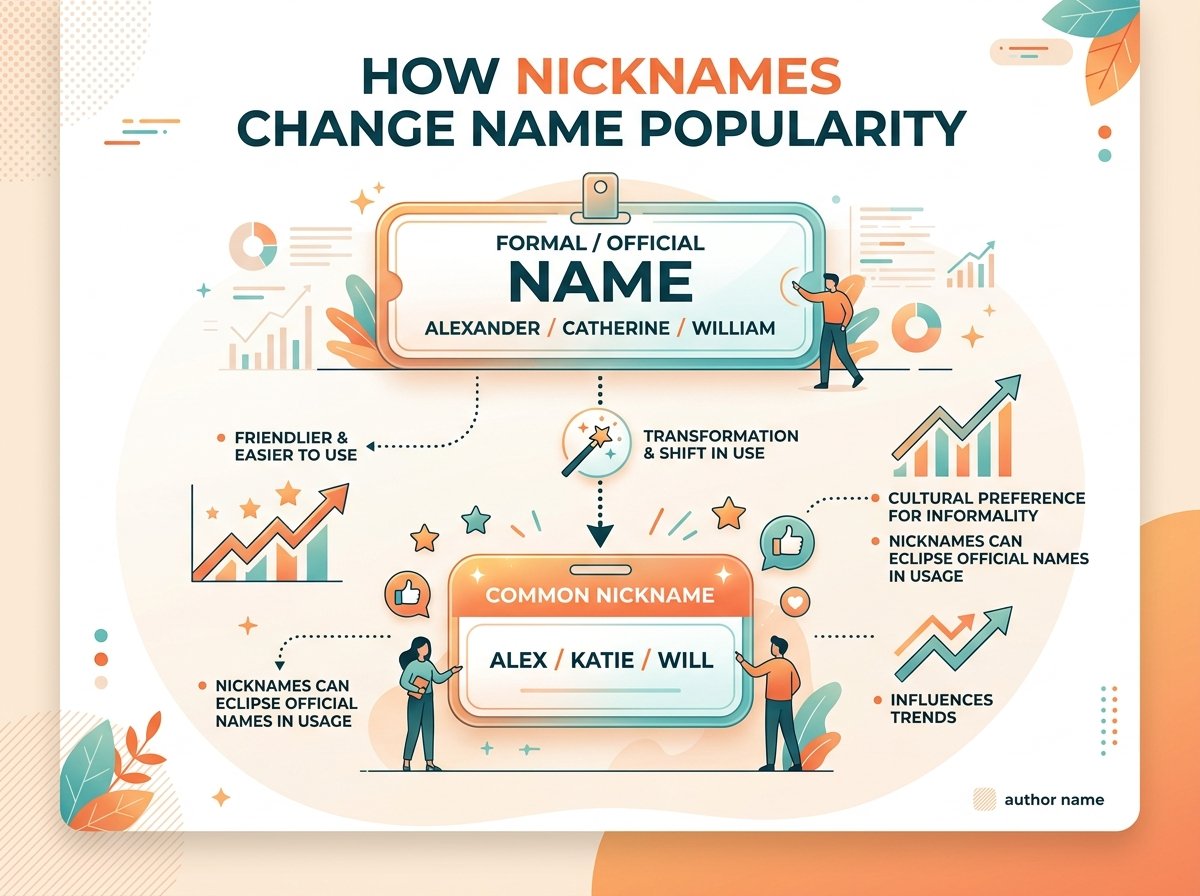
Here’s something wild — the name “Elizabeth” has survived for over 500 years on popularity charts. Not because millions of parents keep falling in love with the name itself. But because it carries an army of nicknames: Liz, Beth, Ellie, Lizzy, Betty, Betsy, Ella. Each generation picks a different nickname, and the full name stays alive.
That’s the quiet power nicknames hold over name popularity.
You probably don’t think about nicknames when you’re looking at baby name rankings or checking how many people share your name. But nicknames don’t just shorten names — they completely reshape which names rise, which ones fall, and which ones get a second life decades later.
Some nicknames get so popular that parents skip the full name entirely. Others breathe new life into old-fashioned names. And a few nicknames have single-handedly killed a name’s reputation.
Let’s talk about how all of this actually works.
How Nicknames Actually Influence Name Rankings
Most baby name data — especially from the Social Security Administration (SSA) — tracks the name parents write on the birth certificate. Not what people actually call the child at home, at school, or at work.
This creates a huge blind spot.
Think about it. If 50 parents name their daughters “Katherine,” 30 name theirs “Catherine,” and 20 go with “Kathryn” — that’s 100 babies with essentially the same name. But on the SSA charts, they show up as three separate entries with lower individual counts.
Now add the nickname layer. Some parents just write “Kate” on the birth certificate. Others write “Katie.” A few go with “Kat.” Each of these splits the data even further.
The result? A name that’s genuinely popular in daily life can look much less popular on official charts. And a name that barely registers on the charts might actually be everywhere — just hiding behind its formal version.
This is why understanding what makes a name rare or common requires looking beyond the raw numbers.
The Splitting Effect
Name researchers call this “popularity dilution.” A single classic name gets split across multiple spellings and nickname versions, making each individual version look less dominant.
Here’s a real example with data from SSA records:
- William ranks consistently in the top 5–10 for boys
- But Will, Liam, Billy, and Bill all exist as separate entries
- Liam alone climbed to #1 in the US from 2017–2023
- If you combined William + Liam, the “William family” would absolutely dominate the charts
So did William get less popular? Not really. Its nickname just became more popular than the original.
The Independence Effect
Sometimes a nickname gets so strong that it breaks free entirely. It stops being a nickname and becomes a standalone name.
Liam is the clearest modern example. Originally an Irish short form of “Uilliam” (the Irish version of William), Liam was rarely used as a given name before the 1990s. Actor Liam Neeson helped put it on the map. By 2017, Liam hit #1 on the SSA charts — while William sat around #4-5.
Parents weren’t thinking “I’ll name him William and call him Liam.” They just named him Liam. Period.
Other nicknames that became independent names:
- Jack (from John)
- Harry (from Henry/Harold)
- Sadie (from Sarah)
- Ellie (from Eleanor/Elizabeth)
- Charlie (from Charles)
- Maggie (from Margaret)
This pattern directly impacts how name popularity changes over time — because what looks like a new name rising is often an old name’s nickname going solo.
The Lifecycle of a Nickname: From Casual to Official
Nicknames don’t just randomly become popular. There’s a pattern — almost a lifecycle — that repeats across generations.
Stage 1: The Nickname Lives in the Shadows
A formal name dominates. Everyone named “Margaret” gets called Margaret on paper. At home, family calls her Maggie, Peggy, or Marge. But the birth certificate says Margaret.
During this stage, the full name gets all the statistical credit.
Stage 2: The Nickname Gets Bolder
Parents start putting the nickname on the birth certificate instead of the formal version. Maybe they think “Margaret” sounds too stuffy. Maybe they just prefer Maggie. The nickname starts appearing in SSA data as its own entry.
Stage 3: The Nickname Overtakes the Original
The nickname becomes more popular than the full name. New parents might not even realize it started as a nickname. They just think “Maggie” is a name.
Stage 4: The Full Name Gets a “Vintage Revival”
After the nickname has dominated for a while, the original formal name starts looking fresh again. Parents rediscover it. “Margaret” sounds distinguished and classic. The cycle restarts.
This is exactly why old-fashioned names keep making comebacks. The full name rests while its nicknames do the heavy lifting. Then the full name returns, feeling brand new to a generation that only knew the nicknames.
Did You Know? The name “Eleanor” nearly disappeared from the top 1000 by the 1980s. But its nicknames — Ellie, Ella, Nora — stayed trendy. By 2020, Eleanor climbed back to the top 30, partly because parents wanted a “real name” behind the popular nickname Ellie.
Famous Examples of Nicknames Reshaping Name Charts
Let’s look at specific names where the nickname story is impossible to ignore.
Elizabeth → A Nickname Factory
No name in the English language produces more nicknames than Elizabeth. Here’s just a partial list:
- Liz, Lizzy, Lizzie
- Beth, Betsy, Betty
- Eliza, Ellie, Ella
- Libby, Buffy
Elizabeth has stayed in the top 10–25 for over a century. But its cultural vibe shifts depending on which nickname is trending. In the 1940s, “Betty” was everywhere (Betty White, Betty Boop). In the 2000s, “Ellie” and “Ella” exploded. The formal name stays stable. The nicknames rotate like fashion trends.
Richard → The Decline Story
Richard was a powerhouse name through the mid-20th century. Its nicknames — Rick, Ricky, Rich, Dick — were everywhere.
Then something shifted. The nickname “Dick” became problematic as slang took over its meaning. Parents stopped using Richard partly because of this association. The name dropped from #5 in the 1950s to outside the top 200 by 2020.
A nickname didn’t just change this name’s popularity. It arguably damaged it.
Margaret → Peggy → Maggie → Full Circle
Margaret ranked in the top 3 girls’ names from 1900–1940. Its nickname Peggy peaked in the 1930s-40s. Then Maggie rose in the 1970s-80s. By the 2000s, all three had faded.
But now? Margaret is climbing again. Parents in 2024-2025 see it as a strong, classic choice — especially because its nickname options give flexibility. You can be Maggie at the playground and Margaret in the boardroom.
James → Jamie → Unexpected Territory
James has been one of the most common male names in the USA for over a century. Its nickname Jamie seemed harmless enough. But Jamie gradually became a name that crossed gender lines, used increasingly for girls from the 1970s onward.
This didn’t hurt James itself (still top 5–6 for boys). But it created an interesting split where the nickname became gender-neutral while the full name stayed firmly masculine.
Why Parents Now Choose Nickname-First
Here’s a major shift in naming culture that’s happened over the past 20 years: parents are picking the nickname first, then deciding if they even need a full name behind it.
Previous generations worked the other way around. You chose a “proper” name — something dignified for the birth certificate — and the nickname came naturally. Your name was Theodore, and people called you Ted.
Today? Parents hear “Theo” and fall in love with it. Some still put Theodore on the birth certificate as a safety net. But plenty of parents just go with Theo. Full stop.
This trend is driven by a few things:
- Casual culture: Formality has decreased in workplaces, schools, and social settings
- Social media: Short, punchy names work better as usernames and personal brands
- Individuality: Parents want their child’s “real” name to be the name they actually use
- Celebrity influence: Stars like celebrities whose names became trends often go by short, nickname-style names
Pro Tip: The “Resume Test” Still Matters
Some parents worry about using a nickname as the legal name. Will “Teddy” be taken seriously on a job application at age 35? Will “Millie” sound professional enough for a doctor?
Research from multiple studies (including a 2023 LinkedIn analysis) shows shorter, friendlier names actually perform well in professional settings now. The old stigma against “informal” names has weakened significantly.
That said, having a formal name as a backup gives your child options. They can choose to go by Theodore on legal documents and Theo everywhere else. Or they can use Theo for everything. The flexibility itself has value.
How Nicknames Create “Hidden Popularity”
This is one of the most misunderstood aspects of baby naming.
Parents spend hours checking SSA data, scrolling through popular names by decade, trying to find a name that’s not “too common.” They see that “Josephine” ranks around #80 and think, “Good, that’s not overused.”
But here’s the catch. If half the Josephines go by Josie, and Josie is also being used independently by other parents, your daughter might end up being one of four Josies in her class — even though “Josephine” looked safely uncommon on the charts.
Names that have this “hidden popularity” problem right now:
| Full Name | Common Nicknames | Combined Real Popularity |
|---|---|---|
| Theodore | Theo, Teddy | Much higher than Theodore alone |
| Eleanor | Ellie, Nora, Nell | Significantly higher |
| Benjamin | Ben, Benji | Top-tier combined |
| Penelope | Penny, Nellie | Rising fast |
| Alexander | Alex, Xander | Extremely common combined |
| Charlotte | Charlie, Lottie | Higher than charts show |
If you genuinely want a unique name for your child, you need to check popularity for both the full name AND its likely nicknames. Otherwise, you might accidentally pick a name that’s everywhere.
Nicknames That Killed Name Popularity
Not all nickname effects are positive. Some nicknames have actively pushed a name off the charts.
Dick (from Richard)
We talked about this one. The slang meaning made parents uncomfortable. Richard dropped dramatically, and “Dick” as a given name almost completely disappeared from birth records after 2000.
Fanny (from Frances)
Perfectly normal nickname in the 1800s and early 1900s. As slang meanings changed (differently in the US and UK), parents stopped using both Fanny and, to some extent, Frances.
Gay (from names like Gaylord, Gayle)
A name and nickname that was common through the 1960s. As the word took on new meaning, it vanished from baby name charts almost overnight. The full names it connected to (Gaylord, Gaynor) suffered collateral damage.
Randy (from Randolph)
Still used in the US, but virtually abandoned in the UK and Australia where “randy” has a specific slang meaning. This shows how nickname damage can be geographically specific.
Quick Fact: The SSA shows that “Dick” as a given name went from 2,500+ babies per year in the 1930s to literally 0 by 2019. That’s one of the sharpest declines for any name in American history — entirely driven by the nickname’s changed meaning.
Cultural and Regional Differences in Nickname Patterns
Nicknames don’t work the same way everywhere. How a name gets shortened — or whether it gets shortened at all — depends heavily on language, culture, and geography.
American vs. British Nickname Traditions
Americans tend to create nicknames by shortening the front: Robert → Rob, Bob. British English has a tradition of more creative nickname derivations: Margaret → Peggy, Richard → Dick, William → Bill. These follow old linguistic patterns (rhyming substitution) that date back to medieval England.
Spanish Naming Culture
Spanish nicknames often follow unique patterns:
- Francisco → Paco, Pancho
- Guadalupe → Lupe
- José → Pepe, Chepe
- Eduardo → Lalo
These nicknames don’t always look or sound anything like the original name. And they affect popularity differently because Spanish-speaking communities often use both the full name and nickname interchangeably throughout life.
Naming Patterns in South Asian Communities
In many South Asian naming traditions, a child might have an official name and a completely unrelated “pet name” used only by family. The pet name (called “daak naam” in Bengali culture, for example) has zero connection to the legal name and doesn’t affect statistical popularity at all.
How This Matters for American Data
The US is a melting pot of naming traditions. SSA data captures what’s on the birth certificate, but the nickname culture surrounding that name — shaped by the family’s cultural background — varies enormously. Two children both named “Alexander” might live as “Alex” in one family and “Sasha” in another (Sasha being the Russian nickname for Alexander).
This cultural dimension adds yet another layer to how name trends spread across states, especially in states with diverse populations like California or Texas.
The Social Media and Pop Culture Nickname Effect
Social media has turbocharged the nickname effect on baby names. Here’s how.
Celebrity Nicknames Become Name Trends
When Kylie Jenner named her daughter Stormi, that was already a nickname-style name. When the Kardashian-Jenner family uses shortened names casually on social media — where millions of followers absorb these choices daily — it normalizes nickname-as-name culture.
The same thing happens with characters in shows and movies. The name “Elsa” was used as a nickname for Elizabeth in Scandinavian countries for centuries. Then Frozen happened in 2013. Elsa exploded as a standalone name globally. And interestingly, after the initial spike, it dropped quickly — because parents didn’t want their daughter associated with a cartoon character.
You can explore more about how social media influences baby names and the speed at which these trends now move.
TikTok and Instagram-Friendly Names
Short names and nicknames perform better on social media. They’re easier to remember, easier to tag, and easier to brand. This has subtly pushed parents toward names that are already nickname-length:
- Mia instead of Amelia
- Leo instead of Leonardo
- Ivy instead of a longer name
- Kai as a standalone name
This isn’t just speculation. Data from baby name registries like BabyCenter and Nameberry shows a measurable trend toward shorter names since 2015, with the average length of popular baby names decreasing slightly each year.
Practical Guide: Using Nickname Knowledge When Choosing a Name
If you’re actually picking a baby name right now (or planning to), here’s how to use everything we’ve discussed.
Step 1: List Every Possible Nickname
Before committing to a name, brainstorm every nickname it could generate. Ask friends. Google it. Check forums and Reddit discussions about names.
For example, if you’re considering Penelope:
- Penny
- Nellie
- Nell
- Poppy
- Pen
Do you like ALL of these? Because kids, teachers, and friends will pick the nickname — you don’t always get to control which one sticks.
Step 2: Check Popularity of the Nickname Independently
Go to the SSA website or a name tracking tool. Look up both “Penelope” and “Penny” separately. Add their numbers together to get a more realistic picture of how common the name actually is in your child’s generation.
Step 3: Consider the “Negative Nickname” Test
What’s the worst nickname someone could create from this name? Kids are creative (and sometimes cruel). Think about playground-proof options. This is part of the psychology behind choosing names that parents often overlook.
Step 4: Think About the Full Lifecycle
Your baby won’t be a baby forever. A name needs to work at age 5, 15, 35, and 75. Nicknames give flexibility across these stages. “Teddy” is adorable at 5. “Ted” works at 35. “Theodore” commands respect at 75. That range is genuinely valuable.
Step 5: Check Cross-Cultural Nickname Meanings
If your family is multilingual or multicultural, check what your name’s nicknames mean or sound like in other languages. “Pippa” (from Philippa) is charming in English but has vulgar associations in some other languages.
Pro Tip: If you truly want a rare name that won’t get accidentally popular through its nicknames, look for names with fewer obvious nickname options. One-syllable names like “Claire” or “James” resist nicknaming. Two-syllable names like “Stella” or “Felix” are harder to shorten meaningfully.
Common Myths About Nicknames and Name Popularity
Myth #1: “If I Name My Child the Full Name, I Control the Nickname”
Reality: You really don’t. You can introduce your child as “Katherine” all you want. If her best friend starts calling her “Kat” in third grade, that’s probably sticking. Some parents try to enforce the full name, but social environments create nicknames organically.
Myth #2: “Nicknames Are Less Professional”
Reality: This was true 50 years ago. Today, CEOs go by Bill (Gates), Tim (Cook), and Jeff (Bezos). The professional stigma around nicknames has largely disappeared. Studies on whether names affect your career show that familiarity and ease of pronunciation matter more than formality.
Myth #3: “Using a Nickname as the Legal Name Limits Options”
Reality: It does slightly limit options, but the tradeoff isn’t as dramatic as people think. A child named “Kate” can’t easily become “Katherine” on official documents without a legal name change. But in practice, most people named Kate never feel the need for a longer version.
Myth #4: “Nickname Trends Don’t Affect the Full Name’s Popularity”
Reality: They absolutely do. When “Ellie” surged in popularity, it pulled “Eleanor,” “Elizabeth,” “Elena,” and “Ellen” along with it — because parents wanted a formal name that could produce the trendy nickname. And when a nickname fades, it can drag the full name down too.
What’s Happening Right Now in 2025
The nickname-to-name pipeline is moving faster than ever. Here are current trends:
Nicknames currently becoming standalone names:
- Theo (from Theodore) — rising independently
- Millie (from Millicent/Amelia) — increasingly used alone
- Archie (from Archibald) — got a royal boost from Prince Harry’s son
- Frankie (from Frances/Frank) — trendy as a gender-neutral option
- Evie (from Evelyn/Evangeline) — climbing fast
Full names making comebacks because of their nickname potential:
- Cordelia (Cora, Delia, Lia)
- Bartholomew (rare, but some parents want “Beau” options)
- Genevieve (Gen, Viv, Evie)
- Theodore (Theo, Teddy, Ted)
This generation of parents — largely millennials and Gen Z — approach naming differently than their parents did. They think about what makes a name sound rich or successful, how it’ll look on a LinkedIn profile, AND what cute nickname it produces. The nickname has become a primary selection criterion, not an afterthought.
FAQ Section
Do nicknames get officially tracked in baby name statistics?
No. The SSA and most government databases only track the name written on the birth certificate. If parents write “Theodore,” it counts as Theodore — even if the child goes by Theo from day one. This means nickname popularity is always somewhat invisible in official data. The only exception is when parents write the nickname itself as the legal name, in which case it appears as a separate entry (like “Theo” showing up independently from “Theodore”).
Can a nickname make a dying name popular again?
Absolutely. This has happened repeatedly throughout naming history. The name “Evelyn” was fading through the 1990s and early 2000s. But the nickname “Evie” started trending, and parents rediscovered Evelyn as a beautiful formal name that produces a trendy nickname. By 2023, Evelyn ranked in the top 10 girls’ names. Similarly, “Theodore” was considered old-fashioned until “Theo” became stylish, pulling the full name back into the top 15.
Should I put the nickname or the full name on the birth certificate?
There’s no single right answer — it depends on your priorities. Putting the full name gives your child flexibility to use different nicknames over their lifetime or go by the formal version in professional settings. Putting just the nickname keeps things simple and authentic to what you’ll actually call them. A good middle-ground approach: ask yourself if your child might ever want the formal version. If the nickname feels complete on its own (like “Kate” or “Jack”), it works fine as a legal name. If it feels diminutive (like “Teddy” or “Kitty”), the full version might serve them better long-term.
How do I find out if a name’s nicknames will be too popular?
Check multiple sources. Start with the SSA’s baby name data for your target name AND all its common nicknames. Then check sites like Nameberry and BabyCenter, which track real-time search interest. Also look at the most searched baby names on Google to gauge current buzz. Add together the ranking of the full name plus all its nickname variants to get a realistic popularity estimate.
Your Name Is More Than What’s on Paper
Nicknames are one of the most powerful — and most underestimated — forces in the baby naming world. They split popularity data, revive dying names, create entirely new names, and sometimes even kill established ones.
The name your child lives with day to day is often the nickname, not the name printed on their birth certificate. That gap between the official and the everyday has shaped naming trends for centuries. And with social media accelerating everything, it’s happening faster now than ever before.
So if you’re choosing a name, don’t just fall in love with the full version. Fall in love with its nicknames too. Because one of those nicknames is probably the name your child will actually carry through life.
And if you’re curious about your own name’s story — how common it really is when you factor in all its variants and nicknames — you can always check how many people actually share your full name. The answer might surprise you.