
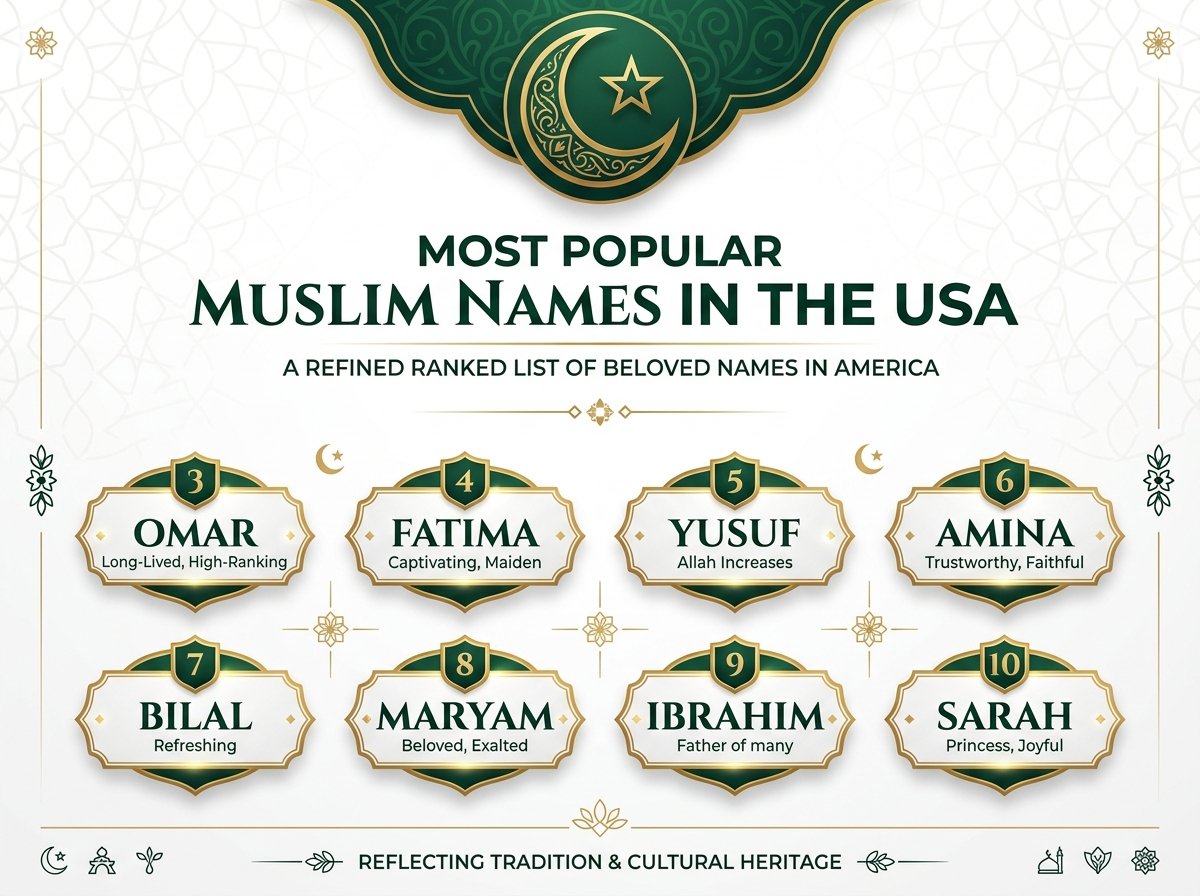
Here’s something that might surprise you — Muhammad has ranked among the top 10 baby names in the United States for several years running. According to the Social Security Administration (SSA), it cracked the top 10 list nationally by 2019, and it’s only grown since then. That’s not a small deal for a country of 330+ million people with incredibly diverse naming traditions.
If you’re a Muslim parent living in America, or someone expecting a baby and searching for the perfect name, you already know the struggle. You want a name that sounds beautiful in English, carries deep Islamic meaning, and doesn’t confuse your kid’s teachers on the first day of school. It’s a real balancing act.
This article breaks down the most popular Muslim names in the USA right now — for both boys and girls. You’ll find meanings, pronunciation tips, popularity trends, and practical advice for choosing a name that fits both your faith and your American life.
And honestly? Some of these names are so universally beautiful that non-Muslim families are picking them up too. Let’s get into it.
Why Muslim Names Are Growing in Popularity Across America
The Muslim population in the United States has grown steadily over the past two decades. The Pew Research Center estimates there are roughly 3.5 to 4.5 million Muslims living in America as of 2025. That’s a significant community — and their naming traditions naturally influence the broader culture.
But it’s not just about numbers. There are a few real reasons Muslim names are becoming mainstream:
- Multicultural families are blending naming traditions. An Egyptian-American dad and a Texan mom might settle on “Zayn” because it works beautifully in both worlds.
- Celebrity influence plays a role. Names like Zayn (Malik), Omar (Epps), and Aaliyah (the singer) crossed cultural barriers years ago. You can see how celebrity names shape real-world baby name trends more than most people realize.
- Sound and simplicity matter. Names like Layla, Adam, and Sara sound natural in English while carrying Islamic roots. That dual appeal is powerful.
- Second and third-generation Muslims in America often choose names that honor their heritage while fitting smoothly into American life.
Quick Fact: The SSA tracks name popularity based on Social Security card applications. Muslim names often appear under multiple spellings (Muhammad, Mohammed, Mohammad), which means their combined popularity is actually higher than any single spelling suggests.
Most Popular Muslim Boy Names in the USA
Let’s start with the boys. These names consistently show up in SSA data, baby name databases, and Muslim community surveys across America.
Muhammad (and Its Spelling Variations)
There’s no way around it — Muhammad is the single most popular Muslim name in the world, and it’s now firmly planted in the American top 10.
- Meaning: Praiseworthy, praised one
- Origin: Arabic — the name of Prophet Muhammad (PBUH)
- Spellings in the USA: Muhammad, Mohammed, Mohammad, Mohamed, Muhammed
Here’s the thing people miss: if you combine all the spelling variations, Muhammad would likely rank even higher on the most common male names in the USA list. The SSA counts each spelling separately, which splits the numbers.
Pro Tip: If you want your child’s name to be easily recognized and spelled correctly in American schools and workplaces, “Muhammad” (with that exact spelling) is the most common version in the USA.
Omar
- Meaning: Long-lived, flourishing, eloquent
- Origin: Arabic — named after Umar ibn al-Khattab (RA), the second Caliph of Islam
Omar has been popular in America for decades, partly because it’s simple, two syllables, and easy to pronounce for English speakers. It consistently ranks in the top 200 SSA names.
Zayn (Zain)
- Meaning: Beauty, grace, adornment
- Origin: Arabic
Zayn exploded in popularity after Zayn Malik became a global pop star. But the name has deep Quranic roots — it appears in Arabic vocabulary related to beauty and excellence. It’s short, memorable, and works perfectly in both American and Muslim contexts.
Adam
- Meaning: Man, earth, or the first human being
- Origin: Shared across Islam, Christianity, and Judaism
Adam is one of those rare names that crosses religious and cultural boundaries completely. It ranks in the top 100 names in America year after year. Muslim parents love it because Prophet Adam (AS) is honored in the Quran.
Ibrahim
- Meaning: Father of many nations
- Origin: Arabic form of Abraham
Ibrahim is gaining serious traction in the USA. It ranks steadily in the top 500 and is climbing. The connection to Prophet Ibrahim (AS) — one of the most respected figures in Islam — makes it a deeply meaningful choice.
Yusuf
- Meaning: God increases, God adds
- Origin: Arabic form of Joseph
Another name that bridges cultures. Yusuf is the Arabic name of Prophet Yusuf (AS), whose story takes up an entire Surah in the Quran. In America, it feels familiar because of its connection to “Joseph” — yet it retains a distinct Muslim identity.
Amir
- Meaning: Prince, commander, leader
- Origin: Arabic
Amir has crossed fully into mainstream American naming. It’s in the top 150 names nationally. The meaning is strong, the sound is smooth, and it doesn’t require any pronunciation coaching for English speakers.
Other Popular Muslim Boy Names in the USA
| Name | Meaning | SSA Popularity Range |
|---|---|---|
| Idris | Interpreter, studious | Top 600 |
| Khalil | Friend, companion | Top 400 |
| Ayaan | Gift of God | Top 500 |
| Rayan | Gate of Heaven | Top 400 |
| Kareem | Generous, noble | Top 700 |
| Zaid | Growth, abundance | Top 600 |
| Bilal | Moisture, freshness | Top 800 |
Most Popular Muslim Girl Names in the USA
Muslim girl names in America tend to lean toward beautiful sounds and meanings connected to nature, light, faith, and grace. Several of them have become so mainstream that many Americans don’t even realize they have Islamic origins.
Aaliyah
- Meaning: Exalted, noble, high
- Origin: Arabic (feminine form of Ali)
Aaliyah has been a powerhouse name in America since the late ’90s, boosted enormously by the beloved singer Aaliyah. It consistently ranks in the top 70 names nationally. The name feels elegant, sounds beautiful in English, and carries deep Islamic meaning.
Did You Know? Aaliyah has appeared on the SSA top 100 list for over 20 consecutive years. That’s rare staying power for any name — Muslim or otherwise. You can explore how name popularity changes over time to understand these long-running patterns.
Layla (Leila)
- Meaning: Night, dark beauty, intoxication
- Origin: Arabic — famously from the classic love story of Layla and Majnun
Layla is everywhere in America right now. It’s currently in the top 25 names nationally. Eric Clapton’s iconic song “Layla” introduced it to mainstream America decades ago, but the name’s roots are deeply Arabic and Islamic.
Fatima
- Meaning: One who abstains, captivating
- Origin: Arabic — named after Fatimah (RA), the daughter of Prophet Muhammad (PBUH)
Fatima has been a consistent presence in American naming for years. It ranks in the top 300 and holds particular significance because of its direct connection to the Prophet’s family. The Spanish-speaking community in America also uses Fatima widely (Our Lady of Fatima), which gives it cross-cultural appeal.
Amira
- Meaning: Princess, commander
- Origin: Arabic (feminine form of Amir)
Amira is climbing fast. It’s currently in the top 200 and rising. The name is easy to say, easy to spell, and carries a meaning that any parent would love for their daughter.
Zara
- Meaning: Star, flower, princess (depending on linguistic tradition)
- Origin: Arabic/Hebrew
Zara shot up in popularity after members of the British Royal Family used it. But the name has strong Arabic roots. It’s short — just four letters — and works effortlessly in American life. It currently ranks in the top 150.
Maryam (Mariam)
- Meaning: Beloved, wished-for child, sea of bitterness
- Origin: Arabic form of Mary
Maryam holds a unique position — she’s the only woman mentioned by name in the Quran, and an entire Surah (Surah Maryam) is named after her. For Muslim parents, it’s one of the most spiritually significant names you can choose. It’s currently in the top 500 in America and growing.
Noor (Nur)
- Meaning: Light, radiance
- Origin: Arabic
Noor is gaining momentum across America. Queen Noor of Jordan brought international attention to it, and its simplicity makes it a natural fit for American life. It also works as a gender-neutral name, which appeals to many modern parents.
Other Popular Muslim Girl Names in the USA
| Name | Meaning | SSA Popularity Range |
|---|---|---|
| Aisha | Living, prosperous | Top 600 |
| Samira | Companion in evening talk | Top 500 |
| Yasmin | Jasmine flower | Top 700 |
| Inaya | Care, concern, protection | Top 500 |
| Safiya | Pure, best friend | Top 800 |
| Hana | Happiness, bliss | Top 400 |
| Lina | Tender, gentle | Top 300 |
How Muslim Parents in America Choose Names — The Real Process
Picking a name isn’t just scrolling through a list and pointing. For Muslim parents in America, there’s a whole thought process behind it that most articles never talk about. Let me break it down honestly.
The Meaning Comes First
In Islam, names carry weight. There’s a well-known hadith where Prophet Muhammad (PBUH) said, “On the Day of Resurrection, you will be called by your names and the names of your fathers, so make your names good.” (Abu Dawud)
This isn’t just tradition — Muslim parents genuinely believe a name’s meaning shapes a child’s identity. You won’t find many Muslim families naming their kid something that sounds cool but means nothing positive.
The “Can Americans Pronounce It?” Test
This is real. Every Muslim parent in America has had this conversation:
“I love the name Khadeejah, but will her teachers call her Ka-DEE-jah? Or worse — Kuh-DEEJ?”
That pronunciation anxiety pushes many parents toward names that work in both Arabic and English. That’s exactly why some names suddenly become popular — they hit that sweet spot of cultural authenticity and American accessibility.
Family Expectations
Grandparents want traditional names. The mom loves something modern. The dad wants something Quranic. And everyone has an opinion.
Pro Tip: Many families find a middle ground by using a traditional Islamic name as the legal first name and a simpler nickname for everyday American life. Muhammad becomes “Mo.” Abdulrahman becomes “Abdul” or “AR.” It works.
Avoiding Names with Negative Associations
Smart parents Google the name before committing. You want to make sure your child’s name doesn’t belong to a controversial figure, a villain in a popular movie, or an unfortunate slang term in English. This sounds silly until you realize someone named their kid “Isis” in 2010 and deeply regretted it by 2014.
Muslim Names That Cross Cultural Lines
Here’s something fascinating — several names are shared between Islam, Christianity, Judaism, and other traditions. These “crossover names” are especially popular among American Muslim families because they feel universally accepted.
- Adam — Honored in the Quran, Bible, and Torah
- Sarah / Sara — Wife of Prophet Ibrahim (AS), recognized across all Abrahamic faiths
- Noah / Nuh — Prophet in Islam and Christianity
- Mary / Maryam — Revered in both Islam and Christianity
- Aaron / Haroon — Prophet in both traditions
- Solomon / Sulaiman — King and Prophet in multiple traditions
If you’re curious about how many people share these common names, you can actually check how many people have your name in the world — it’s surprisingly fun and eye-opening.
These shared names give Muslim kids in America a social advantage — their names don’t feel “foreign” to classmates, yet they carry full Islamic significance at home and in the mosque.
Regional Trends — Where Muslim Names Are Most Popular in the USA
Muslim names don’t trend equally everywhere. Geography matters.
Dearborn, Michigan has the highest concentration of Arab Americans in the country. Names like Muhammad, Fatima, and Hussein dominate local birth registries. In some Dearborn schools, Muhammad is literally the #1 name in the class.
New York City and New Jersey have large South Asian Muslim communities, so you’ll see more names like Ayaan, Zainab, and Rayan trending there.
Texas — particularly Houston and Dallas — has booming Muslim populations from diverse backgrounds. The most popular names in Texas reflect this growing diversity.
California — especially Southern California — sees a blend of Persian, Arab, and South Asian Muslim naming traditions. Names like Cyrus (Kurush), Dariush, and Leila carry Persian-Islamic roots.
You can see how name trends spread across states to understand these geographic patterns better.
Common Myths About Muslim Names — Let’s Clear Them Up
Myth #1: “All Muslim names are Arabic”
Not true. Muslim names come from Arabic, Persian, Turkish, Urdu, Malay, Swahili, and dozens of other languages. A Turkish Muslim might name their daughter “Elif.” A Somali Muslim might choose “Sagal.” A Bosnian Muslim might go with “Emir.” Islam is a global religion, and its naming traditions reflect that.
Myth #2: “You MUST give your child an Arabic name to be a proper Muslim”
Also not true. Islamic scholars generally agree that any name with a good meaning is acceptable, regardless of the language. The key guideline is that the name shouldn’t have a negative or un-Islamic meaning. A name like “Grace” would be perfectly fine, for example.
Myth #3: “Muslim names are hard for Americans to pronounce”
Some are. Some aren’t. Layla, Zara, Omar, and Adam are as easy as any American name. And honestly, if Americans can learn to say “Tchaikovsky” and “Schwarzenegger,” they can handle “Khadijah.”
Myth #4: “Naming a child Muhammad means they’ll face discrimination”
This concern is understandable but increasingly outdated. With Muhammad now in the national top 10, it’s becoming as familiar as Michael or James. Yes, bias exists in pockets of society. But the name’s normalization is happening faster than many people expected.
The Meaning Behind the Most Popular Choices — Why These Names Win
Let’s zoom out and ask: what patterns connect the most popular Muslim names in America?
Short and sweet wins. The fastest-growing Muslim names are mostly 2-3 syllables. Zayn. Layla. Omar. Noor. Zara. American culture favors shorter names, and Muslim parents have noticed.
Strong, positive meanings. Parents aren’t choosing names that mean “servant” or “humble” as often as before. Names meaning “light,” “prince,” “beauty,” and “noble” dominate the charts. There’s a clear preference for aspirational meanings.
Easy spelling. Names with straightforward English phonetics rise faster. “Rayan” beats “Raiyaan.” “Layla” outpaces “Laila” (though both are popular).
Sound similarity to existing American names. Amira sounds close to “Amara” and “Amelia.” Zayn rhymes with “Shane” and “Wayne.” These subtle sound echoes make new names feel instantly familiar. Understanding the psychology behind unique names helps explain why this works.
Tips for Choosing the Perfect Muslim Name for Your Baby in America
If you’re actively choosing a name right now, here’s practical advice that goes beyond the standard “pick a meaningful name” stuff:
1. Say the full name out loud — first, middle, and last. Does it flow? Does it sound natural when a teacher calls roll? “Zayn Ahmed Khan” rolls off the tongue. “Abdulmalik Abdulrahman Siddiqui” might be a mouthful for a kindergarten teacher (though it’s a beautiful name).
2. Check the initials. Make sure the first, middle, and last initials don’t spell something embarrassing. This applies to all names, not just Muslim ones.
3. Test the nickname potential. Kids will shorten names. What does “Abdulrahman” become in a playground? Usually “Abdul” or “Abdu.” Are you okay with that?
4. Google the name. Seriously. Search it. Make sure no infamous person owns it. Make sure it doesn’t mean something unfortunate in another language.
5. Check how common it is. If uniqueness matters to you, look up whether your chosen name is truly unique before you commit. You might discover 50,000 other Laylas in America — or you might find your chosen name is refreshingly rare.
6. Consider both worlds. Your child will live in American society AND within a Muslim community. The ideal name works beautifully in both. It should look good on a college application AND sound right in a du’a.
What’s Trending for 2025 and Beyond?
Based on SSA data trends, baby name forums, and Muslim community patterns, here’s where things are heading:
Rising fast for boys:
- Idris — Boosted by Idris Elba’s popularity and the Quranic Prophet Idris (AS)
- Rayan — Gateway to Paradise; a beautiful meaning that resonates across cultures
- Ayaan — Gift of God; gaining steam across multiple Muslim communities
- Eesa — Arabic form of Jesus; growing among parents who want interfaith-friendly names
Rising fast for girls:
- Inaya — Care and protection; a soft, modern-sounding name
- Alina — Light, beautiful; works in Arabic, Russian, and English
- Nyla — Winner, achiever; surging in popularity charts
- Aria — Noble (multiple origins including Arabic); hugely popular due to Game of Thrones and its pleasant sound
Pro Tip: If you want a name that feels fresh rather than overused, look at names ranked between 500-1000 on the SSA list. They’re recognized but not saturated. Think of it like finding a great restaurant before it gets a two-hour wait. You can explore the most searched baby names on Google to spot trends before they peak.
FAQ Section
What is the most popular Muslim name in the USA?
Muhammad (with all its spelling variations combined) is the most popular Muslim name in the United States. When you add up Muhammad, Mohammed, Mohammad, and Mohamed, it surpasses most traditionally American names in total count. For girls, Aaliyah and Layla consistently rank among the most popular Muslim female names in America.
Are Muslim names accepted in American schools and workplaces?
Yes, absolutely. Anti-discrimination laws protect individuals regardless of their name’s cultural or religious origin. Practically speaking, names like Omar, Layla, Zayn, and Amira are so common now that they don’t raise any eyebrows. While isolated incidents of bias can occur, Muslim names are increasingly normalized across American society.
Can I give my child a non-Arabic Muslim name?
Yes. Islam doesn’t require Arabic names. The general Islamic guideline is that a name should have a good, positive meaning and shouldn’t be associated with anything un-Islamic. Names from Persian, Turkish, Urdu, Malay, and other Muslim-majority cultures are completely valid. Even English names with positive meanings are considered acceptable by many scholars.
How do I find out if my chosen Muslim name is common or rare in America?
You can check the Social Security Administration’s baby name database for popularity rankings. You can also use tools to see how many people share your full name in the USA. This gives you a realistic picture of how common or unique your chosen name actually is.
Do Muslim names affect a child’s experience in America?
Research shows that names can influence first impressions, but the impact of Muslim names has decreased significantly as these names become mainstream. A 2024 study from the National Bureau of Economic Research found that name-based discrimination in hiring has decreased compared to a decade ago, particularly for commonly recognized names. Choosing a well-known Muslim name like Zayn or Layla minimizes any potential bias.
Your Child’s Name Is Their First Gift
Picking a name is one of the most personal decisions you’ll ever make as a parent. For Muslim families in America, it’s also one of the most layered — balancing faith, culture, family, and practical American life all at once.
The good news? You’re living in an era where Muslim names aren’t just accepted in America — they’re celebrated. Muhammad sits comfortably in the top 10. Layla is a playground favorite. Zayn is on every baby name list. Your child’s name can honor your Islamic heritage and fit seamlessly into American life.
So take your time. Say the name out loud. Check the meaning. Test it with family. Google it. And when it feels right — when you say it and your heart settles — you’ll know.
That’s the name.