Most Common Female Names in the USA

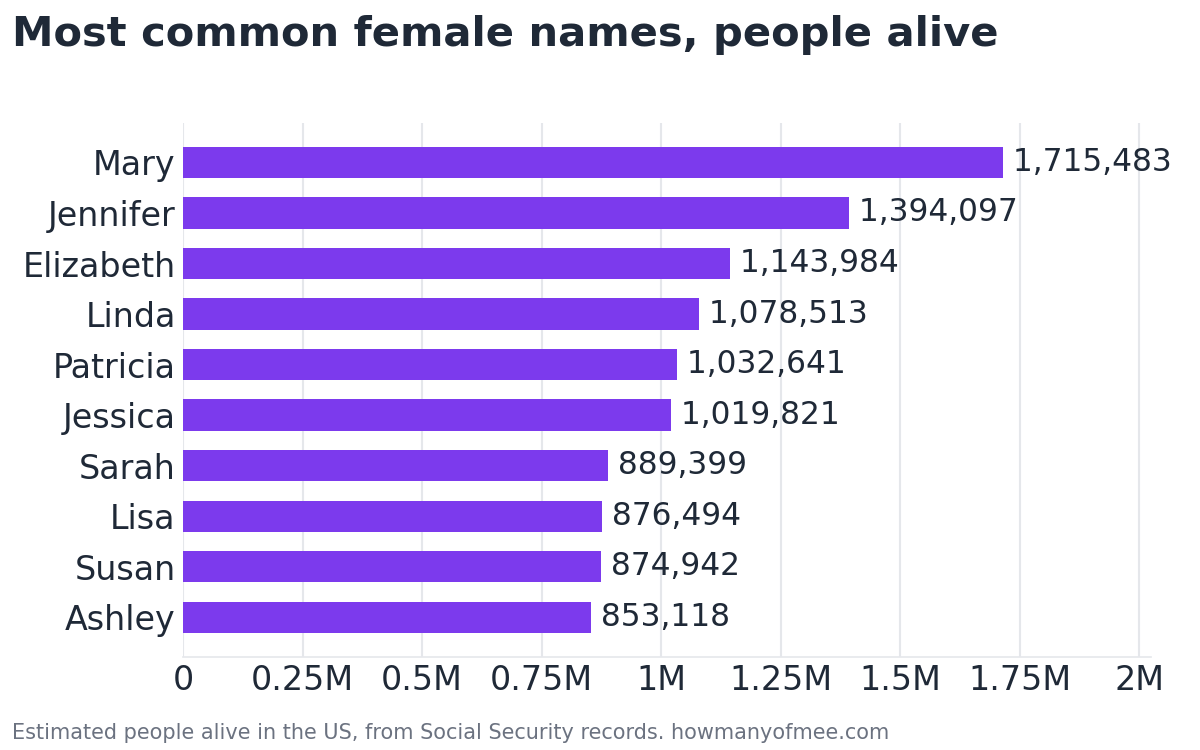
Over 4.5 million Mary’s have walked through American classrooms, offices, and grocery stores since the Social Security Administration (SSA) started tracking names in 1880. That single name held the #1 spot for girls for nearly seven straight decades. Think about that — one name dominated an entire country for longer than most people live.

But here’s what’s interesting. Mary isn’t even close to the top anymore. Name trends shift like fashion, and the most common female names in the USA tell a fascinating story about culture, immigration, pop culture, and even politics. Whether you’re picking a baby name, curious about your own name’s popularity, or just a data nerd who loves patterns, this article breaks down the real numbers behind America’s most popular female names.

You’ll find lists, decade-by-decade breakdowns, state-level differences, and the surprising reasons some names stick around while others vanish. Let’s get into it.


The All-Time Most Common Female Names in the USA

Based on SSA data covering over 140 years of birth records, these names have been given to the highest total number of baby girls in the United States:

  • Mary — approximately 4.12 million
  • Patricia — approximately 1.57 million
  • Jennifer — approximately 1.47 million
  • Linda — approximately 1.45 million
  • Barbara — approximately 1.43 million
  • Elizabeth — approximately 1.43 million
  • Susan — approximately 1.12 million

Mary’s dominance is almost unreal. No other female name comes anywhere close to that 4 million+ figure. Patricia, sitting in second place, has barely a third of Mary’s total count.

Did you know? Elizabeth is the only name on this all-time list that still appears regularly in the top 20 today. Every other name on this list peaked decades ago and has steadily declined.

What makes a name climb to these heights — or fall from them? A lot of it has to do with what makes a name rare or common, including cultural shifts, media influence, and generational identity.


Most Popular Female Names Right Now (2020s Data)

The landscape of popular girl names looks completely different today compared to even 20 years ago. According to the SSA’s most recent data (2023–2024 birth records), these are the top female names being given to American babies right now:

Top 10 Female Baby Names (2023–2024)

  1. Olivia — holding the #1 spot since 2019
  2. Emma — a consistent top-3 name for over a decade
  3. Charlotte — surging thanks to British royal influence
  4. Amelia — a vintage name that’s made a dramatic return
  5. Sophia — global popularity keeps it strong
  6. Mia — short, easy to pronounce, cross-cultural appeal
  7. Isabella — peaked around 2010 but still holds firm
  8. Ava — simple, elegant, and media-friendly
  9. Evelyn — an old-fashioned name experiencing full revival
  10. Luna — one of the fastest risers of the past decade

Notice anything? Not a single name from the all-time list appears here. That’s a dramatic generational shift. The Marys and Patricias of the world have been replaced by Olivias and Charlottes.

Why These Names Are Dominating

Olivia benefits from something name researchers call “phonetic appeal.” It has soft vowel sounds, works across multiple languages, and doesn’t carry a strong association with any single decade. Parents hear it and it feels both classic and fresh.

Charlotte got a massive boost when Prince William and Kate Middleton named their daughter Princess Charlotte in 2015. Celebrity names genuinely do become trending — and royal names carry extra weight.

Luna is probably the most interesting story. It barely registered before 2010. Then Chrissy Teigen named her daughter Luna in 2016, the Harry Potter character Luna Lovegood remained culturally relevant, and the name exploded. It jumped from outside the top 100 to the top 10 in less than a decade. That’s the power of how social media influences baby names today.


Most Common Female Names by Decade (1950–2020)

Names are time capsules. You can often guess someone’s approximate age just from their first name. Here’s a decade-by-decade snapshot of America’s top female names:

1950s: The Classic Era

  • Mary, Linda, Patricia, Susan, Barbara

Mary still reigned supreme, but Linda was breathing down its neck. These names sound “grandma-ish” to younger Americans, but they were the Olivias and Emmas of their time.

1960s: The Transition

  • Lisa, Mary, Karen, Susan, Kimberly

Lisa burst onto the scene seemingly out of nowhere and knocked Mary off the throne for the first time. Karen and Kimberly also represented a shift toward more “modern-sounding” choices.

1970s: The Jennifer Explosion

  • Jennifer, Amy, Melissa, Michelle, Kimberly

Jennifer didn’t just become popular — it became a phenomenon. From 1970 to 1984, Jennifer was the #1 girl’s name in America for fifteen consecutive years. If you’re a Millennial, you probably know at least five Jennifers.

1980s: The Jessica Age

  • Jessica, Jennifer, Amanda, Ashley, Sarah

Jessica took over from Jennifer, and Ashley began its dramatic rise. These are the signature names of the Millennial generation.

1990s: Ashley & Emily Rise

  • Jessica, Ashley, Emily, Samantha, Sarah

Emily started climbing here and would dominate the 2000s. Ashley peaked and began its slow decline. The 90s also saw increased diversity in naming patterns.

2000s: Emily’s Decade

  • Emily, Madison, Emma, Olivia, Hannah

Emily held the #1 position for 12 years (1996–2007). Madison was a fascinating case — it barely existed as a girl’s name before the 1984 movie Splash, where Daryl Hannah’s character chose it. By 2001, it was the #2 name in America.

2010s: The Sophia/Emma Era

  • Sophia, Emma, Olivia, Isabella, Ava

Sophia and Emma traded the #1 spot back and forth for most of the decade. These names reflect a preference for soft sounds and European elegance.

2020s: Olivia’s Reign

  • Olivia, Emma, Charlotte, Amelia, Sophia

Olivia has owned this decade so far. Charlotte and Amelia’s rise shows a clear trend toward old-fashioned names making a comeback.

For the full breakdown across seven decades, check out the most popular names by decade from 1950 to 2020.

🔍 Quick Fact: The average #1 female name today represents a much smaller percentage of total births than it did in the 1950s. Mary accounted for about 4% of all girls born in 1950. Olivia accounts for only about 1% today. Parents are choosing from a much wider pool of names now.


How Female Name Popularity Varies by State

America isn’t one big naming monolith. Regional differences are real, and they’re often surprising.

Southern States

Names like Ava, Harper, and Paisley perform significantly better in states like Alabama, Tennessee, and Mississippi. Southern parents tend to favor names with a softer, more traditional feel.

Western States (California, Nevada, Arizona)

Mia, Camila, and Sofia (the Spanish spelling) rank higher here due to the larger Hispanic population. California’s most popular names reflect the state’s incredible cultural diversity.

Texas

Texas is its own naming universe. Emma and Olivia do well, but names like Camila, Valentina, and Sofia consistently rank in the state’s top lists because of the strong Latino demographic.

Northeastern States

Charlotte, Eleanor, and Evelyn tend to rank higher in the Northeast, reflecting a preference for vintage, literary-sounding names.

Hawaiian Influence

Hawaii often has completely unique top names. Malia (meaning “calm and peaceful” in Hawaiian) regularly appears in Hawaii’s top 10 but rarely cracks the top 100 nationally.

⚡ Pro Tip: If you’re choosing a baby name and want something popular but not too common, check your specific state’s data on the SSA website. A name that’s #5 nationally might be #25 in your state — or the other way around.


Names That Changed Gender Popularity Over Time

Here’s something most people don’t realize: several names that are now considered strongly “female” were originally male names.

  • Ashley — A male name in England for centuries. It was predominantly given to boys in the US until the 1960s. Today, it’s almost exclusively female.
  • Lindsay/Lindsey — Originally a Scottish male surname. The actress Lindsay Wagner (The Bionic Woman, 1976) helped push it toward girls.
  • Kelly — Mostly male until the 1960s, then shifted dramatically.
  • Aubrey — Still used for both, but trending heavily female since the 2000s.
  • Madison — Entirely a surname/male name until Splash (1984).

This phenomenon is surprisingly well-documented. You can explore more about names that changed gender popularity over time — it’s a fascinating rabbit hole.

The trend almost always goes in one direction: male to female. Once a name becomes popular for girls, parents of boys tend to abandon it. Researchers call this the “contamination effect” — not the most flattering term, but it describes a real and consistent pattern.


Common Myths About Female Names in the USA

Myth 1: “Unique names are more popular than ever”

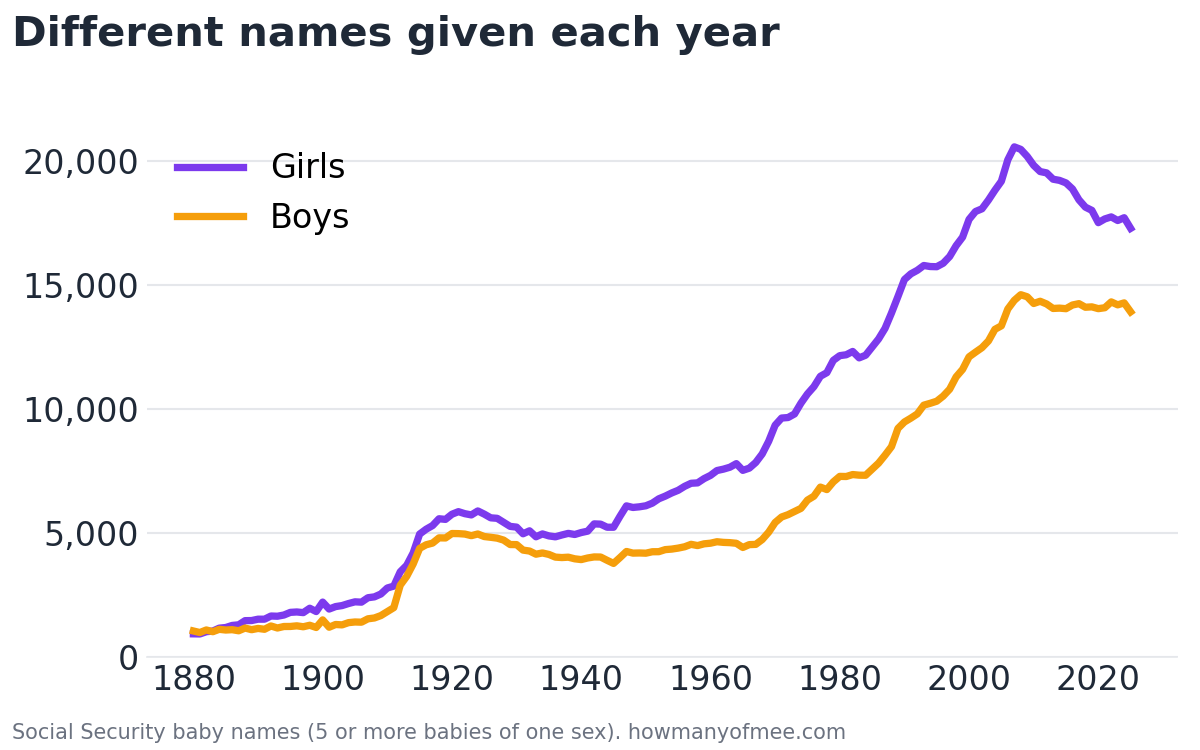
Reality: Unique names are more visible than ever because of social media. But statistically, the most popular names still dominate. The top 10 female names account for roughly 8–9% of all girls born each year. What has changed is that the gap between the #1 name and the #50 name is much smaller than it used to be.

Myth 2: “Pop culture names always become popular”

Reality: Not always. For every Khaleesi that made the top 1000, there’s a Katniss that didn’t. Names from pop culture only stick if they have broad phonetic appeal and don’t feel too “attached” to a single character. Arya (from Game of Thrones) worked because it already existed as a real name in several cultures. Hermione? Not so much — it barely moved despite Harry Potter’s massive global reach.

Myth 3: “Old names never come back”

Reality: They absolutely do. Evelyn, Hazel, Eleanor, Violet, and Stella are all names that were popular 100+ years ago, faded completely, and are now back in the top 50. Name researchers have identified roughly an 80–100 year cycle for name revivals. Understanding how name popularity changes over time helps explain this pattern.

Myth 4: “A common name means less individuality”

Reality: Your name is one part of your identity, not all of it. Research from psychology journals shows that people with common names don’t report feeling less unique than those with rare names. What matters more is the personal meaning behind the name and the identity you build around it. That said, the psychology behind unique names is genuinely interesting reading.


Why Do Certain Female Names Stay Popular for So Long?

Some names spike and crash within a decade (looking at you, Jennifer and Madison). Others — like Elizabeth, Anna, and Sarah — have stayed in or near the top 100 for over a century. What’s the difference?

The “Timelessness” Formula

Names that endure typically share these traits:

  • Biblical or historical roots — Elizabeth, Sarah, Rachel, and Anna all have deep religious significance across multiple traditions. Parents from many backgrounds feel comfortable choosing them.
  • Multiple nickname options — Elizabeth can become Liz, Beth, Eliza, Betty, Lizzy, or Ella. That flexibility keeps the name feeling fresh across generations.
  • Cross-cultural pronunciation — Names that are easy to say in English, Spanish, French, and other major languages have a built-in advantage.
  • No strong generational stamp — Elizabeth doesn’t scream “1950s” or “2010s.” It belongs to every era equally.
  • Moderate popularity — Paradoxically, names that never become the absolute #1 tend to last longer. Being #1 creates a backlash effect. Elizabeth has rarely been #1 but has almost never left the top 25.

The “Flash-in-the-Pan” Pattern

Names that spike and crash usually share opposite traits:

  • They’re strongly tied to one celebrity or character
  • They have a very “trendy” sound (like the -aden ending for boys)
  • They feel strongly of one specific decade
  • They get so popular so fast that parents start avoiding them

Jennifer is the textbook case. Fifteen years at #1 created a massive backlash, and it fell out of the top 100 by the early 2000s. Today it hovers around #400.


How Many People Actually Share Your Name?

Here’s a fun question most people ask at some point: “How many other people have my exact name?”

If your name is Mary Smith, the answer is… a lot. Mary is the most common female first name, and Smith is the most common surname in America. There are estimated to be over 50,000 Mary Smiths in the US.

But if your name is something like Zara Kowalski? Probably only a handful — maybe even just you.

You can actually check how many people share your full name using name frequency databases. It’s surprisingly addictive once you start looking up friends and family members too.

The combination of first name and surname creates millions of possibilities, but common names cluster in predictable ways. About 7% of Americans share their full name with at least one other person.


The Cultural Shift: Religious Names vs. Modern Names

For most of American history, the most common female names came from the Bible or were adapted from saints’ names. Mary, Ruth, Sarah, Rebecca, Rachel, Hannah, Elizabeth — these names dominated because the US was a predominantly Christian country, and naming children after biblical figures was the norm.

That started changing in the 1960s. The cultural revolution brought a desire for individuality. Parents began choosing names that sounded beautiful to them rather than defaulting to traditional options.

By the 2000s, the top female names were a mix of:

  • Literary influences (Emma from Jane Austen, Charlotte from the Brontës)
  • International appeal (Sophia, Isabella, Mia)
  • Nature names (Lily, Violet, Ivy, Willow)
  • Virtue names revived (Grace, Hope, Faith — though these peaked and are declining)

Religious naming traditions haven’t disappeared — they’ve just become one option among many. The most popular Christian baby names still include many familiar choices, but they share space with secular and multicultural options now.


Fastest Rising and Falling Female Names Right Now

Names Shooting Up (2020–2025)

  • Wren — Up 200+ spots in five years. Short nature names are trending hard.
  • Maeve — Irish heritage names are having a moment.
  • Eloise — Another vintage revival that parents can’t get enough of.
  • Isla — Scottish name boosted by celebrity use.
  • Ophelia — Shakespeare is apparently still relevant in naming trends.

Names Dropping Fast

  • Karen — The “Karen meme” did measurable damage. It fell from #660 in 2019 to near-disappearance.
  • Alexa — Amazon’s virtual assistant essentially killed this name. It dropped from #32 in 2015 to below #300 by 2023.
  • Isis — Once a beautiful name with Egyptian goddess origins. The terror group’s name made it virtually unusable after 2014.
  • Katrina — Hurricane Katrina in 2005 caused a permanent decline.

⚠️ Warning: If you’re considering a name for your baby, be aware that current events and pop culture can dramatically impact a name’s perception — sometimes overnight. Some names suddenly become popular or unpopular for reasons nobody can predict.


How to Use This Data If You’re Picking a Baby Name

Knowing the most common female names is great for trivia, but it also has practical value if you’re a parent or soon-to-be parent. Here are some grounded, practical tips:

Check multiple data sources. The SSA is the gold standard, but also look at BabyCenter and Nameberry trend data. They track names in real time and can show rising names before they hit the SSA’s annual report.

Think about the classroom test. If you choose Olivia in 2025, your daughter might share her name with 2–3 other girls in her class. That’s not necessarily bad — but it’s worth knowing. Some parents prefer a top-50 name that’s familiar but not overused.

Consider the “future adult” test. Your baby will also be a 30-year-old professional and a 70-year-old retiree with this name. Does it work at every life stage?

Look beyond the top 10. Names ranked #50–#200 on the SSA list are often the sweet spot — recognizable enough that nobody will mispronounce them, but uncommon enough that your kid won’t be “Olivia M.” her entire school career.

Test across contexts. Say the full name out loud with your surname. Write it down. Imagine it on a resume, a diploma, and a doctor’s name badge. If it works in all those contexts, you’re probably in good shape.

Want to see whether a name you’re considering is truly unique or more popular than you think? You can check if your name is truly unique using statistical tools.


FAQ Section

What is the #1 most common female name in the USA of all time?

Mary is the #1 most common female name in the entire history of the United States. According to SSA records since 1880, approximately 4.12 million girls have been named Mary. It held the #1 position for most years between 1880 and 1961.

What is the most popular girl’s name in America right now?

Olivia has been the #1 female baby name in the United States since 2019, based on SSA birth certificate data. Emma and Charlotte consistently hold the #2 and #3 positions.

Do common names affect career success?

Research is mixed on this. Some studies suggest that people with easy-to-pronounce names may receive slightly more favorable first impressions. A 2012 study published in the Journal of Experimental Social Psychology found that name pronounceability did affect perceptions of trustworthiness. But the effect is small, and career success depends on far more than your first name.

Why do female name trends change faster than male name trends?

Naming researchers have noted that parents tend to be more “creative” or “experimental” with girls’ names than boys’ names. Boys’ names like James, William, and John have stayed in the top 20 for over a century. Girls’ names cycle through much faster. One theory is that gender expectations still make parents more conservative with boys’ names, while girls’ names face less social pressure to be traditional.

How many girls receive the #1 name each year?

Roughly 17,000–18,000 baby girls receive the #1 name annually in recent years. That’s out of approximately 1.8 million female births per year, which means the #1 name represents less than 1% of all baby girls. In the 1950s, Mary represented about 4% of all female births — a massive difference that shows how naming has diversified.


Your Name Tells a Story

Every name on every list in this article carried meaning for the parents who chose it. Mary was chosen out of faith. Jennifer was chosen because it sounded fresh and modern in 1970. Olivia gets chosen today because it sounds elegant across cultures and languages.

The most common female names in the USA aren’t just data points — they’re a mirror reflecting what Americans valued at different moments in time. Faith. Individuality. Global connection. Literary beauty. Simplicity.

If your name is on any of these lists, you’re part of a massive community of people who share that same identity marker. If your name isn’t on any list, that’s its own kind of interesting story. Either way, your name is the first word the world learned about you — and that’s pretty cool.

Curious about the other side of the naming coin? Go see the most common male names in the USA and compare patterns. You’ll notice some fascinating differences in how American parents approach naming boys vs. girls.

Leave a Comment