
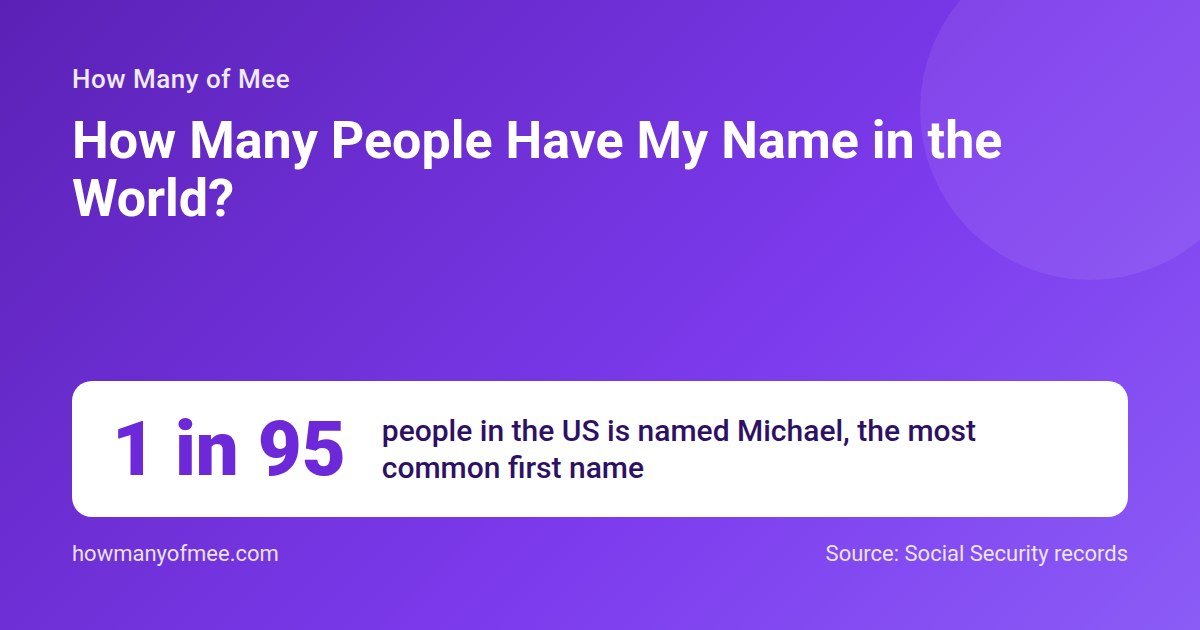
Right now, about 8 billion people live on this planet. And every single one of them has a name. So here’s a thought that hits most of us at some point — how many of those 8 billion people share MY name?
Maybe you Googled yourself and found someone with your exact name living in another country. Maybe a friend sent you a screenshot of a stranger on social media with your full name. Or maybe you’re just curious whether your name is one-of-a-kind or shared by thousands.
Whatever brought you here, the answer isn’t as straightforward as you’d expect. Your first name might be shared by millions, but your full name — first plus last — narrows things down dramatically. Some full names exist only once on the entire planet. Others? Hundreds of thousands of people carry them.
Let’s break this down step by step, look at the tools that can give you real estimates, and explore what actually makes a name common or rare across the globe.
How Name Frequency Actually Works
Before you rush to check your name’s count, it helps to understand the basic math behind name distribution.
Your name has two main parts — first name and surname. Each one has its own frequency. The number of people who share your full name depends on how these two frequencies overlap.
Here’s a simplified example:
- If your first name is “James” (roughly 4.7 million people in the U.S. alone), that’s extremely common.
- If your last name is “Smith” (about 2.4 million in the U.S.), that’s the most common American surname.
- But “James Smith” as a full combination? The U.S. Census estimates around 38,000+ people carry that exact full name.
The formula isn’t just multiplication, though. Statisticians use probability models based on census data, birth records, and population databases to estimate these overlaps.
Quick Fact: The most common full name in the United States is often cited as James Smith or Mary Smith, depending on the dataset and decade you’re looking at.
If you’re curious about how many people share your full name, the numbers might surprise you — or reassure you that you’re more unique than you thought.
Tools That Tell You How Many People Have Your Name
You don’t need to be a data scientist to find out. Several free online tools give you a solid estimate. Here are the most reliable ones:
HowManyOfMe.com
This is probably the most popular tool for this exact question. It uses U.S. Census Bureau data and calculates how many people in the United States share your first name, last name, and full name combination.
How to use it:
- Go to the website
- Enter your first name and last name
- Hit search
- You’ll get an estimate for the U.S.
Limitation: It only covers the United States. So if your name is common in India, Nigeria, or Brazil, this tool won’t capture that global count.
Forebears.io
This one goes global. Forebears pulls data from public records, phone directories, and electoral rolls from dozens of countries. You can search your surname and see which countries it’s most prevalent in.
Best for: Understanding your surname’s worldwide distribution and density by country.
Behind the Name
Great for historical and cultural context. You can search your first name, see its origins, its popularity across decades, and which countries use it most.
Social Security Administration (SSA) Data
If you were born in the United States, the SSA maintains detailed records of baby name popularity going back to 1880. You can search the most popular names according to SSA data to see exactly where your name ranks by year.
WorldNames PublicProfiler
This tool maps surname distribution across Europe and several other regions. It’s useful if your family has European roots and you want to see where your last name clusters geographically.
Pro Tip: No single tool gives a perfect global number. For the best estimate, cross-reference at least two or three of these tools. And remember — they all use statistical models, not actual headcounts.
What Makes a Name Common or Rare?
You might wonder why some names are shared by millions while others belong to just a handful of people. The answer involves culture, geography, history, and even random trends.
Population Size of Origin Country
Names from countries with massive populations tend to have higher global counts. “Muhammad” is the most common first name on Earth — partly because of its religious significance in Islam, and partly because Muslim-majority countries like Indonesia, Pakistan, Bangladesh, and Egypt have enormous populations.
Similarly, “Wei” and “Fang” are extremely common in China, where 1.4 billion people live.
If you’re interested in specific cultural patterns, check out the most popular Muslim names in the USA or the most popular Hindu names worldwide for detailed breakdowns.
Cultural Naming Traditions
Some cultures draw from a small pool of names. In Iceland, naming laws restrict parents to an approved list. In many Arab countries, naming children after prophets and religious figures is deeply traditional, which concentrates name frequency.
Other cultures encourage uniqueness. American parents, for example, have been moving toward rare and unusual baby names for the past two decades.
Decade of Birth
Name popularity shifts dramatically over time. “Linda” was the #1 female name in the U.S. during the late 1940s. By 2020, it had virtually disappeared from the top 100.
“Liam” and “Olivia” dominate right now, but give it 30 years — they’ll likely feel as dated as “Gertrude” or “Harold.”
Understanding how name popularity changes over time helps you see why two people born 40 years apart can have wildly different name frequencies.
Surname Concentration
Some last names are hyper-concentrated in one region. “Nguyen” is carried by roughly 40% of Vietnam’s population — that’s about 38 million people in one country alone. “Wang” belongs to over 92 million people in China.
On the flip side, some surnames are incredibly rare. If your last name is unusual, your full name might be truly unique in the world.
The World’s Most Common Names — By the Numbers
Let’s look at some hard numbers to put things in perspective.
Most Common First Names Globally (Estimated)
| Name | Estimated People Worldwide | Primary Regions |
|---|---|---|
| Muhammad (all spellings) | 150–200 million | Middle East, South Asia, Southeast Asia, Africa |
| Maria | 100+ million | Latin America, Europe, Philippines |
| John | 45+ million | English-speaking countries, Europe |
| Wei | 40+ million | China |
| Ana/Anna | 50+ million | Global (nearly every culture has a version) |
Most Common Surnames Globally
| Surname | Estimated People | Primary Country |
|---|---|---|
| Wang | 92+ million | China |
| Li | 90+ million | China |
| Smith | 4.4+ million | USA, UK, Australia, Canada |
| Nguyen | 38+ million | Vietnam |
| García | 10+ million | Spain, Latin America, USA |
| Kumar | 50+ million | India, Nepal |
Did You Know? If your name is “Muhammad Wang,” you’d have one of the statistically rarest full names despite both parts being individually among the most common. That’s because these names rarely cross cultural lines.
Curious about how common American names stack up? You can explore the most common male names in the USA and most common female names in the USA for a detailed look.
Why Your “Unique” Name Might Not Be So Unique
A lot of people assume their name is rare — until they actually check.
Here’s what typically happens:
You’ve never met anyone with your name. That feels unique, right? But your social circle is tiny compared to the global population. You interact with maybe 1,000–5,000 people in your lifetime. The world has 8 billion. You could share your name with 50,000 people and never bump into a single one.
Your name sounds unusual in YOUR country. A name like “Priya” might sound rare in a small town in Iowa, but it’s one of the most common female names in India, shared by millions.
Spelling variations fool you. You might think “Kaitlyn” is unique, but add up Caitlin, Katelyn, Katelynn, Kaitlin, and all the other spellings — they collectively represent hundreds of thousands of people.
Pro Tip: When checking your name’s frequency, try all common spelling variations. The real count is the sum of all of them.
Why Your “Common” Name Might Actually Be Rare
The reverse happens too. Some people assume their name is ordinary, but the full combination tells a different story.
If your first name is common but your surname is rare — say, “Emily Zbornak” — you might be the only person on Earth with that exact full name.
The difference between first name and surname popularity plays a huge role here. A common first name paired with a rare last name (or vice versa) often creates a combination that’s genuinely one-of-a-kind.
Some names even exist only a few times in the entire world. If you’re one of those people, your name is basically a natural fingerprint.
How Your Name Compares Across Different Countries
Name frequency isn’t evenly spread. The same name can be wildly popular in one country and completely unknown in another.
Regional Patterns
- “José” is everywhere in Spanish-speaking countries but rare in Scandinavia.
- “Olga” is common in Russia and Eastern Europe but unusual in East Asia.
- “Fatima” ranks high across the Muslim world — from Morocco to Malaysia — but barely registers in Japan.
- “John” dominates in the English-speaking world but has equivalents (Jean, Juan, Giovanni, Johann, Ivan) that are equally popular in their respective regions.
Migration Effects
Immigration reshapes name statistics. “Liam,” originally Irish, became the #1 baby name in the United States. “Arjun,” a traditional Indian name, now appears in baby name lists across the UK, Canada, and Australia.
Different countries have very different patterns of unique names. Scandinavian countries tend to have more diverse naming pools, while East Asian countries often concentrate on fewer, more traditional names.
Common Myths About Name Frequency
Let’s clear up some misconceptions that pop up all the time.
Myth 1: “If I Google my name and nothing shows up, nobody else has it.”
Reality: Google only indexes a fraction of the world’s information. Billions of people have zero internet presence. Just because Google doesn’t show results doesn’t mean your name is unique.
Myth 2: “Name frequency websites give exact counts.”
Reality: Every tool uses estimates based on statistical models. Census data has gaps. Not every country maintains detailed name records. The numbers you see are educated approximations — not precise headcounts.
Myth 3: “Rare names have always been rare.”
Reality: Some names that seem rare today were once extremely popular. “Ethel” and “Mildred” were top-10 names in the early 1900s. Names cycle in and out of fashion, and studying the most popular names by decade from 1950 to 2020 makes this pattern crystal clear.
Myth 4: “Adding a unique spelling makes my name one-of-a-kind.”
Reality: Changing “Jackson” to “Jaxsyn” doesn’t make it a different name in statistical databases. Census records and most name-tracking tools normalize spellings. Phonetically, it’s still the same name.
Myth 5: “My last name determines my ancestry precisely.”
Reality: Surnames have been changed, anglicized, shortened, and adopted across centuries. “Lee” can be English, Chinese (李), or Korean (이). Same spelling, completely different origins.
What Your Name Count Actually Means for You
Okay, so you’ve checked your name and gotten a number. What now? Does it matter?
Identity and Uniqueness
There’s something psychologically satisfying about knowing whether your name is shared or singular. People with very common names often report feeling “lost in the crowd,” while people with extremely rare names sometimes feel burdened by constant mispronunciations.
The psychology behind unique names shows that name uniqueness genuinely affects how people perceive themselves and how others perceive them.
Professional Impact
Your name’s commonality can affect your digital footprint. If 50,000 other “John Smiths” exist, good luck standing out in Google search results or on LinkedIn. People with rare names have a natural advantage in personal branding.
Research has even explored whether your name can affect your career. The findings are both fascinating and a little unsettling.
Practical Considerations
- Social media handles: Common names mean your preferred username is almost certainly taken.
- Legal documents: Shared names can cause mix-ups in background checks, credit reports, and even legal proceedings.
- Email addresses: Good luck getting john.smith@gmail.com.
How to Find Out Your Exact Name Count (Step-by-Step)
Here’s a practical walkthrough to get the best estimate possible:
Step 1: Start with U.S. data. Go to HowManyOfMe.com. Enter your first and last name. Write down the U.S. estimate.
Step 2: Check global surname distribution. Go to Forebears.io. Search your last name. Note which countries have the highest counts.
Step 3: Search your first name separately. Use Behind the Name or the SSA database to see your first name’s popularity by country and decade.
Step 4: Cross-reference. If your name has cultural roots in a specific country (say, India or Nigeria), look for that country’s census data or name registries.
Step 5: Factor in spelling variants. Search alternate spellings. “Mikhail” and “Michael” are the same name across different cultures. Your true name-twin count includes all variants.
Step 6: Be realistic. Accept that the number is an estimate. Even governments don’t have perfect name records for every citizen.
Warning: Be cautious with websites that ask you to enter personal details beyond your name. Stick to well-known tools. Some name-search sites are actually data harvesting operations.
Fun Facts About Names and Numbers
Let’s wrap up the core content with some interesting tidbits:
- There are roughly 6,000 Batmans in the world. Mostly in Turkey, where “Batman” is an actual city and surname.
- “Mary” was the most popular female name in the U.S. for 100+ consecutive years — from the 1800s until 1961.
- Iceland has an official “Naming Committee” that must approve every baby name. If it’s not on the list, you can’t use it.
- In South Korea, about 50% of the population shares just five surnames: Kim, Lee, Park, Choi, and Jung.
- The longest first name ever recorded had over 1,000 characters. Yes, someone actually did that to their child.
You can find more stories like these — including the weirdest names ever found online — if you enjoy going down this rabbit hole.
Frequently Asked Questions
How many people in the world have my exact full name?
The answer depends on how common both your first name and surname are, and whether they overlap culturally. Tools like HowManyOfMe.com can estimate U.S. counts, while Forebears.io provides global surname data. For a common name like “James Smith,” estimates suggest around 38,000+ people in the U.S. alone. For an unusual combination, you might be the only one on the planet.
Is there a free tool to check how many people share my name?
Yes, several free tools exist. HowManyOfMe.com covers U.S. data using Census Bureau statistics. Forebears.io offers global surname search across multiple countries. Behind the Name provides first name popularity by culture and decade. The SSA Baby Names database lets you check historical popularity for U.S.-born individuals. None require payment for basic searches.
Does my name being common or rare affect anything in real life?
It can. People with very common names often face challenges with online visibility, social media usernames, and even getting confused with others in legal or financial records. People with rare names may struggle with mispronunciations but enjoy better personal branding. Studies suggest name uniqueness can subtly influence personality development, career perceptions, and first impressions.
Why do some names suddenly become popular out of nowhere?
Pop culture drives sudden name surges. After the movie “Frozen” released in 2013, the name “Elsa” spiked dramatically. Celebrity babies, TV show characters, and even viral social media moments can push a name from obscurity to the top 100 within a year or two. You can read more about why some names suddenly become popular for specific examples.
Can two people have the exact same full name legally?
Absolutely. There’s no law in most countries preventing name duplication. Thousands of people can — and do — share identical full names. Legal systems use additional identifiers like date of birth, Social Security numbers, and addresses to distinguish between individuals. Your name isn’t a unique ID; it’s just a label.
Your Name Is Your Story
Here’s what it comes down to: your name sits at the intersection of culture, family history, geography, and sometimes pure chance. Whether 100,000 people share it or you’re literally the only one — that number is just a statistic.
What makes YOUR version of the name unique is the life attached to it.
Still, there’s genuine value in knowing where your name stands. It helps with personal branding, gives you insight into your cultural roots, and honestly — it’s just really fun to find out.
So go ahead. Check your count. Search for your name twins. And if you discover you’re one of a kind? That’s pretty cool. And if you share your name with 50,000 strangers? That’s its own kind of connection to people you’ll probably never meet but are linked to by a handful of letters.
Either way, now you know how to find out — and what those numbers actually mean.
