Shortest Popular Names in History

A single letter once served as a legal first name in the United States. That’s right — people have walked this earth with names as short as one or two characters. And here’s the wild part: some of the most powerful, most remembered, most beloved figures in human history carried names you can spell faster than you blink.

Think about it. Ed. Al. Jo. Lee. Bo. Mae. These aren’t nicknames. These are full, legal, birth-certificate names that millions have carried proudly.

Short names pack a punch. They’re easy to say, impossible to forget, and they cut through the noise. While some parents today chase unique, elaborate names, history tells us that the shortest names often traveled the farthest. Across cultures, decades, and continents, tiny names have dominated baby name charts, political stages, sports arenas, and Hollywood marquees.

So what makes a two-letter or three-letter name stick around for centuries? Why do some short names fade while others refuse to die? And which short names have been the most popular across history?

Let’s break it all down — name by tiny name.


Why Short Names Have Always Been Popular

You might assume short names are a modern trend. Nope. Short names go back thousands of years — across almost every civilization.

Ancient Hebrew names like El, Ur, and Ab carried deep spiritual meaning. Chinese names like Li, Wu, and Lu have been among the most common surnames and given names for millennia. Latin names like Rex (meaning king) were short, direct, and loaded with authority.

There’s a reason brevity works. Short names are:

  • Easy to pronounce across languages and accents
  • Quick to write — a big deal before typewriters existed
  • Memorable — your brain holds onto them faster
  • Versatile — they fit formal documents and playground shouts equally well
  • Hard to mispronounce — fewer letters mean fewer errors

Research from naming psychology supports this too. Studies suggest that names with fewer syllables often feel more trustworthy and competent to strangers. That’s a subtle but real advantage in social and professional settings.

📌 Quick Fact: According to SSA (Social Security Administration) data, multiple two-letter and three-letter names have consistently ranked in the U.S. Top 100 for over a century.


The Shortest Popular Male Names in History

Let’s start with the guys. Some of the most common male names in the USA — and worldwide — are astonishingly short.

Two-Letter Male Names

Two-letter names are rare on modern birth certificates, but historically, several have held strong.

  • Ed — Short for Edward, Edgar, or Edwin, but used as a standalone name for centuries. Ed Sullivan, Ed Sheeran (born Edward), Ed Harris — the name carries cultural weight.
  • Al — Al Capone. Al Pacino. Al Green. Whether as a given name or a universally recognized short form, “Al” has been a staple of American identity.
  • Bo — Bo Diddley. Bo Jackson. Bo Derek. This two-letter name has roots in Scandinavian culture (meaning “to live”) and gained mainstream popularity in the U.S. during the 20th century.

Did You Know? The name “Bo” appeared on U.S. baby name charts as a standalone name starting in the 1970s and saw a significant spike after athlete Bo Jackson became a household name in the late 1980s.

Three-Letter Male Names

Three-letter names are where the real goldmine sits. These names have dominated history.

  • Leo — From the Latin word for “lion,” Leo has been the name of 13 popes. It ranked #31 on the SSA charts in 2023 and has been climbing steadily.
  • Max — A powerhouse name across German, English, and Jewish cultures. Max Planck. Max Weber. It’s direct, strong, and timeless.
  • Ben — Benjamin Franklin, Ben Kingsley, Ben Affleck. “Ben” works as a standalone name and as a nickname, giving it double reach.
  • Tom — Tom Hanks. Tom Brady. Tom Jones. This three-letter name has been in the English-speaking Top 100 for most of recorded naming history.
  • Sam — Sam Houston. Uncle Sam. Sam Walton. Whether tied to Samuel or Samson, “Sam” carries a friendly, approachable energy.
  • Jay — Jay-Z. Jay Leno. Jay Gatsby (fictional, but culturally massive). As a standalone name, Jay peaked in the 1960s–70s but remains recognizable globally.
  • Roy — Roy Rogers. Roy Keane. A classic short name that peaked in popularity during the early-to-mid 1900s.
  • Lee — One of the most cross-cultural short names ever. Lee Harvey Oswald. Bruce Lee. Robert E. Lee. It works as a first name, middle name, and surname across Western and East Asian cultures.
  • Ian — Scottish origin, a form of John. Ian Fleming (creator of James Bond) made this three-letter name internationally cool.
  • Rex — Latin for “king.” Rex Harrison. Rex Ryan. It’s also one of the most popular dog names, which is either a compliment or an insult depending on your perspective.

📌 Pro Tip: If you’re exploring how popular specific short names are, you can check how many people share your name to see real-time statistics.

Four-Letter Male Names That Shaped History

Four letters might not seem “short,” but compared to names like Alexander, Christopher, or Nathaniel — they’re practically micro.

  • John — Arguably the most popular English-language name in all of human history. Kings, presidents, popes, saints, musicians, actors. John has done it all.
  • Jack — Originally a nickname for John, Jack became a standalone powerhouse. Jack Kennedy. Jack Nicholson. Jack Ma.
  • Paul — Apostle Paul. Paul McCartney. Paul Newman. This four-letter name has biblical roots and has stayed relevant for 2,000 years.
  • Mark — Mark Twain. Mark Zuckerberg. Another biblical name that’s been a global constant.
  • Adam — The literal first name in the Bible. Adam Smith. Adam Sandler. Four letters, infinite cultural weight.
  • Luke — Star Wars made it pop-culture royalty, but Luke has been a popular biblical name for centuries before that.
  • Ryan — Irish origin. Ryan O’Neal put it on the map in the 1970s. It peaked in the 1990s and still ranks high today.
  • Eric — Viking roots. Eric the Red. Eric Clapton. A name that traveled from Scandinavia to every English-speaking country.
  • Evan — Welsh form of John. Short, clean, and increasingly popular since the 2000s.
  • Finn — Irish and German origins. Once considered old-fashioned, Finn has surged since the 2010s thanks to pop culture (Star Wars, Glee, Adventure Time).

The Shortest Popular Female Names in History

Women’s names in history tend to be slightly longer on average — think Elizabeth, Catherine, Margaret. But the shortest ones? They’ve been absolute legends.

Two-Letter Female Names

  • Jo — Jo March from Little Women made this name literary royalty. As a standalone name and short form of Josephine, Joanna, or Joan, “Jo” has deep roots.
  • Vi — Short for Violet or Virginia. More common in the early 1900s, “Vi” was a familiar name in British and American culture.

Three-Letter Female Names

  • Eve — The first woman’s name in biblical tradition. Three letters. Infinite recognition. Eve has never truly left the popularity charts.
  • Ann — One of the most enduring female names in the English language. Queen Anne. Ann Boleyn (alternate spelling). It’s been a Top 100 name for centuries and remains a go-to middle name choice.
  • Mae — Mae West made this spelling iconic. It’s a variant of May, connected to the Roman goddess Maia and the month itself. Mae peaked in the early 1900s but has seen a comeback in recent years.
  • Ida — Huge in the late 1800s and early 1900s. Ida B. Wells, the legendary journalist and civil rights activist, gave this name lasting historical significance.
  • Ava — Ava Gardner made it glamorous. It dropped off for decades, then roared back. By 2020, Ava ranked #3 in the U.S. Three letters. Top 3. That’s dominance.
  • Ivy — English botanical name. Ivy has climbed the charts steadily since 2010. Beyoncé naming her daughter Blue Ivy in 2012 didn’t hurt.
  • Mia — Mia Farrow. Mia Hamm. Originally a Scandinavian pet form of Maria, Mia hit #5 on U.S. charts in 2023.
  • Zoe — Greek for “life.” Zoe Saldana. It’s ranked in the U.S. Top 50 consistently since the early 2000s.
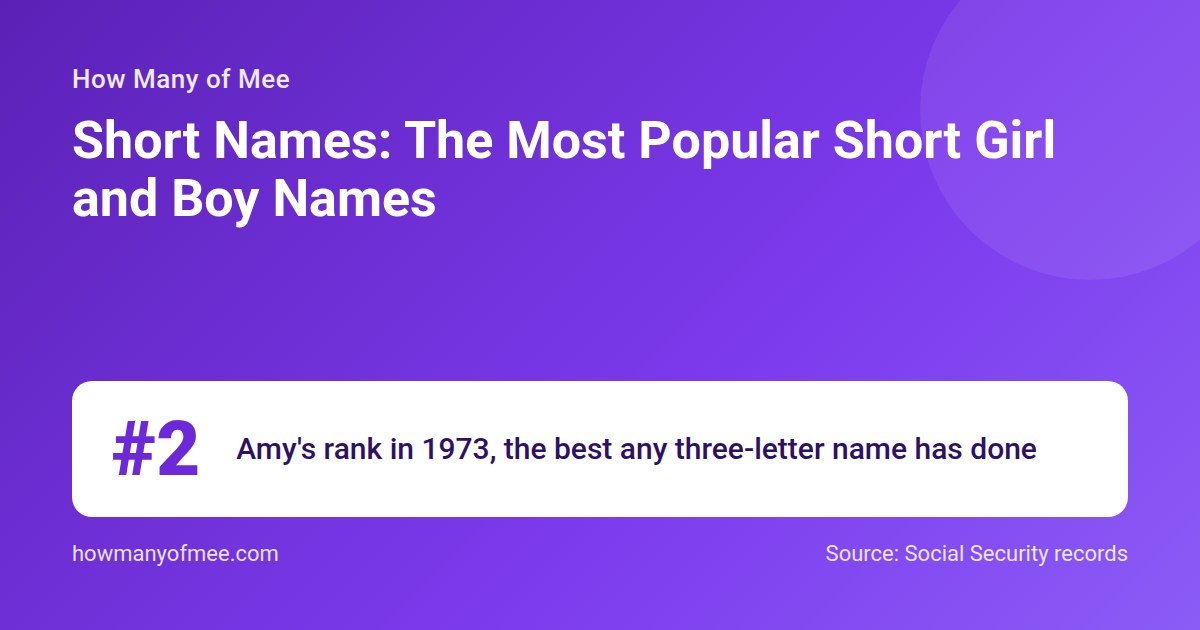
  • Amy — Amy Winehouse. Amy Adams. Amy March. A name that peaked in the 1970s–80s but still has strong recognition.
  • Kim — Kim Novak. Kim Basinger. Kim Kardashian. Peaked in the 1960s. Three letters, decades of cultural impact.

Four-Letter Female Names

  • Mary — The single most popular female name in recorded Western history. Period. Virgin Mary. Mary Shelley. Mary Queen of Scots. For most of the 20th century, Mary sat at #1 in the U.S. — then it finally started sliding in the 1970s.
  • Anne — The four-letter version of Ann. Anne Frank. Anne Hathaway (Shakespeare’s wife AND the actress). Royal, literary, and timeless.
  • Emma — Jane Austen’s novel gave it literary cachet. Emma Watson gave it modern star power. It’s been #1 multiple times in the 2000s and 2010s.
  • Jane — Jane Austen. Jane Eyre. Jane Fonda. Jane Goodall. Four letters, and each one carries authority.
  • Ruth — Biblical. Ruth Bader Ginsburg. Babe Ruth (surname, but still). A powerful four-letter name that peaked in the 1920s.
  • Sara — The simplified spelling of Sarah. Sara Bareilles. Common across English, Spanish, Arabic, and Hebrew cultures.
  • Lisa — Mona Lisa. Lisa Simpson. Lisa Kudrow. A name that absolutely dominated the 1960s–70s. At its peak, 1 in every 20 baby girls born in the U.S. was named Lisa.
  • Lily — Lily Allen. Lily James. A botanical name that’s been in the Top 50 since the 2000s and shows no signs of fading.
  • Lucy — From the Latin “lux” (light). Lucy was the name given to the famous 3.2-million-year-old hominid fossil discovered in Ethiopia. I Love Lucy cemented it in pop culture.
  • Ruby — Gemstone name. Ruby Bridges, the civil rights icon who desegregated schools in 1960, gave this name historical gravity.

📌 Did You Know? The name “Ava” was barely used in the mid-20th century. Its sudden jump back to the top is a fascinating case study in how name popularity cycles work.


Short Names That Cross Genders

Some of the shortest names in history don’t belong to one gender. They float between both — and that flexibility is part of what makes them popular.

  • Lee — Equally common for men and women historically
  • Jo — Used for boys (Jo March was female, but Joseph gives us male Jo)
  • Sam — Samantha and Samuel both shorten to Sam
  • Pat — Patrick and Patricia
  • Kim — Kim was originally a male name (Rudyard Kipling’s 1901 novel Kim) before becoming a female favorite
  • Alex — Four letters, works for Alexander and Alexandra

This gender flexibility is a trend that’s only growing. Gender-neutral names are trending heavily among Gen Z and Gen Alpha parents who want names without rigid gender associations.


Short Names Across Different Cultures

Short names aren’t just an English-language thing. Every culture has them, and many have become globally popular.

East Asian Short Names

  • Li — The most common surname in China, carried by over 90 million people. As a given name, it means “beautiful” or “powerful” depending on the character.
  • Yu — Common across Chinese, Japanese, and Korean naming traditions.
  • Wu — Another incredibly common Chinese surname that doubles as a given name.
  • Mei — Means “beautiful” in Chinese. Used across East and Southeast Asia.
  • Kai — Hawaiian, Japanese, and European origins. Means “sea” in Hawaiian. It’s become a global favorite.

Arabic and South Asian Short Names

  • Ali — One of the most popular Muslim names worldwide. Ali ibn Abi Talib, the fourth caliph of Islam, gave this name eternal significance. Three letters, 1.4 billion+ Muslims who recognize it instantly.
  • Om — Sacred in Hinduism, Buddhism, and Jainism. Used as a name and a spiritual symbol across South Asia.
  • Raj — Means “king” in Hindi/Sanskrit. Raj Kapoor. A three-letter name with royal meaning.
  • Uma — Uma Thurman brought it to Western audiences, but it’s a popular Hindu name meaning “splendor” — another name for the goddess Parvati.
  • Dev — Sanskrit for “god” or “divine.” Short, powerful, cross-cultural.

European Short Names

  • Jan — Hugely popular in Dutch, German, Polish, and Czech cultures. A variant of John.
  • Pia — Italian and Scandinavian. Means “pious” or “devoted.”
  • Dag — Scandinavian. Means “day.” Former UN Secretary-General Dag Hammarskjöld carried this two-letter-sounding three-letter name.
  • Ulf — Old Norse for “wolf.” Still used across Scandinavia.
  • Ivo — German, Dutch, and Slavic. Short, distinctive, and centuries old.

The global spread of short names proves something interesting: brevity translates. A name like “Kai” works in Tokyo, Berlin, Honolulu, and Lagos. That cross-cultural portability is a hidden superpower of short names.


What Makes Short Names Stick Around?

Not every short name survives. Some fade. “Ira” was huge in the 1890s. “Ora” was a Top 100 name in 1900. “Ola” and “Oda” have virtually disappeared.

So what separates the survivors from the forgotten?

1. Celebrity and Cultural Attachment

Names get boosted — or buried — by the people who carry them. “Ava” was dormant until Ava Gardner. “Mia” got a lift from Mia Farrow. Celebrity influence on baby names is well-documented and powerful.

2. Sound Patterns That Feel Good

Linguistics research shows that names with open vowel endings (Ava, Leo, Mia) tend to sound warmer and more approachable. Names ending in hard consonants (Max, Jack, Rex) feel stronger and more decisive. Both patterns work — they just serve different vibes.

3. Cross-Generational Flexibility

Names like “Sam,” “Ben,” and “Ann” work for a toddler, a college student, a CEO, and a grandmother. That range keeps them alive across decades.

4. Spelling Simplicity

Short names are almost impossible to misspell. In an era of email addresses, online forms, and global communication, that’s a genuine practical advantage.

5. They Survive Nickname Culture

Here’s something ironic: long names often survive because their nicknames are short. Elizabeth → Liz. William → Will. Robert → Rob. But names that are already short? They don’t need nicknames. They ARE the nickname. And that directness has real staying power.

You can explore how name popularity shifts over time and see exactly when certain short names peaked and dipped.


Common Myths About Short Names

Let’s bust a few misconceptions that float around.

Myth #1: “Short Names Aren’t Real Names — They’re Just Nicknames”

Wrong. Many short names are full, standalone names with their own etymological roots. “Eve” isn’t short for anything. “Rex” isn’t a nickname. “Kai” stands alone in multiple languages. While some short names did start as diminutives, many have established independent identities over centuries.

Myth #2: “Short Names Sound Less Professional”

Actually, the opposite might be true. A 2012 LinkedIn study found that CEOs with shorter first names were overrepresented at the top. Names like “Bob,” “Jack,” and “Fred” appeared disproportionately among Fortune 500 leaders. Can your name affect your career? The data suggests yes — and short names might have an edge.

Myth #3: “Short Names Are All Common and Boring”

Some of the rarest names on record are also among the shortest. Names like “Oz,” “Bex,” “Tao,” and “Ren” are short AND unusual. Being short doesn’t automatically mean being common. You can check if your name is truly unique regardless of its length.

Myth #4: “Two-Letter Names Aren’t Legal”

In most U.S. states, there’s no minimum character requirement for a legal name. Two-letter names like “Ed,” “Al,” and “Jo” have been registered on birth certificates for well over a century. Some states have specific restrictions on symbols or numbers, but letter count? Usually not an issue.


The Shortest Name Debate: Can a Name Be Just One Letter?

This is where things get wild.

Yes, one-letter names have existed. President Harry S. Truman’s middle name was literally just the letter “S” — it didn’t stand for anything. His parents chose it to honor both grandfathers (Anderson Shipp Truman and Solomon Young) without favoring either.

In some Asian cultures, single-character names are traditional. The former UN Secretary-General U Thant of Myanmar used “U” as an honorific, but his actual name was essentially one syllable: Thant.

Legal challenges have popped up with one-letter names. Some U.S. computer systems and government forms require a minimum of two characters for a first name. This has caused real headaches for people with single-letter legal names — passports, driver’s licenses, and airline tickets have all created issues.

📌 Quick Fact: Several people in the U.S. have the legal first name “J” or “T” — confirmed by SSA records. These aren’t initials standing for something longer. They’re the actual, complete first name.


Short Names Trending Right Now (2025–2026)

The love affair with short names isn’t slowing down. Based on SSA data trends and Google’s most searched baby names, here are short names gaining momentum:

Boys:

  • Kai — Still climbing. Cross-cultural appeal is massive.
  • Leo — Top 20 and rising.
  • Jax — Modern, punchy. A departure from the classic “Jack.”
  • Ari — Hebrew origin. Means “lion.”
  • Ace — Bold choice. Gaining traction since the 2010s.
  • Fox — Yes, really. It entered the SSA Top 1000 in 2016.

Girls:

  • Mia — Locked in the Top 10.
  • Ava — Still dominant.
  • Ivy — Climbing steadily.
  • Ada — A tech-world favorite (Ada Lovelace, the first computer programmer).
  • Gia — Italian origin. Sleek and modern.
  • Wren — Nature name. Short and distinctive.

The pattern is clear: parents want names that are short, strong, and globally portable. The era of eight-syllable names isn’t over, but short names are winning market share — and they have been for a while.


FAQ Section

What is the shortest popular name in history?

In the English-speaking world, two-letter names like Ed, Al, and Jo are among the shortest that achieved widespread popularity. For women, Io (from Greek mythology) and Jo are notable. Among names that reached genuine mass popularity, Ed and Jo stand out as the shortest with significant historical usage confirmed by census and birth records.

Are two-letter names legal in the United States?

Yes. Most U.S. states don’t have a minimum character requirement for first names. Names like “Ed,” “Jo,” “Al,” and even single-letter names like “J” have been legally registered. Some electronic systems may have trouble processing very short names, but legally, they’re typically accepted.

What is the most popular three-letter name of all time?

For males, John at four letters just misses, so Tom, Ben, and Sam are strong contenders. Lee might take the overall crown because it’s been massively popular as both a first name and surname across Western and East Asian cultures. For females, Ann and Eve have the longest historical track records, though Mia and Ava are dominating the current era.

Why do short names feel more powerful?

Cognitive science offers a clue. Shorter names require less processing time for your brain, which creates a feeling of fluency and familiarity. Familiar-feeling things are perceived as more trustworthy and likable — a phenomenon psychologists call the “fluency heuristic.” A name like “Max” hits your brain faster than “Maximilian,” and that speed creates an impression of directness and confidence.

Do short names become more or less popular over time?

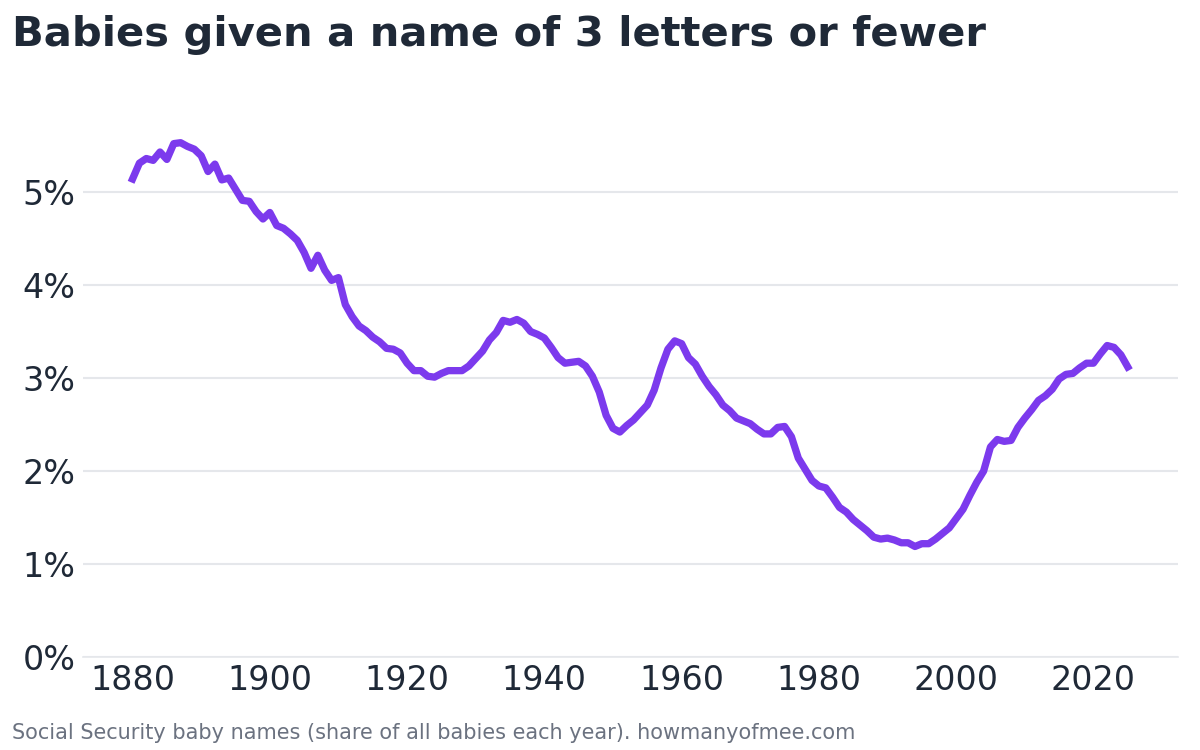
Both — it depends on the specific name. Some short names (like Mary, Ann, and John) were mega-popular for centuries, dipped, and are now either stable or rebounding. Others (like Mia, Ava, and Leo) were relatively uncommon for decades before surging recently. The overall category of short names has been gaining popularity since roughly the 1990s, as parents increasingly favor simplicity and global accessibility.


Your Name, Your Story — Length Doesn’t Define Legacy

Here’s something worth sitting with: some of the most powerful people who ever lived carried names shorter than your Wi-Fi password.

Eve. Ali. Rex. Mae. Lee. Max. Ava. Ben.

These aren’t just names. They’re proof that impact has nothing to do with length. A two-letter name can topple empires. A three-letter name can win Oscars. A four-letter name can change the world.

If you’re a parent picking a name, don’t feel pressured to choose something long and elaborate just because it “sounds more complete.” History disagrees. And if your own name is short — wear it proudly. You’re carrying a tradition that stretches back thousands of years across every continent and culture.

Curious about your own name’s popularity? Find out how many people share your name — and see exactly where your name stands in the grand sweep of history. Short or long, common or rare, your name is yours. And that’s what makes it matter.

Leave a Comment