
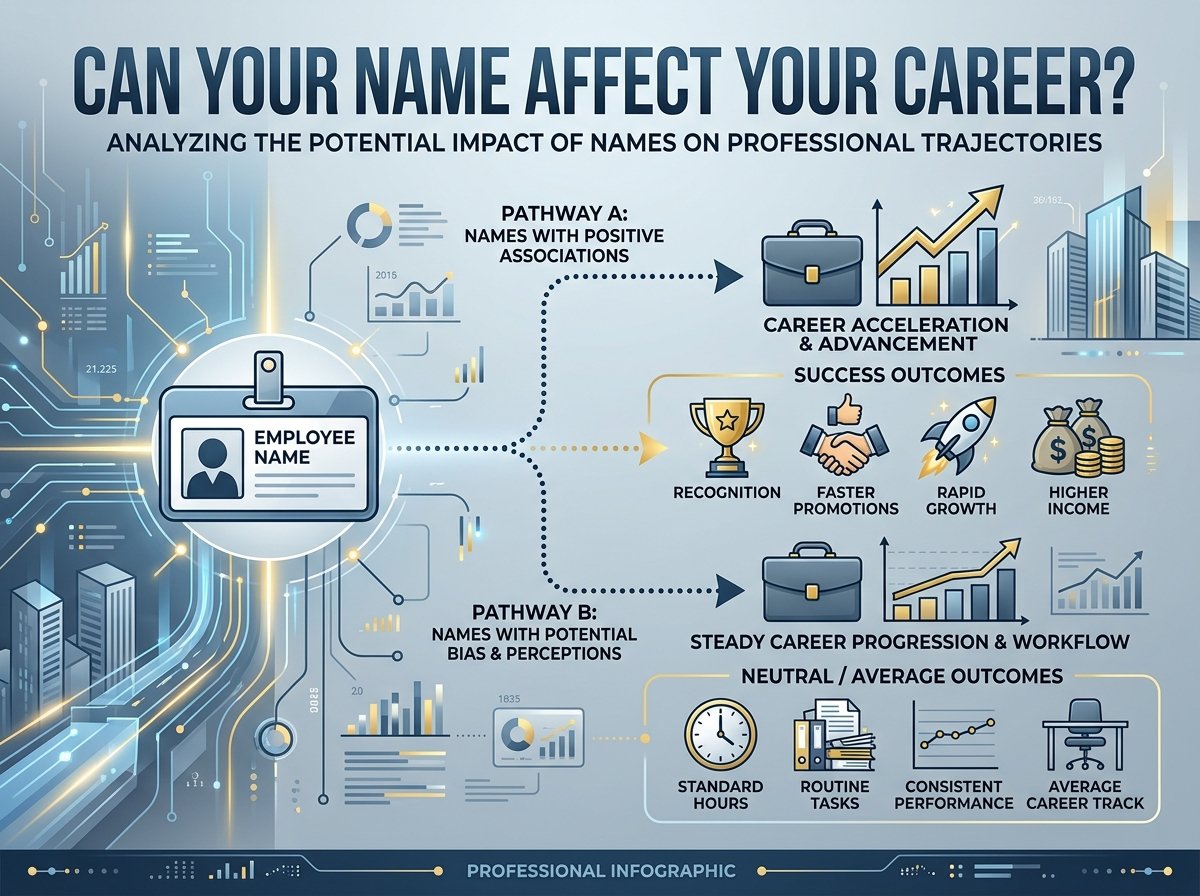
A resume with the name “James” gets 50% more interview callbacks than the exact same resume with the name “Jamal.” That’s not opinion — that’s from a landmark study by the National Bureau of Economic Research.
Let that sit for a moment.
You spend years building skills, earning degrees, and polishing your resume. But before anyone reads a single line about your experience, they see your name. And that name? It triggers a snap judgment — about your gender, your ethnicity, your age, your social class, and even how competent you might be.
Sounds unfair, right? It absolutely is. But ignoring this reality won’t make it go away. So let’s have an honest conversation about how names shape career outcomes, what the research actually says, and — most importantly — what you can do about it.
H2: The Science Behind Names and First Impressions
Your name is usually the very first piece of information someone learns about you. Before they see your face, hear your voice, or shake your hand — they read your name. And the human brain, wired for pattern recognition, immediately starts forming assumptions.
H3: The “Name Pronunciation Effect”
Researchers at the University of Melbourne found something fascinating in 2012. People with easy-to-pronounce names are perceived as more trustworthy, more likable, and more likely to get promoted. The study, led by Dr. Simon Laham, showed this effect held true across different cultures and languages.
Why? Because our brains associate fluency — how easily we process something — with positive feelings. If your name flows off the tongue, people feel a subtle sense of comfort. If they stumble over it, there’s a tiny friction, and that friction colors their perception.
Quick Fact: This doesn’t mean hard-to-pronounce names doom you. It means there’s an unconscious bias you should know about — so you can counter it.
H3: Names Trigger Stereotypes Instantly
A name can signal gender, ethnicity, religion, age, and even socioeconomic background — all in a split second. And those signals activate stereotypes, whether the person reading the name wants them to or not.
Think about it. You see the name “Reginald” and picture a very different person than when you see “Cody.” You see “Priya” and make different assumptions than when you see “Sarah.”
This isn’t because people are bad. It’s because the psychology behind unique names is deeply tied to how our brains categorize and process social information. We’re pattern-matching machines — and names are one of the strongest patterns we use.
H2: What the Resume Studies Actually Prove
This isn’t guesswork. Multiple controlled experiments have measured the impact of names on hiring decisions with hard data.
H3: The Bertrand & Mullainathan Study (2004)
This is the big one. Economists Marianne Bertrand and Sendhil Mullainathan sent out nearly 5,000 fake resumes to real job postings in Boston and Chicago. The resumes were identical in every way — except the names.
Half had traditionally White-sounding names like Emily Walsh and Greg Baker. Half had traditionally Black-sounding names like Lakisha Washington and Jamal Jones.
The results were stark:
- White-sounding names received 50% more callbacks
- A “White” name was worth about 8 extra years of work experience
- The discrimination was consistent across industries, company sizes, and job types
This study shook the academic world because it isolated the name effect perfectly. Same resume. Same skills. Same everything. The only variable was the name at the top.
H3: The Gender Bias in Names
A Yale University study in 2012 asked science faculty to evaluate an application for a lab manager position. Half received the application with the name “John.” Half received the exact same application with the name “Jennifer.”
John was rated significantly more competent, more hirable, and was offered a higher starting salary — about $4,000 more per year. Both male and female faculty showed this bias.
So it’s not just about ethnicity. Gender signals in names create measurable career disadvantages too.
H3: International Name Discrimination
This pattern repeats globally. Studies in the UK showed that applicants with Muslim-sounding names needed to send 74% more applications to get the same number of callbacks as those with traditionally British names. Research in Sweden, Germany, and Australia has produced similar findings.
If you’re curious about how many people share your full name and what that might mean for standing out in job markets, the name commonality factor adds another interesting dimension to this conversation.
H2: How Names Influence Salary and Promotions
The name effect doesn’t stop at getting hired. It follows people throughout their careers.
H3: The “CEO Name” Phenomenon
A study published in the Journal of Financial Economics looked at the names of S&P 500 CEOs and found something interesting. CEOs overwhelmingly have short, common, easy-to-pronounce names. Think Bob, John, James, David, Michael.
That doesn’t mean you need to be named John to become a CEO. But it suggests that name-based biases compound over time. Small advantages at each career stage — getting callbacks, making good first impressions, being remembered — add up to significant gaps over a 30-year career.
H3: The “Name-Letter Effect” on Career Choices
This one’s wild. Psychologist Brett Pelham found that people are slightly more likely to choose careers that match their names. Dennis and Denise are overrepresented among dentists. People named Lawrence are more likely to become lawyers. People named Louis are disproportionately likely to live in St. Louis.
Is this a major effect? No. But it shows how deeply our names embed themselves into our identity and even our unconscious choices.
H3: Salary Differences Linked to Name Perception
Research from TheLadders (a job search platform) found that people with names perceived as “higher status” or “rich-sounding” earned an average of $6,000–$12,000 more annually in comparable positions. Names carry class signals, and those signals influence how colleagues, managers, and clients perceive your authority and competence.
Pro Tip: Awareness is the first step. If you suspect name bias is affecting your career, strategies exist to counterbalance it — we’ll cover them below.
H2: Common vs. Unique Names — Which Helps Your Career?
This is one of the most debated questions parents and professionals face. Should you blend in or stand out?
H3: The Case for Common Names
Common names carry real professional advantages:
- Easy to remember — recruiters won’t butcher your name in interviews
- No awkward introductions — you skip the “how do you pronounce that?” moment
- Perceived as mainstream — right or wrong, familiar names feel “safe” to hirers
- Google-proof — a common name can actually provide privacy
If you’ve got one of the most common male names in the USA or most common female names in the USA, you’re statistically less likely to face pronunciation-based bias.
H3: The Case for Unique Names
But there’s a flip side. Unique names have their own career advantages:
- Memorability — in a pile of 200 resumes, a distinctive name stands out
- Personal branding — easier to build a unique online presence
- Conversation starters — your name itself becomes an icebreaker
- Perceived creativity — some industries (design, arts, media) actually favor unusual names
The key difference? Unique names help in creative, progressive industries. Common names help in conservative, traditional ones (law, finance, government).
H3: The Sweet Spot
Research suggests the best career outcome comes from names that are distinctive but pronounceable. Think: Elon, Oprah, Satya. Unusual enough to be memorable, simple enough to say without hesitation.
If you’re curious where your own name falls on this spectrum, checking whether your name is truly unique can give you useful perspective.
H2: Name Bias in Different Industries
Not all fields treat names equally. The impact varies a lot depending on where you work.
H3: Tech Industry
Silicon Valley talks a big game about meritocracy, but studies tell a different story. A 2016 study by Hired.com found that candidates with Asian-sounding names received lower salary offers for identical roles compared to candidates with Anglo-Saxon names. The gap was about 4–8%.
That said, the tech industry has also been faster than most to adopt blind hiring practices — removing names from initial application reviews. Companies like Google, Deloitte, and GapJumpers have implemented versions of this.
H3: Law and Finance
These are traditionally conservative fields where name bias tends to be strongest. Studies show that “upper-class sounding” names (think: Charles, Elizabeth, Alexander) correlate with higher partnership rates at law firms and faster promotion tracks at investment banks.
A 2015 study from the Social Mobility Commission in the UK found that elite law firms admitted to favoring candidates whose names “sounded like they’d fit in.”
H3: Creative Industries
Here’s where the script flips. In advertising, media, entertainment, fashion, and design — unusual names can actually be an asset. A memorable name becomes part of your personal brand. Creative directors, agents, and producers are actively drawn to names that feel distinctive.
H3: Healthcare and Academia
These fields show mixed results. Name bias exists in patient trust (patients sometimes prefer doctors with familiar-sounding names) and in grant funding (researchers with Anglo-Saxon names have historically received more NIH funding). But these gaps have narrowed significantly as diversity initiatives have expanded.
H2: Myths and Misconceptions About Names and Careers
Let’s clear up some stuff that people get wrong.
H3: Myth 1 — “Changing Your Name Fixes Everything”
Some people legally change their names or use Anglicized versions professionally. Does it help? Sometimes, yes — studies show that immigrants who adopt local-sounding names get more callbacks. But it’s a personal decision with real emotional weight. You shouldn’t have to erase your identity to get a fair shot, and systemic change matters more than individual adaptation.
H3: Myth 2 — “Name Bias Only Affects Minorities”
Wrong. Name bias affects everyone, just in different ways. People with “old-fashioned” names face age assumptions. People with names associated with lower socioeconomic backgrounds face class bias. Men with names perceived as feminine face bias. White applicants with unusual spellings face bias. It’s a universal phenomenon, even though it hits some groups harder than others.
H3: Myth 3 — “Your Name Determines Your Success”
This is the most dangerous myth. Your name creates friction or advantage at certain checkpoints — getting callbacks, making first impressions, being remembered. But it doesn’t determine outcomes. Plenty of people with “disadvantaged” names have built extraordinary careers. The bias is real, but it’s one factor among many. Skills, persistence, networking, and timing all matter more in the long run.
H3: Myth 4 — “Only Old-Fashioned Companies Care About Names”
Even startups with ping-pong tables and “culture fit” interviews show name bias. Unconscious bias doesn’t care about your company’s mission statement. It operates below conscious awareness, and even well-intentioned people carry it.
Did You Know? Research on how names impact personality shows that names don’t just affect how others see you — they can actually influence how you see yourself, which in turn shapes your career confidence and choices.
H2: What You Can Actually Do About Name Bias
Okay, so the problem is real. Now what? Here are practical, research-backed strategies.
H3: For Job Seekers
1. Lead with accomplishments. If your name might trigger bias, make your resume so strong that your qualifications overshadow any name-based assumptions. Quantify everything. “Increased revenue by 34%” speaks louder than any name.
2. Use a professional headshot on LinkedIn. Sounds counterintuitive, but a 2020 study found that adding a photo to profiles with “ethnic” names actually reduced discrimination. When people see a face, they shift from stereotyping to individualizing.
3. Build a personal brand beyond your resume. A strong LinkedIn profile, a portfolio website, a professional blog — these give people reasons to know you beyond four letters on a page.
4. Network aggressively. Referrals bypass the resume screen entirely. If someone inside the company recommends you, your name becomes irrelevant because you’ve already been vouched for.
5. Consider strategic name presentation. Some people use initials, shortened versions, or middle names professionally. This is a personal choice — there’s no shame in it, and no obligation to do it either.
H3: For Employers and Managers
1. Implement blind hiring. Remove names (and photos, and addresses) from the initial resume review. Multiple studies show this dramatically reduces bias.
2. Use structured interviews. Ask every candidate the same questions. Score answers on a rubric. This minimizes the impact of first-impression biases, including name-based ones.
3. Train for unconscious bias — but don’t stop there. Awareness training helps, but it’s not enough on its own. Combine it with systemic changes (blind reviews, diverse hiring panels, accountability metrics).
4. Audit your data. Look at your callback rates, interview rates, and hiring rates broken down by name demographics. The numbers don’t lie.
H3: For Parents Choosing Baby Names
If you’re naming a child and career impact crosses your mind — you’re not overthinking it. Research validates this concern.
A balanced approach: choose a name that’s meaningful to your family AND reasonably easy to pronounce and spell in the environment where your child will likely grow up. That’s not selling out. That’s being strategic.
Some parents today explore why certain names sound rich or successful before finalizing their choice. That’s smart planning, not shallow thinking.
H2: The Future of Names in the Workplace
Things are changing. Slowly, but measurably.
H3: AI and Blind Hiring Are Growing
More companies use AI-powered hiring tools that strip identifying information from applications. Platforms like Applied, Blendoor, and GapJumpers are gaining traction. By 2025, roughly 30% of Fortune 500 companies had some form of blind hiring in their process.
But there’s a catch: AI itself can be biased. Amazon famously scrapped an AI recruiting tool in 2018 because it had learned to penalize resumes that included the word “women’s” (as in “women’s chess club”). The tool wasn’t looking at names directly, but it was picking up proxy signals. So technology isn’t a magic fix — it needs careful design.
H3: Diversity, Equity, and Inclusion (DEI) Momentum
Despite political debates around DEI in 2024–2025, the underlying data hasn’t changed. Companies with diverse leadership still outperform homogeneous ones financially (McKinsey’s ongoing research confirms this). And name-blind processes are one of the simplest, least controversial ways to increase diversity in hiring pipelines.
H3: Global Remote Work Changes the Game
Here’s an underappreciated factor. The rise of remote work has made name bias both better and worse.
- Better: In text-based communication (Slack, email), people sometimes form impressions based on your ideas before learning your name.
- Worse: Without face-to-face interaction, names become an even stronger anchor for first impressions, because there are fewer other cues to offset them.
The net effect is still being studied, but early research suggests that remote work might slightly reduce name-based hiring bias while increasing name-based collaboration bias within teams.
FAQ Section
Does changing your name legally improve career outcomes?
Some studies suggest it can help with initial callbacks and interviews, especially for immigrants or people with names that face strong bias in their country. A Swedish study found that immigrants who changed to Swedish-sounding names saw a measurable increase in employment rates. But this is deeply personal. You shouldn’t feel pressured to change your name — and the bigger solution is fixing biased systems, not forcing individuals to adapt.
Which types of names face the most career bias?
Names that signal ethnic minority status, lower socioeconomic class, or are very difficult to pronounce in the dominant language of the workplace face the most documented bias. African-American sounding names in the US, Muslim-sounding names in Europe, and Indigenous names in Australia and Canada are among the most studied. Gender-ambiguous names can face bias in either direction depending on the industry.
Can a “good” name guarantee career success?
Absolutely not. A favorable name might give you a small statistical advantage at certain checkpoints — like getting a callback or making a first impression. But career success depends on skills, work ethic, relationships, timing, and many other factors. Think of your name as one card in a very large hand. It matters, but it’s never the whole game.
Do nicknames or shortened names help in professional settings?
They can. Many professionals use shortened versions of their names (like “Mike” instead of “Mikhail” or “Liz” instead of “Elizaveta”) to make introductions smoother. Research on the name pronunciation effect suggests this can reduce friction. But some people report feeling like they’re hiding part of their identity — so the right choice depends on your comfort level and context.
Is name bias getting better or worse over time?
The honest answer: it depends on where you look. In industries adopting blind hiring and structured interviews, name bias is measurably declining. In informal hiring processes (small businesses, networking-based industries), it persists. Overall awareness has increased dramatically since the landmark 2004 Bertrand & Mullainathan study, and that awareness does translate — slowly — into systemic change.
Wrapping This Up
Your name carries weight. The research is clear and consistent — names influence callbacks, first impressions, salary offers, and promotion rates. That’s not an exaggeration. It’s decades of controlled experiments saying the same thing.
But here’s the part that matters most: name bias is a headwind, not a wall. It makes the climb harder for some people, but it doesn’t make the summit unreachable. The professionals who understand this bias can strategize around it — through networking, personal branding, skill-building, and choosing workplaces that actively fight unconscious bias.
And if you’re on the other side — hiring, managing, promoting — you now know what the data says. Small process changes like blind resume reviews and structured interviews can eliminate most of this bias overnight. That’s not just ethically right. It’s good business, because you’ll stop accidentally filtering out talented people over something as irrelevant as the letters their parents chose.
Your name is part of your story. It shouldn’t write the ending.
Want to explore what your own name says about you? Check out how many people have your name in the world — it’s a fascinating starting point for understanding where you stand in the world of names.