Only about 150 surnames cover nearly 50% of the entire U.S. population. Smith, Johnson, Williams — you’ve heard them thousands of times. But buried underneath those common names are some truly unique last names in America that fewer than 100 people carry.
Think about that for a second. In a country of over 330 million people, some surnames belong to just a handful of families. Some of these rare last names come from forgotten European villages. Others trace back to Native American languages, Japanese immigrants, or even clerical errors at Ellis Island that accidentally created brand new surnames.
If you’ve ever been curious about what makes a name rare or common, this article is going to answer a lot of your questions. We’ll explore the most unique American last names, where they came from, why they’re disappearing, and what makes a surname genuinely rare in 2025.
What Makes a Last Name “Unique” in America?
Before we get into specific names, let’s clear something up. What does “unique” actually mean here?
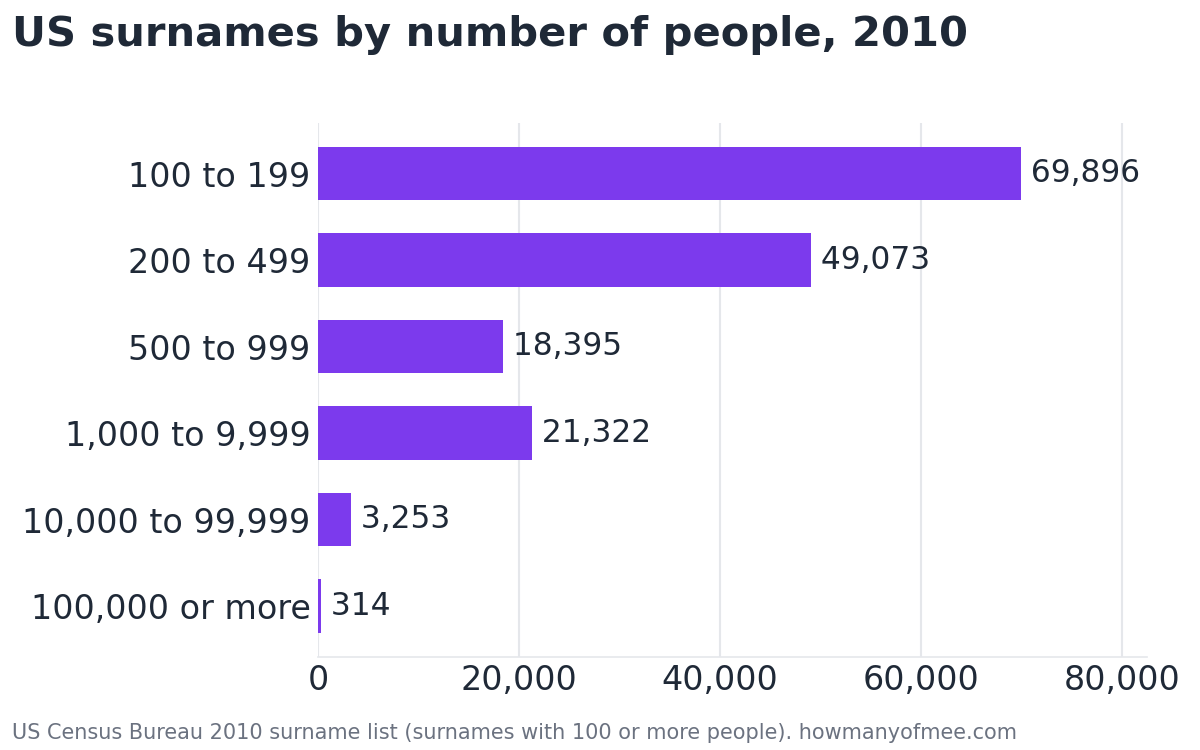
A truly unique last name isn’t just one that sounds unusual to your ears. There’s a measurable threshold. The U.S. Census Bureau tracks surname frequency, and based on their data, a name qualifies as rare if fewer than 1,000 people carry it nationwide. Ultra-rare surnames belong to fewer than 100 people total.
Here’s how surname rarity generally breaks down:
- Common: Over 100,000 bearers (Smith, Garcia, Brown)
- Uncommon: 10,000–100,000 bearers
- Rare: 1,000–10,000 bearers
- Very Rare: 100–1,000 bearers
- Ultra-Rare: Fewer than 100 bearers
Quick Fact: The U.S. has roughly 6.3 million distinct surnames on record — more than any other country. That massive number exists because of America’s immigration history from virtually every nation on earth.
Your last name might feel ordinary to you, but you’d be surprised. You can actually check how many people share your surname to get a real sense of where it falls on the rarity scale.
The Most Unique Last Names in America (Categorized)
Let’s break these down into categories so you can understand not just what these names are, but where they came from and why they’re so rare.
European-Origin Rare Surnames
America’s melting pot history means many European surnames arrived during the great immigration waves of the 1800s and early 1900s. Some survived. Many didn’t — at least not in their original form.
Here are some of the rarest European-origin last names still found in America:
- Zzyzx — Yes, this is a real surname. Likely modified from a Slavic origin. Fewer than 10 people carry it.
- Snicket — English origin, extremely rare. It originally described someone who lived near a narrow passageway.
- Brisendine — A French-origin surname that barely survived immigration. Under 200 bearers in the entire country.
- Fenoughty — Irish/Scottish origin. Anglicized from Gaelic roots. Fewer than 50 people have this name.
- Dargavell — Scottish origin. Tied to a tiny region in Dumfriesshire. Almost extinct in America.
- Mirch — Germanic roots. Possibly a variant of other German surnames altered during immigration processing.
- Tuffin — English surname from Devon/Cornwall. Fewer than 300 bearers in the U.S.
Pro Tip: Many European surnames became rare in America not because the families died out, but because immigration officers at ports like Ellis Island often misspelled or simplified names. A single pen stroke could create an entirely new surname — one that now exists nowhere else on earth.
Asian-Origin Rare Surnames
Asian immigration brought thousands of surnames that are common in their home countries but extremely rare on American soil.
- Quisumbing — Filipino origin. Rare even in the Philippines, this surname has fewer than 500 bearers in America.
- Tachibana — Japanese origin. A historic clan name that very few Japanese-American families carry today.
- Xing — Chinese origin. While common in China, fewer than 2,000 Americans have this as their surname.
- Bhattacharyya — Bengali origin. The unusual spelling (with double ‘y’) makes this specific variant extremely rare.
- Thilakawardana — Sri Lankan origin. One of the longest and rarest South Asian surnames in U.S. records.
These names are perfect examples of how name popularity changes over time — common in one country, nearly invisible in another.
Native American & Indigenous Rare Surnames
Some of the most unique last names in America come from indigenous languages. Many of these were assigned or adopted during the reservation era (late 1800s to early 1900s), often as translations of native names.
- Birdsbill — Found primarily among the Mandan and Hidatsa peoples. Extremely rare.
- Killsontop — A Crow Nation surname. Fewer than 100 bearers.
- Prettypaint — Also from the Crow Nation. Descriptive surnames like this were common in translation.
- Tallbull — Northern Cheyenne origin. A historically significant name, but very few families carry it today.
- Whitecalf — Blackfeet Nation. Under 200 people have this surname.
Did You Know? Many Native American surnames are compound descriptive words because U.S. government agents in the 1800s literally translated indigenous names into English. That’s why you get surnames that sound like short poems.
African-American Rare Surnames
The history of Black surnames in America is deeply tied to the legacy of slavery, Reconstruction, and the Great Migration. While many formerly enslaved people adopted the surnames of enslavers or chose common names like Freeman, some families ended up with truly unique surnames.
- Smothers — English origin but now extremely rare, concentrated in Southern states.
- Blythewood — Linked to a plantation name in South Carolina. Fewer than 500 bearers.
- Quashie — West African (Akan) origin. One of the few directly African-origin surnames that survived in America.
- Cuffee/Cuffe — Derived from the Akan day-name “Kofi.” Extremely rare today.
Invented, Blended & Accidental Surnames
Here’s a category most people don’t think about. Some of the rarest American last names were literally created — through immigration mistakes, deliberate name changes, or cultural blending.
- Zzyzwicz — Possibly created or heavily modified at immigration. A contender for the “last name in the dictionary.”
- Supernaw — Likely an anglicization of a French-Native American blended name. Under 300 bearers.
- Dusthimer — German-origin, possibly “Dustheimer,” modified over generations. Under 200 people.
- Fernsby — English place-name that was almost extinct but recently gained attention as a “cool rare surname” in online lists.
- Whitbeck — Dutch-origin, modified from “Witbeck.” A Hudson Valley family name that’s slowly disappearing.
Why Are These Surnames Disappearing?
You might wonder: if these families exist, why are the names fading?
There are several real reasons, and they’re all connected.
Marriage & Name Changes
The biggest factor is simple: women historically take their husband’s surname. If a family with a rare surname only has daughters, and those daughters marry men with common surnames, the rare name vanishes in one generation.
Example: If the last family carrying “Fenoughty” has two daughters who marry a Smith and a Johnson — that’s it. Fenoughty is gone forever.
Small Family Sizes
Modern American families are smaller than they were a century ago. The average family in 1900 had 4–5 children. Today, it’s closer to 1.7. Fewer children means fewer chances to carry a rare surname forward.
Deliberate Name Simplification
Many immigrants and their descendants deliberately changed their surnames to “fit in.” A German family named Pfefferkuchen might simplify to Pepper. A Polish family named Szczepanski might become Stevens. The original name effectively dies.
This connects directly to why certain names sound rich or successful — people often changed names to access economic opportunities.
Record Loss & Clerical Errors
Natural disasters, courthouse fires, and poor record-keeping have erased the history of some surnames entirely. If you can’t prove a name existed, it effectively didn’t — at least in official records.
The Rarest Last Names in the U.S. by the Numbers
Let’s put some data behind all of this. Based on U.S. Census data and surname frequency databases, here are approximate bearer counts for some of America’s most unique surnames:
| Surname | Estimated Bearers in U.S. | Origin |
|---|---|---|
| Zzyzx | Under 10 | Slavic/Modified |
| Killsontop | Under 100 | Crow Nation |
| Fenoughty | Under 50 | Irish/Scottish |
| Quashie | Under 400 | West African (Akan) |
| Brisendine | Under 200 | French |
| Prettypaint | Under 100 | Crow Nation |
| Tachibana | Under 800 | Japanese |
| Dargavell | Under 50 | Scottish |
| Supernaw | Under 300 | French/Native American |
| Tuffin | Under 300 | English |
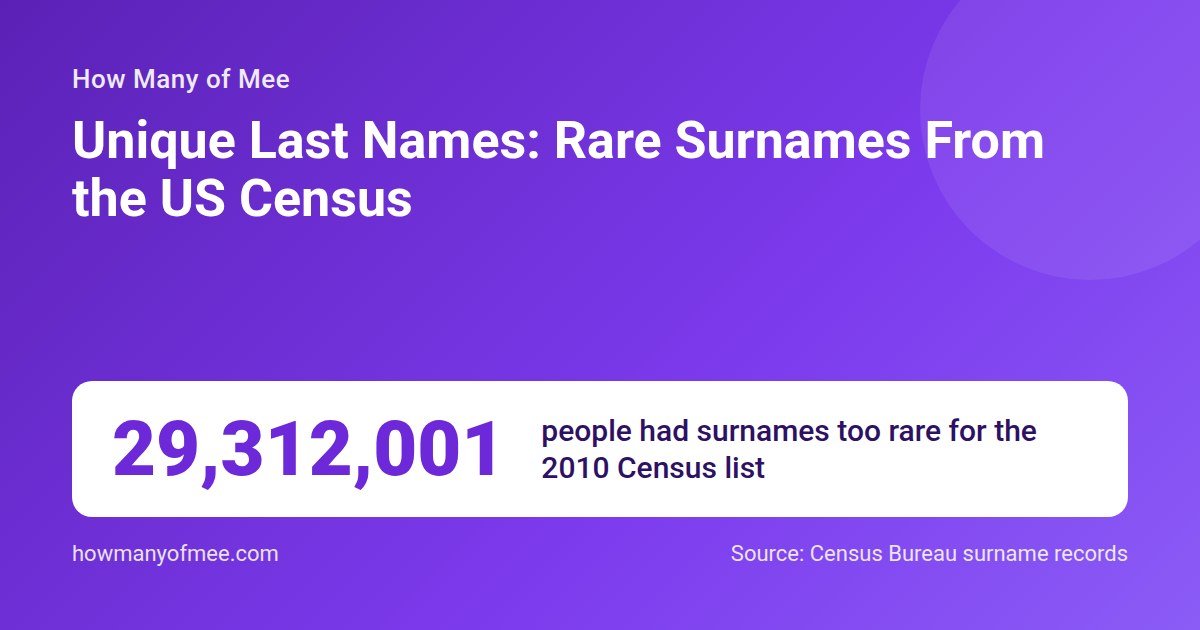
Warning: Exact numbers are hard to pin down because the Census Bureau doesn’t release data for surnames with very few bearers (to protect privacy). These estimates come from combining census data, genealogical databases, and public records.
If you’re curious about your own name’s rarity, you can check how many people have your name in the world and see where you stand.
Common Myths About Rare Last Names
Let’s bust some misconceptions. You’ll find a lot of bad information floating around the internet about unique surnames.
Myth #1: “Rare Surnames Mean Rare Ancestry”
Not true. Your surname being rare doesn’t mean your family line is small. It might just mean the name form is unusual. You could have thousands of relatives who carry a modified version of the same original name.
Myth #2: “Ellis Island Officers Changed Everyone’s Names”
This is one of the most persistent myths in American genealogy. The reality? Ship manifests were prepared at the departure port, not at Ellis Island. Ellis Island officers worked from those pre-made lists. Name changes did happen, but usually over time in local communities — not at the moment of arrival.
Myth #3: “You Can’t Have a Truly Unique Surname”
Actually, you can. Some surnames exist for just one family in the entire world. These usually result from clerical errors, creative combining of parents’ names, or deliberate legal name changes. There are names that exist only a few times in the world, and some of them are last names.
Myth #4: “Unique Last Names Are Always Foreign”
Plenty of ultra-rare American surnames are thoroughly English in origin. They just happened to come from tiny villages or occupations that no longer exist. “Arkwright” (maker of arks/chests), “Dankworth” (from an obscure English hamlet), and “Relish” (possibly an old English nickname) are all examples.
How Do Unique Surnames Affect People’s Lives?
You might think a name is just a name. But research says otherwise.
The Career Effect
Studies from institutions like the National Bureau of Economic Research have shown that people with unusual or hard-to-pronounce surnames face measurable disadvantage in hiring. Resumes with simple, familiar surnames get more callbacks than identical resumes with unusual ones.
This isn’t fair, but it’s real. And it’s one reason many families with rare surnames simplified them. You can read more about how your name can affect your career — the research is genuinely fascinating.
The Identity Effect
On the flip side, many people with unique last names report a strong sense of identity and family pride. Your surname connects you to a specific lineage. If only 50 people in the world share your last name, you’re carrying something genuinely special.
The Practical Headache Effect
Let’s be honest — rare surnames cause everyday frustrations. Misspellings on official documents. Auto-correct mangling your name in emails. Customer service agents asking you to spell it three times. People with names like Bhattacharyya or Pfefferkorn know this struggle intimately.
Did You Know? The psychology behind unique names shows that people with unusual names often develop stronger self-differentiation — they’re more comfortable standing out from the crowd.
How to Find Out If Your Last Name Is Truly Unique
Curious about your own surname? Here’s a practical step-by-step approach:
Step 1: Use the U.S. Census Bureau’s surname frequency data. They publish lists of surnames occurring 100+ times in America.
Step 2: Check genealogical databases like Ancestry.com, FamilySearch.org, or Forebears.io. These can show you global distribution of your surname.
Step 3: Search public records databases. If your name has very few hits, that’s a strong indicator of rarity.
Step 4: Try a tool like HowManyOfMe to check if your name is truly unique. These tools estimate how many Americans share your exact first + last name combination.
Step 5: Look at immigration and naturalization records. If your surname was modified during immigration, you might discover the original (and possibly rarer) version of your family name.
The Future of Rare American Surnames
What happens to these unique last names going forward? The trends point in two competing directions.
The Bad News: Many Will Disappear
Small family sizes, continued marriage-based name changes, and cultural assimilation mean that dozens of ultra-rare American surnames will likely go extinct within the next 50 years. Once a surname’s bearer count drops below 10, it’s essentially one generation away from vanishing.
The Good News: New Unique Surnames Are Being Created
Here’s something most people overlook — new surnames get created all the time. Hyphenated marriage names (like Ramirez-Chen), legal name changes to invented words, and immigrant families arriving from previously underrepresented countries all add to America’s surname diversity.
The number of distinct surnames in America has actually increased by roughly 10% since the year 2000, driven largely by immigration from Sub-Saharan Africa, South and Southeast Asia, and the Middle East.
Also, there’s a growing movement — especially among younger generations — to preserve rare family names. Some couples choose to give children the mother’s rarer surname instead of the father’s common one. Others hyphenate specifically to keep a rare name alive.
This trend connects beautifully to why parents choose rare names today. The desire for individuality isn’t just about first names anymore — it’s about the full name package.
FAQ: Most Unique Last Names in America
What is the rarest last name in America?
Pinpointing a single “rarest” surname is tricky because the Census Bureau doesn’t publish data on names held by very few people. But based on available records, surnames like Zzyzx, Fenoughty, and Killsontop are among those with the fewest known bearers — possibly under 50 people each. The true rarest surnames might be ones held by a single family that we simply don’t have public data on.
Can you legally create a new last name in the United States?
Yes, absolutely. In most U.S. states, you can legally change your surname to virtually anything through a court petition — as long as the name change isn’t intended for fraud, doesn’t contain numbers or symbols (in most jurisdictions), and isn’t obscene. Many people have created completely new surnames this way, which technically makes them the only bearers of that name in the world.
Why do some last names only exist in America?
Several reasons. Immigration processing sometimes altered original surnames into forms that don’t exist in the home country. Blended families combined parts of two surnames. And some names evolved through generations of American English pronunciation until they no longer resembled the original. These “accidental” surnames are uniquely American creations.
How many unique last names exist in the United States?
According to Census data and linguistic studies, approximately 6.3 million distinct surnames are recorded in the United States. That’s more than any other single country. About 60% of those surnames are held by fewer than 100 people each, making the majority of American surnames technically “rare.”
Do unique last names help or hurt you professionally?
Research is mixed but leans toward a slight disadvantage in initial hiring due to unconscious bias — especially if the name is perceived as hard to pronounce. But once past that initial barrier, a unique surname can actually be beneficial for personal branding, recognition, and memorability. Many entrepreneurs and public figures report that their unusual names helped them stand out.
Your Last Name Tells a Story Worth Knowing
Every surname — common or rare — carries a piece of human history. Those 150 dominant American surnames represent mass migration patterns and cultural assimilation. But the unique last names? They represent the edges. The tiny villages, the specific families, the immigration moments, the clerical accidents, and the deliberate choices that make genealogy so endlessly interesting.
If your last name is rare, you’re holding onto something that might not exist in another generation. That’s worth understanding, worth documenting, and maybe even worth preserving.
And if your last name is Smith? Don’t worry — there’s probably a fascinating story behind that too. You can always find out how many people share your full name and discover just how common — or uncommon — your complete identity really is.
Either way, the name you carry says something about where you came from. Knowing that story is always worth the effort.