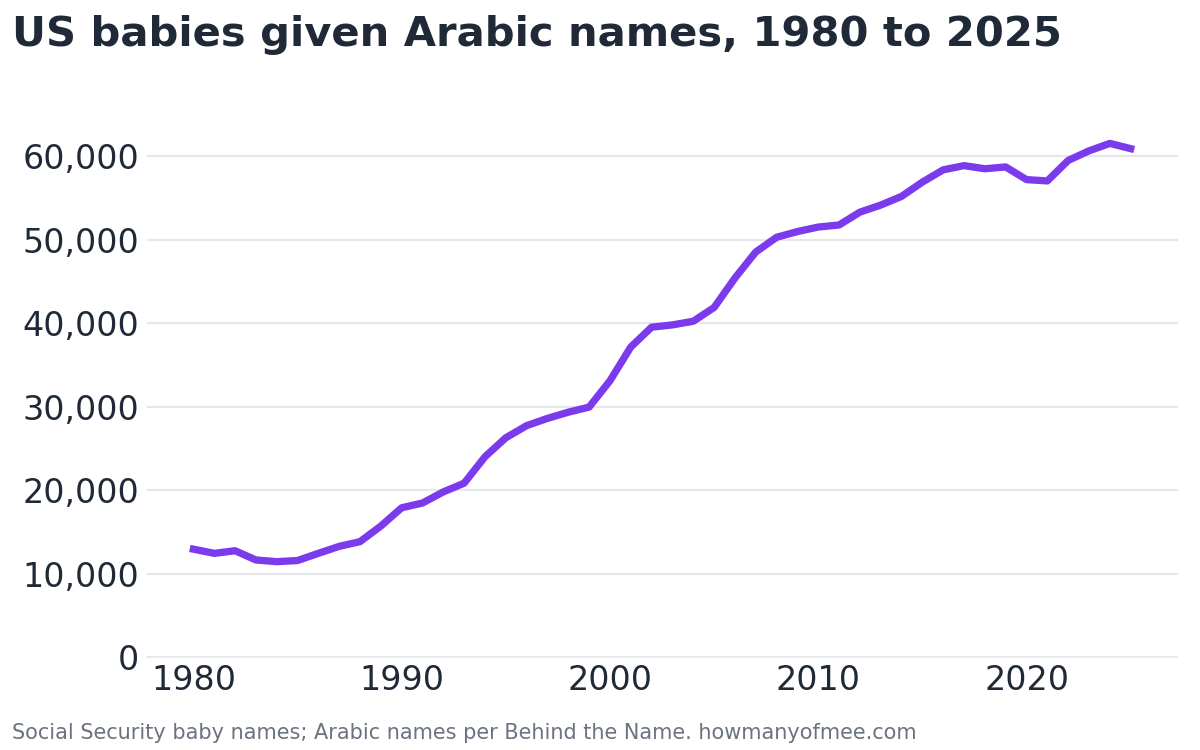
Muhammad isn’t just a name — it’s the most common first name on the entire planet. Roughly 150 million people carry this name across the globe, according to various naming databases and demographic studies. That single fact tells you something powerful about Arabic names: they don’t just exist in the Arab world. They’ve spread across continents, cultures, and centuries.
Whether you’re an expecting parent exploring Arabic names for your baby, a language enthusiast curious about name origins, or someone who simply wants to understand why certain Arabic names pop up so often, this article is for you. We’ll break down the most popular Arabic names for both boys and girls, explore what they actually mean, and talk about why some of these names have remained dominant for over a thousand years.
You might also be curious about how many people share your name worldwide — it’s a fun rabbit hole to go down, especially with Arabic names that cross so many borders.
Let’s get into it.
Why Arabic Names Carry So Much Weight
Arabic names aren’t random sounds. Each one is chosen with deep intention. In Arab and Islamic cultures, a name is considered a lifelong gift from parents to a child. The Prophet Muhammad himself reportedly said, “On the Day of Resurrection, you will be called by your names and by your fathers’ names, so give yourselves good names.”
That hadith has shaped naming traditions for over 1,400 years.
The Three Pillars of Arabic Naming
Arabic names typically draw from three sources:
- Religious significance — Names of prophets, companions of the Prophet, or names mentioned in the Quran
- Descriptive qualities — Names that describe positive traits like bravery, beauty, wisdom, or generosity
- Family heritage — Names passed down through generations to honor ancestors
This is quite different from Western naming trends where pop culture and celebrity influence play a bigger role. If you’re curious about why some names suddenly become popular in the West, the contrast with Arabic naming traditions is pretty interesting.
Quick Fact: Arabic is the fifth most spoken language in the world, with over 420 million native speakers across 25+ countries. That alone explains why Arabic names appear so frequently in global name statistics.
The Most Common Arabic Names for Boys
Let’s start with male names, because the data here is striking. Several Arabic male names consistently rank among the most popular names globally — not just in Arab countries.
1. Muhammad (محمد)
No surprise here. Muhammad — along with its spelling variations like Mohammed, Mohammad, Mohamed, and Muhammed — is the single most used first name on Earth. It means “praised” or “praiseworthy.”
Here’s what makes Muhammad so dominant:
- It’s the name of the Prophet of Islam, so Muslim families across ALL cultures (Arab, South Asian, Southeast Asian, African, European) choose it
- There are at least 14 common spelling variations in English alone
- In England and Wales, Muhammad has been the most popular baby boy name for multiple years running
- In the USA, when you combine all spellings, it consistently ranks in the top 10
Did you know? The name Muhammad has been in continuous, heavy use since the 7th century. That’s roughly 1,400 years of unbroken popularity — no other name in human history comes close.
2. Ahmed / Ahmad (أحمد)
Ahmad means “most commended” or “most praiseworthy.” It shares the same root as Muhammad (the Arabic root ح-م-د which relates to praise). It’s also considered one of the names of the Prophet Muhammad himself, mentioned in the Quran in Surah As-Saff (61:6).
Ahmad is extremely popular across Egypt, Turkey, the Gulf states, and South Asia.
3. Ali (علي)
Short, powerful, and universally recognized. Ali means “exalted” or “noble.” It’s the name of Ali ibn Abi Talib, the cousin and son-in-law of the Prophet Muhammad, and the fourth Caliph of Islam.
Ali is particularly popular among Shia Muslims, but it’s widely used across all Muslim communities. Its simplicity makes it easy to pronounce in virtually any language, which has helped its global spread.
4. Omar / Umar (عمر)
Omar means “flourishing” or “long-lived.” It comes from the Arabic root for life and prosperity. Umar ibn Al-Khattab, the second Caliph of Islam, is the most famous bearer of this name. He’s known for his justice and strong leadership.
Omar has crossed over significantly into non-Muslim cultures too. You’ll find Omars in Latin America, Europe, and across the Americas.
5. Yusuf / Yousef (يوسف)
Yusuf is the Arabic form of Joseph. It means “God increases” or “God will add.” Prophet Yusuf’s story in the Quran (Surah Yusuf, Chapter 12) is often called “the best of stories,” which has made this name deeply beloved.
The name works beautifully across cultures because it has equivalents in Hebrew (Yosef), English (Joseph), Spanish (José), and many other languages.
6. Ibrahim (إبراهيم)
Ibrahim is the Arabic form of Abraham. It means “father of many.” Prophet Ibrahim is considered the patriarch of monotheism in Islam, Christianity, and Judaism, making this name significant across multiple faiths.
7. Hassan and Hussein (حسن و حسين)
These twin names — belonging to the grandsons of the Prophet Muhammad — are extremely common. Hassan means “handsome” or “good,” while Hussein is its diminutive, meaning “little handsome one” or “small beauty.”
Both names are especially prevalent in Iraq, Lebanon, Iran, and among Shia communities worldwide.
Other Popular Arabic Male Names
| Name | Meaning | Notable Fact |
|---|---|---|
| Khalid | Eternal, immortal | Named after the famed warrior Khalid ibn al-Walid |
| Tariq | Morning star, one who knocks at night | Tariq ibn Ziyad conquered Spain in 711 CE |
| Amir | Prince, commander | Popular in both Arab and non-Arab countries |
| Bilal | Moisture, freshness | Bilal ibn Rabah was the first muezzin (caller to prayer) |
| Mustafa | Chosen one | Another name for the Prophet Muhammad |
| Samir | Entertaining companion | Common across North Africa and the Levant |
If you want to see how these names compare to the most popular Muslim names in the USA, the crossover is significant — but there are some surprising differences too.
The Most Common Arabic Names for Girls
Arabic female names are often breathtakingly poetic. They draw from nature, beauty, virtue, and spiritual significance. Here are the ones you’ll encounter most often.
1. Fatima (فاطمة)
Fatima means “one who abstains” or “captivating.” It’s the name of the Prophet Muhammad’s daughter, Fatima al-Zahra, who holds an incredibly honored position in Islam.
Fatima is used across the entire Muslim world — from Morocco to Indonesia. The Portuguese city of Fátima (famous for its Catholic shrine) actually got its name from an Arab princess, showing how far this name has traveled culturally.
Pro Tip: If you’re naming your daughter Fatima, know that the most common nicknames include Fatma, Fati, and Tima — all widely recognized.
2. Aisha / Ayesha (عائشة)
Aisha means “alive” or “living.” Aisha bint Abu Bakr was the wife of the Prophet Muhammad and is known as a scholar and narrator of hadith. She reportedly narrated over 2,200 hadiths, making her one of the most important figures in Islamic scholarship.
The name has many spellings: Aisha, Ayesha, Aysha, Aicha. It’s popular across the Arab world, South Asia, Turkey, and increasingly in Western countries.
3. Maryam (مريم)
Maryam is the Arabic form of Mary. She’s the mother of Prophet Isa (Jesus) and is the only woman mentioned by name in the Quran. An entire chapter (Surah Maryam, Chapter 19) is named after her.
This makes Maryam special — it’s beloved by both Muslims and Christians. It’s one of the few Arabic names that has genuine cross-faith appeal.
4. Noor / Nur (نور)
Noor means “light.” It’s a unisex name but more commonly given to girls. The Quran refers to God as “the Light of the heavens and the earth” (Surah An-Nur, 24:35), giving this name profound spiritual significance.
Queen Noor of Jordan (born Lisa Najeeb Halaby) brought international attention to this name when she married King Hussein in 1978.
5. Layla / Leila (ليلى)
Layla means “night” or “dark beauty.” It’s famous from the classic Arabic love story of Layla and Majnun — often compared to Romeo and Juliet. The poet Qays ibn al-Mulawwah went mad with love for Layla, earning the nickname “Majnun” (madman).
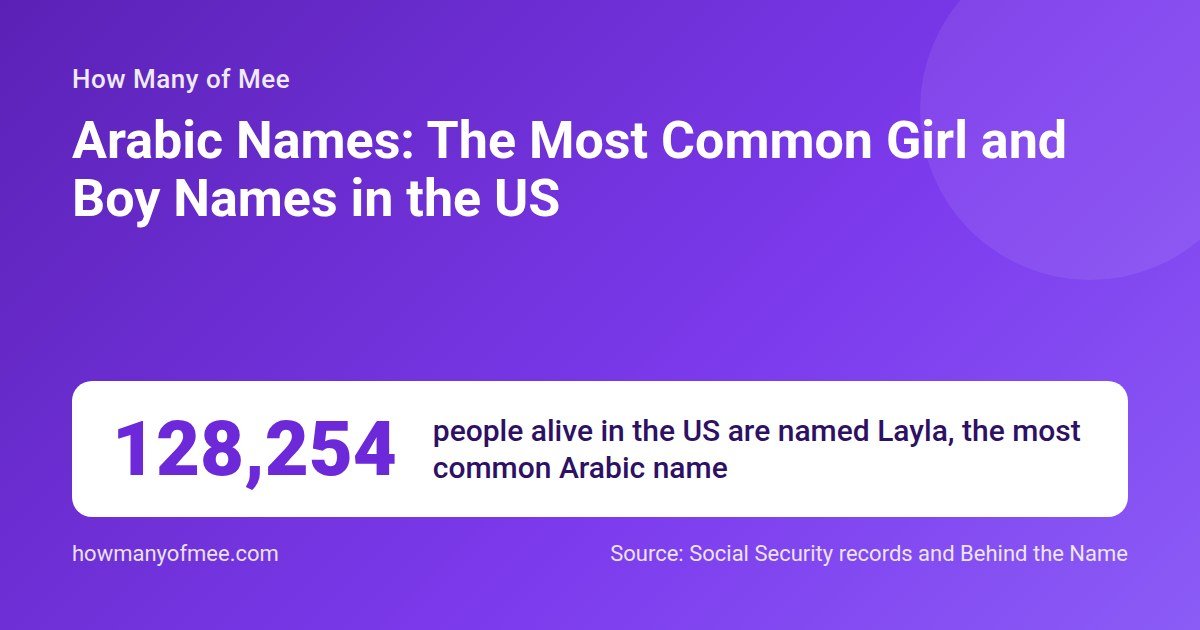
Eric Clapton’s 1970 hit “Layla” introduced this name to Western audiences, and it’s been rising in popularity in the US and UK ever since.
6. Zahra (زهراء)
Zahra means “flower” or “shining, radiant.” It’s often associated with Fatima al-Zahra (Fatima the Radiant). The name evokes beauty and light, and it’s commonly used across North Africa, the Middle East, and Iran.
7. Amina (أمينة)
Amina means “trustworthy” or “faithful.” It was the name of the Prophet Muhammad’s mother, Amina bint Wahb. The name carries a gentle but strong connotation — someone you can rely on completely.
Other Popular Arabic Female Names
| Name | Meaning | Notable Fact |
|---|---|---|
| Khadija | Premature baby, early born | Prophet Muhammad’s first wife and first Muslim |
| Sara | Princess, noble lady | Used across Islamic, Christian, and Jewish traditions |
| Hana | Happiness, bliss | Simple and universally appealing |
| Yasmin | Jasmine flower | Crossed into Western naming trends easily |
| Samira | Entertaining companion (female) | Popular in both Arab and South Asian cultures |
| Zainab | Fragrant flower, father’s precious jewel | Name of Prophet Muhammad’s daughter and granddaughter |
Wondering how Arabic female names stack up against common female names in the USA? Some, like Layla and Sara, now appear on both lists.
Why Do Certain Arabic Names Stay Popular for Centuries?
Most naming trends follow a cycle. A name rises, peaks, fades, and sometimes comes back. You can see this pattern clearly with name popularity trends by decade in Western cultures. But Arabic names break this pattern.
Here’s why:
Religious Anchoring
The biggest reason is simple: these names are tied to religious figures who’ll always matter. Nobody in the Muslim world is going to “get tired” of the name Muhammad or Fatima the way Americans got tired of the name Jennifer. The spiritual weight keeps these names permanently relevant.
Cultural Continuity
Arabic-speaking societies have maintained stronger naming traditions compared to many Western cultures. There’s less pressure to be “unique” and more emphasis on honoring heritage. Grandparents’ names get passed down. The first-born son is often named after the paternal grandfather.
The Meaning Factor
Arabic names always mean something specific. Parents aren’t just picking a pleasant sound — they’re choosing a quality they want their child to embody. This gives every name a built-in purpose that transcends trends.
Did you know? Some research on how name popularity changes over time shows that names with deep cultural roots are far more resistant to decline than names driven by pop culture.
Global Muslim Population Growth
With approximately 1.9 billion Muslims worldwide (about 24% of the global population, per Pew Research Center projections), the sheer number of families choosing from the same pool of traditional names keeps those names dominant in global statistics.
Common Myths and Misconceptions About Arabic Names
Let’s clear up a few things that people often get wrong.
Myth 1: “All Arabic Names Are Muslim Names”
Not true. Arabic is a language, and Islam is a religion. Many Arabic names predate Islam. Names like Layla, Tariq, and Hind were used by pre-Islamic Arabs. Christian Arabs also use Arabic names — think names like Boutros (Peter), Jibreel (Gabriel), and Maryam (Mary).
Myth 2: “Muhammad Can Only Be Spelled One Way”
English transliteration of Arabic creates many valid spellings. Muhammad, Mohammed, Mohamed, Mohammad, Muhammed — these are all legitimate renderings of the same Arabic name محمد. There’s no single “correct” English spelling because English and Arabic use completely different alphabets.
Myth 3: “Arabic Names Are Hard to Pronounce”
Some Arabic names contain sounds that don’t exist in English (like the letter ع ‘ayn or خ kha). But many of the most common Arabic names — Ali, Omar, Sara, Noor, Layla — are perfectly easy for English speakers. The popularity of these names in Western countries proves it.
Myth 4: “Every Muslim Must Have an Arabic Name”
Islam doesn’t require Arabic names. It recommends names with good meanings. A Malaysian Muslim might have a Malay name, a Turkish Muslim might have a Turkish name. Arabic names are preferred by many, but they’re not obligatory. Understanding what makes a name rare or common helps you see how cultural choice plays into naming patterns.
Arabic Names That Have Gone Global
Some Arabic names have crossed over so completely that many people don’t even realize they’re Arabic in origin.
- Layla — Now a top 25 baby name in the US and UK
- Omar — Widely used in Spanish-speaking countries
- Sara/Sarah — So common globally that its Arabic roots are often forgotten
- Jasmine/Yasmin — Became a mainstream Western name, especially after Disney’s Aladdin (1992)
- Tariq — Used across Europe, particularly in France and Spain
- Karim — Popular in France due to footballer Zinedine Zidane’s middle name and Karim Benzema
If you look at the most popular Pakistani names worldwide, you’ll notice significant overlap with Arabic names — because Arabic naming traditions have deeply influenced South Asian Muslim cultures.
How Arabic Naming Conventions Work
Arabic names follow a structure that’s quite different from the Western “first name + last name” system. Understanding this helps you appreciate why Arabic names work the way they do.
The Kunya System
A kunya is a name that identifies someone as the parent of their child. For example, “Abu Ahmad” means “father of Ahmad,” and “Umm Fatima” means “mother of Fatima.” This is considered a respectful way to address someone.
The Nasab (Patronymic)
“Ibn” (son of) or “bint” (daughter of) connects a person to their father. So “Ali ibn Hussein” means “Ali, son of Hussein.” This chain can extend multiple generations: “Ali ibn Hussein ibn Ali ibn Abi Talib.”
The Laqab (Title or Descriptor)
This is a descriptive title. Historical examples include “Al-Rashid” (the rightly guided), “Al-Amin” (the trustworthy), and “Salahuddin” (righteousness of the faith).
The Nisba (Origin Identifier)
This indicates where someone is from, what tribe they belong to, or what they do. “Al-Masri” means “the Egyptian,” “Al-Baghdadi” means “from Baghdad,” and “Al-Najjar” means “the carpenter.”
Pro Tip: If you see a long Arabic name and feel overwhelmed, just remember — it’s telling you a story. Each part adds a layer of identity: who this person is, whose child they are, where they’re from, and what they’re known for.
Regional Variations in Arabic Name Popularity
Arabic isn’t one monolithic culture. The names popular in Morocco differ from those trending in Saudi Arabia or Iraq. Here’s a quick regional breakdown:
North Africa (Morocco, Algeria, Tunisia, Libya, Egypt)
Popular names include Amine/Amina, Youssef, Fatima-Zahra (double name), Hamza, and Imane. North African countries often blend Arabic names with Amazigh (Berber) naming traditions.
The Levant (Syria, Lebanon, Jordan, Palestine)
You’ll hear Khaled, Rami, Lina, Dana, and Samer frequently. Christian Arab populations in Lebanon and Syria use names like Georges, Elias, and Mariam.
Gulf States (Saudi Arabia, UAE, Qatar, Kuwait, Bahrain, Oman)
Traditional names dominate here: Abdullah (servant of God), Abdulrahman (servant of the Most Merciful), Sultan, Noura, and Al-Anoud. The “Abd” prefix names (meaning “servant of”) followed by one of God’s 99 names are especially common.
Iraq
Hussein, Hassan, Abbas, and Zahra are extremely popular, reflecting the strong Shia heritage in southern Iraq. Noor and Mustafa are also frequently chosen.
Arabic Names and Their Impact Beyond Naming
Arabic names carry weight in ways that go beyond personal identity. Research published in various sociology journals has explored how names can influence perceptions and opportunities. Studies on whether your name can affect your career reveal some uncomfortable truths about name-based bias in hiring.
For Arabic-named individuals living in Western countries, this is a real consideration. Some studies — like the one conducted by the National Bureau of Economic Research — found that résumés with “foreign-sounding” names received fewer callbacks. This doesn’t mean anyone should change their name. But it’s worth knowing about the biases that exist.
On the flip side, as Arabic names like Layla, Omar, and Zayn become more mainstream in Western countries, the familiarity gap is shrinking. Representation matters, and every parent who gives their child an Arabic name in a non-Arab country contributes to normalizing it.
FAQ Section
What is the most common Arabic name in the world?
Muhammad (and its various spellings) is the most common Arabic name globally. With an estimated 150+ million bearers worldwide, it’s also considered the most popular first name on Earth. Its dominance comes from the Islamic tradition of naming boys after the Prophet Muhammad, practiced by Muslim families across every continent.
Are Arabic names only for Muslims?
No. Arabic is a language spoken by people of many faiths, including Christians, Jews, and Druze. Many Arabic names — like Layla, Tariq, Sara, and Karim — are used by Arab Christians and non-religious Arabs. Some Arabic names (like Maryam and Ibrahim) are shared across Islam, Christianity, and Judaism because they refer to figures honored in all three Abrahamic faiths.
Why do Arabic names have so many different English spellings?
Arabic uses a completely different alphabet than English. There’s no one-to-one correspondence between Arabic letters and English letters. The Arabic letter “ح” doesn’t exist in English, so it gets approximated as “H” or “Ha.” The result? One Arabic name can have five or more valid English spellings. Muhammad alone has over 14 documented English variations.
What are the most popular Arabic baby names in 2025?
Based on recent naming data from the Arab world and Muslim-majority communities globally, top Arabic baby names trending into 2025 include Yusuf, Adam, Rayan, and Zayn for boys. For girls, Maryam, Aaliyah, Noor, and Layla continue to dominate. Traditional names remain strong, but shorter, easy-to-pronounce names are gaining traction — especially among diaspora families.
Do Arabic names always have a meaning?
Yes — virtually every Arabic name has a specific, traceable meaning. Arabic is a root-based language, so each name connects back to a root word with a clear definition. This is one of the key reasons parents choose Arabic names: you’re not just giving your child a label, you’re giving them a meaning they can carry through life.
Your Name Tells Your Story
Arabic names have survived invasions, colonization, migration, and modernization — and they’re still going strong. They’re spoken in nurseries in Cairo, classrooms in London, and offices in New York. A name like Fatima connects a baby born today to a woman who lived in 7th-century Arabia. A name like Yusuf links a modern child to a prophet whose story has been told for thousands of years.
That’s the real power of Arabic names. They’re not trends that come and go. They’re living connections to history, faith, language, and identity.
If you’re choosing an Arabic name for your child, take your time with it. Say it out loud. Learn its meaning. Understand its history. And if you’re just curious about how many people share your name — Arabic or otherwise — go ahead and check if your name is truly unique. You might be surprised by what you find.