
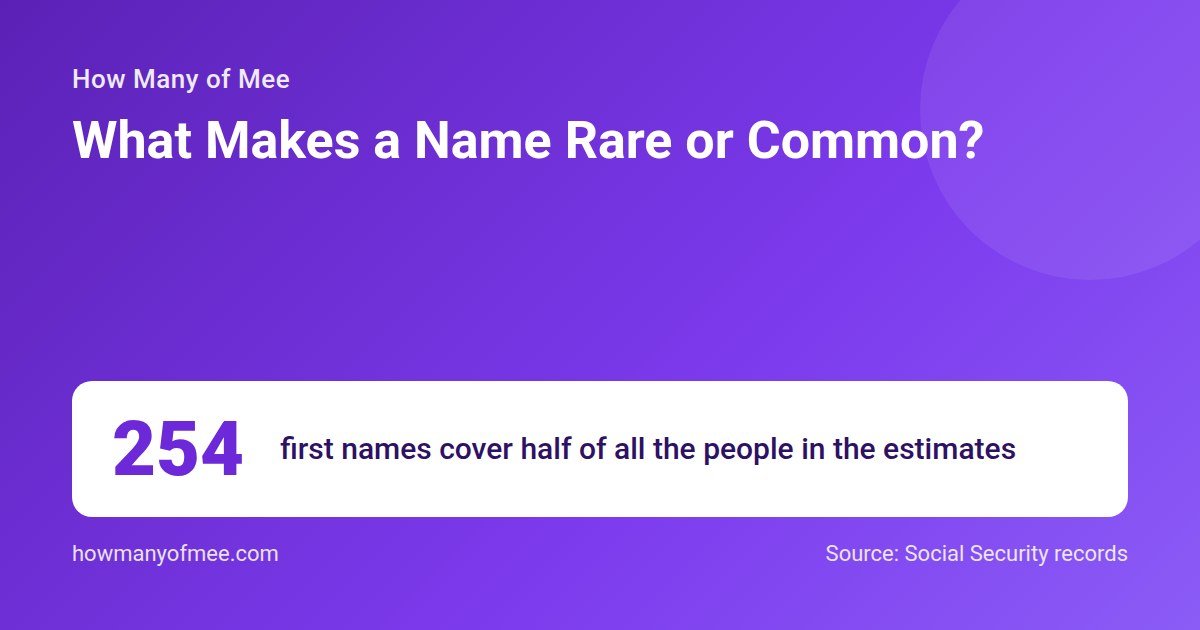
A name is rare or common because of how many people have it. On How Many of Mee, that means how many people alive in the US have the name today. Most names are rare: of the 105,966 first names in Social Security records, 103,507 belong to 10,000 people or fewer. A small group of names covers most people: just 254 names account for half of everyone the estimates cover. This guide explains the tiers and what the records show about why a name ends up rare or common.
The Five Rarity Tiers
Each name page puts the name in one of five tiers, by the estimated number of people alive with it:
| Tier | People alive | Names |
|---|---|---|
| Very Common | over 1,000,000 | 26 |
| Common | 500,001 to 1,000,000 | 63 |
| Uncommon | 100,001 to 500,000 | 452 |
| Rare | 10,001 to 100,000 | 1,918 |
| Very Rare | 10,000 or fewer | 103,507 |
One name from each tier, from the top down: Michael (3,595,413), Emma (570,127), Hazel (108,692), Santiago (98,899) and Zelda (9,481). Only 26 names reach the top tier. The page also shows a “1 in N” figure, the US population divided by the estimate, so you can compare any two names directly.
A Few Names Cover Most People
The estimates cover about 275 million people. Sorting the names from most to least common, this is how many it takes to cover a share of them:
| Share of people | Names needed |
|---|---|
| 50% | 254 |
| 75% | 918 |
| 90% | 3,386 |
| 99% | 29,429 |
The other 76,537 names together cover the last 1% of people.
What the Records Show About Why Names Are Rare or Common
Social Security records don’t say why parents chose a name, but they show five patterns clearly.
1. When the Name Was Popular
Rarity counts the living, so a name given to many babies long ago can be rare today. These names were all most popular before 1950:
| Name | Peak year | Babies since 1880 | People alive |
|---|---|---|---|
| Linda | 1947 | 1,458,899 | 1,078,513 |
| Dorothy | 1924 | 1,115,908 | 252,968 |
| Mildred | 1920 | 452,998 | 63,531 |
| Gertrude | 1917 | 177,668 | 14,332 |
Mildred was given to 452,998 babies, but 60% of them were born from 1910 to 1929, so only about 63,531 people with the name are alive. Linda peaked in 1947, and most of the people given it are still alive.
2. How Many Ways It Is Spelled
Every spelling is counted as its own name, so one name heard in many spellings is split into smaller counts:
| Spelling | People alive | Tier |
|---|---|---|
| Jayden | 273,372 | Uncommon |
| Jaden | 93,872 | Rare |
| Jaiden | 41,150 | Rare |
| Jadyn | 15,357 | Rare |
| Jaydon | 9,184 | Very Rare |
| Jaeden | 6,089 | Very Rare |
| Jaydin | 4,245 | Very Rare |
Together these spellings come to about 443,269 people, but only Jayden reaches the Uncommon tier on its own.
3. Where It Is Used
Some names are concentrated in a few places, so they feel common there and rare everywhere else. In the state records, which start in 1910:
- Chaim: 74% of the babies were recorded in New York
- Moshe: 71% of the babies were recorded in New York
- Ramiro: 53% of the babies were recorded in Texas
- Salvador: 49% of the babies were recorded in California
The guide to names across states looks at this in more detail.
4. How New It Is
37,275 names first appeared in the records in 2000 or later, and all but 11 of them are still Very Rare. A new name needs years of steady use to build a large count of people alive.
5. What Happens in the World
- Madison was the 2,326th most common girls’ name in 1984. The film Splash, whose mermaid calls herself Madison, opened in March 1984. Births rose from 84 that year to 382 in 1985, and by 2001 Madison was the #2 girls’ name.
- Katrina was given to 1,328 babies in 2005, the year of Hurricane Katrina, then 855 in 2006 and 505 in 2007.
- Isis was given to 501 babies in 2013. The militant group known as ISIS captured Mosul in June 2014, and births fell to 117 in 2015 and 53 in 2016.
The records show when the numbers moved, not why. Other things may have played a part.
Can a Rare Name Become Common?
Yes, and it can happen within a generation, as Madison shows. Ezra has just done it: with about 105,850 people alive, it moved up to the Uncommon tier with the 2025 records, after its biggest year ever in 2024 (9,222 babies). Santiago is close behind: it is still Rare, with about 98,899 people alive, but 7,560 babies were named Santiago in 2025 alone, the most in any year. A rising name’s tier is a snapshot: each name page shows the trend by year, so you can see which way a name is moving. For names on their way back, see old-fashioned names making a comeback.
Check Your Own Name
- Type your first name in the search box on the home page and open its page.
- Read its tier, its “1 in N” figure and its rank, then look at the chart to see whether it is rising or falling.
- Check your other spellings, which have pages of their own.
- If your name has no page, fewer than 5 babies of one sex received it in every year since 1880, which makes it rarer than any name in the Very Rare tier.
For a step-by-step walk through a name page, see how to check if your name is truly unique.